

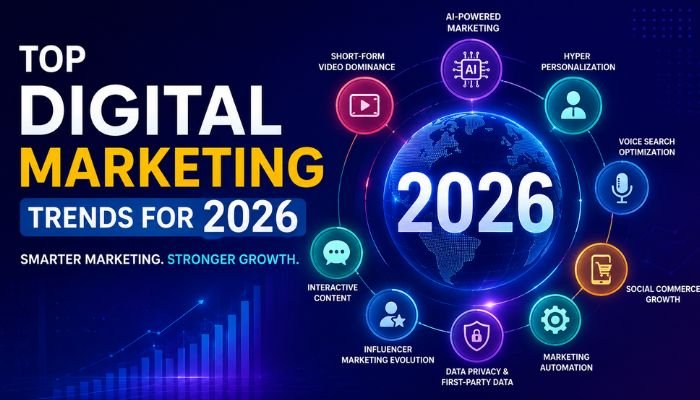
In the current business landscape, technology is evolving at an incredible pace. Therefore, understanding the Top Digital Marketing Trends for 2026 has become absolutely vital for modern organizations. Indeed, artificial intelligence, automated processes, and shifting consumer habits are reshaping how brands communicate online. Consequently, companies must adapt quickly to stay competitive in this fast-moving digital environment.
Furthermore, traditional advertising channels are losing their effectiveness. Because modern consumers demand instant, personalized solutions, companies cannot rely on static campaigns. Instead, they must implement dynamic, interactive strategies that build real trust. As a result, staying updated with emerging digital trends is no longer optional for business survival.
Moreover, these innovations are opening exciting growth avenues for creative brands. Specifically, smart automation helps small teams run complex campaigns effortlessly. Meanwhile, advanced analytics tools allow marketers to predict user needs with incredible accuracy. Thus, adopting these modern strategies will help you build a highly resilient, future-proof organization.
What Are Digital Marketing Trends?
To begin, we should define what marketing trends actually represent in simple terms. Specifically, they are the shifting patterns, technologies, and strategies that define how brands reach their audiences. Because digital platforms change constantly, these trends show where consumer attention is moving. Therefore, tracking these changes helps you avoid wasting money on outdated tactics.
In addition, many different professionals must follow these shifts closely. For example, local startup founders, global ecommerce brands, and professional agencies use these patterns to plan budgets. Consequently, following these shifts ensures your messages always land where your potential buyers spend their time.
Furthermore, these shifts are not just temporary tech hypes. Instead, they represent fundamental changes in how human beings discover, research, and purchase products online. Because of this, learning about these changes helps you understand modern consumer psychology much better. Overall, tracking these trends is the key to maintaining a successful online presence.
Why Digital Marketing Trends Matter in 2026
First of all, market competition has reached an all-time high online. Therefore, businesses must move incredibly fast to capture consumer interest. In fact, ignoring the future of digital marketing can cause your brand to become invisible overnight. Indeed, modern buyers will quickly choose competitors who offer a smoother, faster digital experience.
Secondly, customer expectations are changing very rapidly. Specifically, modern users expect brands to understand their personal needs instantly. Consequently, generic bulk advertisements can make your brand look lazy and unhelpful. Thus, implementing modern strategies helps you deliver highly personalized experiences at scale.
Thirdly, massive technological shifts are altering the search and social media landscapes. For instance, smart AI interfaces are changing how people look for information online. Because of this, traditional search ranking methods are becoming much less reliable. Therefore, you must adopt new strategies to maintain your digital visibility.
Finally, these innovations offer incredible opportunities for fast business growth. Specifically, early adopters of new platforms can secure massive organic reach at a very low cost. Meanwhile, they can automate repetitive tasks to save time and money. Clearly, mastering these modern trends is vital for sustainable success.
How Digital Marketing Has Evolved
To understand where the industry is heading, we must look at where it started. The table below displays a detailed timeline of how digital promotion has changed over the years.
| Marketing Era | Main Focus | Key Change |
| Traditional Marketing | Print, TV, Radio | Broadcast messages sent to massive, untargeted audiences. |
| Early Digital Marketing | Simple Websites & Email | Basic online presence, banner ads, and bulk email blasts. |
| Social Media Marketing | Community & Profiles | Two-way communication, profile building, and viral content sharing. |
| Mobile Marketing | Apps & SMS | Responsive designs, mobile ads, and location-based promotions. |
| AI-Powered Marketing | Automation & Chatbots | Smart content creation, personalized feeds, and automated workflows. |
| Predictive Marketing | Analytics & Intent | Forecasting buyer behavior using advanced algorithm models. |
Top Digital Marketing Trends for 2026
Currently, the industry is witnessing a massive transition toward conversational, automated, and hyper-personalized strategies. In this section, we will explore the latest digital marketing trends that are shaping the corporate world this year.
Trend #1: AI-Powered Marketing
First of all, AI in digital marketing is no longer a futuristic experiment. Instead, it has become the absolute engine of modern online promotion. Specifically, organizations use smart software to analyze massive datasets in seconds. Consequently, this helps teams uncover valuable customer insights that humans might miss.
Furthermore, content creation has become much faster because of smart design and writing tools. For example, marketers can generate high-quality ad drafts, captions, and graphics instantly. However, human editing remains vital to keep your brand voice authentic and warm. Nevertheless, the initial creation phase is incredibly efficient now.
Additionally, smart chatbots are handling complex customer interactions on corporate websites. Because these bots understand natural language, they can guide users to the right products. Meanwhile, smart systems can optimize your advertising budgets across multiple platforms in real-time. Thus, artificial intelligence dramatically improves your overall operational efficiency.
Trend #2: AI Search and Search Generative Experience
To begin, SEO trends 2026 are heavily shaped by generative answers in search results. Specifically, platforms like Google are displaying conversational summaries at the very top of search pages. Because of this change, users often find answers without clicking any traditional links.
Consequently, this shift has changed how web publishers optimize their pages. Therefore, companies must focus on appearing inside these generative summaries directly. To explain, this strategy requires you to write highly structured, authoritative content.
Moreover, voice search and natural, conversational queries are growing rapidly. Because people speak to search engines like they are talking to friends, keyword targeting has changed. Specifically, you must target complete questions and long conversational phrases. As a result, your content must offer direct, clear answers to remain visible.
Trend #3: Short-Form Video Dominance
Currently, video marketing trends show that short vertical videos remain the most popular content format online. Specifically, platforms like TikTok, Instagram Reels, and YouTube Shorts capture billions of views daily. Because attention spans are shorter than ever, quick video clips are highly effective.
Consequently, brands are investing heavily in producing vertical video content. For example, simple three-second hooks are used to stop users from swiping past. In addition, these videos must feel organic and unedited to build real trust. Indeed, overly produced, corporate commercials do not perform well on these platforms.
Furthermore, social algorithms actively push short video content to non-followers. Therefore, this format is the best way to grow your audience organically without paid ads. By sharing quick tips, reviews, or funny clips, you can build a massive following. Thus, short video remains a core pillar of modern digital promotion.
Trend #4: Hyper-Personalization
First, generic marketing messages are losing their effectiveness incredibly fast. Therefore, companies are using digital marketing strategies 2026 focused on hyper-personalization. Specifically, this process uses real-time customer data and smart algorithms to customize every user experience.
For example, when a user visits an online store, the website layout can change based on their past browsing history. In addition, the system can display custom product recommendations and special discount codes. As a result, the customer feels understood, which greatly improves your conversion rates.
Furthermore, this level of customization extends to your digital advertising campaigns. Specifically, ad platforms can show unique ad creatives to different user demographics automatically. Consequently, your advertising spend becomes much more efficient. Thus, hyper-personalization is vital to building a highly successful modern brand.
Trend #5: Voice Search Optimization
To start, smart speakers and virtual assistants have become standard household items globally. Therefore, voice search optimization is a critical trend for modern digital teams. Because speaking is much faster than typing, voice queries are growing rapidly.
Specifically, voice searches are highly conversational and long. For example, a user might type “best cafe London” on a laptop. However, they will say “where is the closest coffee shop open now” to their phone. Consequently, your content must match these natural spoken language patterns to rank.
In addition, smart assistants usually provide only one single answer to a voice query. Therefore, appearing as the top result is much more critical than before. To achieve this, you must use structured schema code on your website. This helps smart assistants read your business hours, location, and services with perfect accuracy.
Trend #6: Influencer Marketing Evolution
First of all, the world of influencer marketing has shifted dramatically over the last few years. Specifically, social media marketing trends show that brands are moving away from massive celebrity accounts. Instead, they are partnering with micro-influencers and nano-influencers who have smaller but highly loyal followings.
Because small creators interact with their followers regularly, their recommendations carry immense trust. Consequently, campaigns run with micro-influencers often deliver a much higher return on investment. Furthermore, these partnerships are highly affordable, making them excellent for growing startups.
Additionally, companies are focusing on building long-term creator partnerships rather than one-off sponsored posts. For instance, a creator might use a brand’s products in their videos over several months. Thus, the promotion feels highly authentic and natural to their audience. This steady exposure builds lasting customer trust.
Trend #7: Social Commerce Growth
Currently, social media platforms are no longer just places to share photos. Instead, they have evolved into fully functional digital shopping malls. Specifically, users can browse, choose, and purchase products directly inside social apps.
Consequently, social commerce is experiencing massive growth globally. For example, Instagram, TikTok, and Pinterest have integrated native checkout features. Because this removes the need to visit an external website, the buying process is incredibly fast.
Moreover, live shopping events are becoming highly popular on social apps. During a live video, hosts can showcase a product and share a direct buy link. As a result, viewers can make immediate purchases while interacting with the host. Clearly, this seamless integration of shopping and social media is transforming retail.
Trend #8: First-Party Data Marketing
To begin, privacy regulations and tracking limitations have changed how companies collect user data. Specifically, latest digital marketing trends show a massive transition toward first-party data. Because web browsers are blocking third-party tracking cookies, you must collect data directly.
Therefore, companies are finding creative ways to encourage users to share their information voluntarily. For example, you can offer helpful guides, newsletters, or special discounts in exchange for an email address. Consequently, you can build a highly valuable, secure digital asset that you own.
Furthermore, owning your customer data protects your business from sudden advertising platform changes. Specifically, you can contact your subscribers directly through email without paying for ad placements. Thus, first-party data marketing is highly essential for building a resilient, long-term brand.
Trend #9: Marketing Automation
First, managing multiple promotion channels manually can take a massive amount of time. Therefore, organizations are adopting advanced marketing automation trends to streamline their daily workflows. Specifically, software can handle repetitive tasks like sending follow-up emails and scheduling posts.
For instance, you can set up automated customer journeys that respond to user actions instantly. If a user downloads a guide, the system can automatically send helpful emails over two weeks. Consequently, your team can nurture leads and drive sales in the background 24/7.
Additionally, smart automation tools can sync your customer data across different platforms. For example, your CRM system can update your email list and ad audience lists automatically. As a result, your marketing operations run much faster and with fewer manual errors.
Trend #10: Interactive Content
To start, passive reading is losing its effectiveness as users demand more active online experiences. Therefore, content marketing trends are moving rapidly toward highly interactive content formats. Specifically, these formats invite users to participate actively instead of just scrolling.
For example, companies use simple digital quizzes to guide users to the right products. In addition, interactive infographics, polls, and calculators are highly popular on blog posts. Consequently, these tools capture user attention for much longer, which improves your search rankings.
Furthermore, interactive content provides valuable customer data directly to your marketing team. Specifically, you can see exactly how users answer quiz questions or use calculators. As a result, you can learn about their preferences and customize your future offers. Thus, interactive tools are excellent for both engagement and research.
Trend #11: Community-Driven Marketing
First of all, building a massive audience of passive followers is no longer enough. Instead, modern brands are investing heavily in building active, highly loyal communities. Specifically, they want to create digital spaces where their customers can interact with each other.
For example, companies are launching private Facebook Groups, Discord servers, and branded forums. Consequently, customers can share tips, ask questions, and discuss products directly. Because of these interactions, users feel a deep connection and loyalty to your brand.
Moreover, community members act as highly active brand advocates. Specifically, they will recommend your products to their friends and defend your brand online. Therefore, community-driven marketing is a highly effective way to grow your business organically through word-of-mouth.
Trend #12: Omnichannel Marketing
To begin, modern consumers use multiple different devices and platforms during their buying journey. For instance, a user might discover a product on TikTok, research it on Google, and buy it on a laptop. Therefore, delivering a consistent experience across all these channels is highly critical.
Consequently, omnichannel marketing is a key trend for modern organizations. Specifically, this strategy ensures that your branding, messaging, and offers are identical everywhere. As a result, the transition between different platforms is completely seamless for the customer.
Furthermore, advanced tracking tools help you understand how different channels work together. For example, you can see if a social media ad helped drive an offline store purchase. Thus, omnichannel marketing helps you optimize your overall promotional strategy.
Trend #13: AI-Powered Email Marketing
First, direct messaging remains one of the most profitable marketing channels. However, email marketing trends 2026 show that basic bulk emails are no longer effective. Instead, companies use smart systems to send highly personalized, automated messages.
For example, algorithms can analyze a subscriber’s behavior to predict the best time to send an email. In addition, smart systems can automatically write subject lines and suggest relevant products. Consequently, open rates and click-through rates improve significantly.
Moreover, smart audience segmentation allows you to group your subscribers automatically. Specifically, the software can split your list based on past purchase values or email interactions. Therefore, you can send highly tailored offers to each group, maximizing your overall sales.
Trend #14: Conversational Marketing
To start, modern customers hate waiting in long queues for support or sales help. Therefore, businesses are adopting digital marketing innovations centered around conversational marketing. Specifically, this process uses live chat, WhatsApp, and messaging apps to connect with buyers instantly.
For instance, when a user has a question about a product, they can open a chat window. Consequently, a smart assistant can answer their question and share a product link immediately. As a result, the user can make a purchase in seconds without leaving the chat app.
Furthermore, messaging platforms allow you to build informal, friendly relationships with your audience. Specifically, sending quick text updates feels much more personal than sending formal emails. Thus, conversational tools are highly effective for driving quick conversions and improving customer trust.
Trend #15: Predictive Analytics
Finally, digital marketing future strategies are shifting from reactive reporting to proactive forecasting. Specifically, companies use predictive analytics to anticipate buyer behavior and market trends. Because algorithms can scan past sales patterns, they can forecast future performance.
For example, the system can predict which products will sell out next month. Consequently, your marketing team can prepare ad campaigns in advance. In addition, predictive tools can identify which leads are most likely to buy your premium services.
Therefore, you can focus your sales energy and budget on the most promising opportunities. This prevents you from wasting resources on cold leads or unpopular products. Clearly, predictive analytics is a highly powerful tool to maximize your overall return on investment.
Digital Marketing Trends Comparison Table
To help you prioritize your marketing budget, let us compare these major trends. The table below details the impact level, main benefit, and setup difficulty of each trend.
| Trend | Impact Level | Business Benefit | Difficulty |
| AI-Powered Marketing | Extremely High | Boosts team speed, saves costs, and improves optimization. | Medium |
| AI Search (SEO) | Extremely High | Protects and grows your organic website traffic. | High |
| Short-Form Video | High | Delivers massive organic reach to new audiences. | Medium |
| Hyper-Personalization | Extremely High | Improves conversion rates and boosts customer trust. | High |
| Voice Search | Medium | Captures high-intent hands-free local searches. | Low |
| Micro Influencers | High | Delivers highly trusted, authentic product reviews. | Low |
| Social Commerce | High | Shortens the buying journey by enabling direct purchases. | Medium |
| First-Party Data | Extremely High | Builds a secure company asset that you own. | High |
| Automation | High | Keeps your marketing campaigns running 24/7. | Medium |
| Interactive Content | High | Captures user attention and collects customer data. | Medium |
Benefits of Following Digital Marketing Trends
Adapting your strategies to match modern trends offers incredible advantages. The table below outlines the key benefits of staying updated.
| Benefit | Why It Matters | Business Impact |
| High Competitive Edge | You can outrun slow competitors who ignore new technology. | Increases your market share and online authority. |
| Improved Ad Efficiency | Smart tools prevent you from wasting money on boring ads. | Lowers your customer acquisition costs significantly. |
| Strong Customer Trust | Interactive, personal campaigns build deep brand loyalty. | Boosts your customer retention and lifetime value. |
| Faster Sales Cycles | Automated, conversational tools close deals much faster. | Accelerates your overall business growth and cash flow. |
| Reliable Data Assets | First-party data protects you from platform tracking changes. | Secures your digital independence and marketing control. |
Industries Most Affected by Digital Marketing Trends
While these shifts impact every modern company, some sectors are seeing massive transformations. The table below highlights how different industries are affected.
| Industry | Key Trend Impact | Recommended Strategy |
| Ecommerce | Social commerce, vertical video, hyper-personalization. | Add direct buying features to social apps and run video ads. |
| SaaS | AI insights, automated onboarding, predictive analytics. | Build automated email flows based on user software activity. |
| Healthcare | Conversational booking, voice search, local SEO. | Create helpful Q&A pages and local map listings for clinics. |
| Education | Interactive tools, quizzes, community building. | Build online student forums and offer helpful free mini-courses. |
| Real Estate | Visual virtual tours, local SEO, SMS marketing. | Post high-quality video walkthroughs on Instagram and YouTube. |
| Finance | Secure automated messaging, personalized advice, chatbots. | Install secure, helpful chat assistants on your homepage. |
| Local Businesses | Voice search, map listings, micro influencer ads. | Ask happy local customers to leave reviews on your Google profile. |
Real-World Examples of Digital Marketing Trends
To understand how these strategies work in practice, let us look at seven detailed real-world scenarios.
1. Ecommerce Brand
An online shoe store connected a hyper-personalization tool to its website. Consequently, when a customer browsed red boots, the homepage adjusted to display matching red accessories. Thus, the store’s average order value increased by thirty percent within two months.
2. SaaS Company
A software startup integrated smart predictive analytics into their sales platform. Specifically, the tool analyzed user activity to identify which trial users were likely to upgrade. Therefore, the sales team called those specific warm prospects first, doubling their close rate.
3. Startup
A young healthy-snack startup partnered with ten local micro-influencers to promote their launch. Instead of writing formal scripts, they asked the creators to post honest snack reviews. As a result, the startup’s online inventory sold out completely within one week.
4. Local Business
A local dental clinic optimized their website for conversational voice search queries. For example, they wrote short, clear answers to questions like “who is the closest open dentist now.” Consequently, their phone call volume increased by forty percent from local searchers.
5. Marketing Agency
An advertising agency transitioned all their client email lists to first-party data capture methods. Specifically, they built interactive quizzes to collect customer email addresses. Consequently, they protected their clients’ campaigns from losing reach when browser cookies changed.
6. Influencer
A fitness influencer launched an exclusive, paid community server for her followers. Inside, members shared their daily meals, celebrated workout wins, and asked questions. Because the community was highly active, her premium fitness course sales increased by fifty percent.
7. Enterprise Company
A global travel firm integrated smart automated workflows to handle booking confirmations. Specifically, the system automatically sent custom WhatsApp messages with local hotel tips based on flight times. Thus, customer satisfaction scores reached an all-time high.
Best Tools for Modern Digital Marketing
To implement these trends successfully, you must use the right software. The table below compares the best tools available this year.
| Tool | Best For | Main Features | Best Users |
| ChatGPT | Content brainstorming and drafting | Text generation, analysis, translation | Marketers of all levels |
| Canva AI | Graphic design and video clips | Auto image editing, video templates | Small business owners |
| HubSpot | Omnichannel marketing and CRM | Contact tracking, automated flows, sales sync | Medium to large companies |
| Semrush | Search analysis and SEO | Keyword research, competitor tracking | SEO professionals |
| Ahrefs | Backlink tracking and site health | Link research, broken link alerts, audit tools | Technical SEO teams |
| Mailchimp | Automated email marketing | Audience segmentation, visual flows, templates | Startups and creators |
| Hootsuite | Social media scheduling | Post queuing, brand monitoring, inbox tracking | Social media managers |
| Zapier | App connections and workflow automation | Automated triggers, data syncing across apps | Operations teams |
Digital Marketing Workflow for 2026
To achieve consistent success, you must follow a structured plan. Below is a step-by-step workflow for modern digital promotion.
[1. Research Audience]
            ↓
[2. Analyze Trends]
            ↓
[3. Create Content]
            ↓
[4. Personalize Campaigns]
            ↓
[5. Automate Processes]
            ↓
[6. Measure Results]
            ↓
[7. Optimize Performance]
            ↓
[8. Scale Growth]
1. Research Audience
First, look closely at your target customer preferences and pain points. Discover which social apps they use and how they look for answers.
2. Analyze Trends
Secondly, identify which modern trends match your business goals and resources. For example, decide if you should focus on vertical video or chat automation.
3. Create Content
Next, design helpful, interactive content like quick videos and simple product quizzes. Ensure your content offers real-world value to your audience.
4. Personalize Campaigns
Furthermore, use customer data to customize your offers, emails, and website experiences. Avoid sending generic, bulk messages to your list.
5. Automate Processes
After that, set up automated workflows to handle email delivery and social posting. This keeps your marketing campaigns running in the background 24/7.
6. Measure Results
Subsequently, track your key performance metrics like video watch times, email clicks, and sales. Identify what strategies drive the most conversions.
7. Optimize Performance
In addition, make continuous improvements based on your analytics. For instance, rewrite weak headings or update slow-loading mobile pages.
8. Scale Growth
Finally, reinvest your profits into testing new platforms and tools. Consequently, your digital community and customer base will continue to grow over time.
Statistics and Research About Digital Marketing Trends
To show the global impact of these shifts, let us examine some recent industry findings.
| Statistic | Why It Matters |
| 85% of users prefer watching short-form videos to reading | Creating vertical videos is the most consistent way to attract young buyers. |
| 70% of companies use some form of AI in their daily workflows | Adopting smart tools is essential to keep up with industry competition. |
| First-party data captures drive 3 times more email clicks | Collecting data directly from users leads to highly successful campaigns. |
| Chatbots resolve up to 80% of routine customer questions | Automated messaging tools save support teams massive hours of manual work. |
| Personalized ads deliver a 200% higher return on investment | Customizing your ad creatives is vital to maximize your promotion budget. |
Future of Digital Marketing Beyond 2026
Looking further ahead, the future of digital marketing will be shaped by even deeper autonomous systems. Specifically, we will see the rise of highly advanced AI agents that can run entire marketing departments.
First, these agents will make independent, real-time choices. For example, they can automatically create ads, test them with users, and adjust budgets without human oversight.
Secondly, immersive technologies like virtual reality and augmented reality will become mainstream. Consequently, users will be able to try on clothes or walk through virtual homes using VR headsets. Thus, interactive marketing will reach an entirely new level.
Finally, predictive systems will become incredibly accurate. Specifically, algorithms will predict exactly when a user wants to buy a product before the user even finishes researching it. Therefore, autonomous marketing systems will deliver personalized offers at the perfect moment.
Expert Insight: What Marketers Should Focus On
According to leading industry analysts, technology should never replace human connection. Indeed, while smart tools are wonderful for automation, customers still crave real authenticity. Therefore, the top marketing trends focus on building real trust and genuine communities.
Consequently, modern marketers should focus on mastering two key areas. First, learn how to use AI tools to handle repetitive data tasks and automation. Secondly, spend your energy building deep human relationships through storytelling and community management.
Ultimately, technology is just a tool to help you reach people. By combining smart automation with authentic, human-focused content, your brand will easily stand out. Thus, focus on helping your customers, and your business will thrive.
Common Mistakes Businesses Make
When trying to adopt new trends, many organizations make critical errors. The table below lists common mistakes and better approaches.
| Mistake | Better Approach | Why It Matters |
| Trying to use every trend | Start with one trend that matches your resources and master it. | Prevents your team from feeling overwhelmed and burning out. |
| Publishing boring AI content | Always edit and add personal human stories to every generated draft. | Keeps your brand voice authentic, unique, and trustworthy. |
| Ignoring mobile device design | Always design your pages to load fast and look great on phone screens. | Mobile traffic represents over half of all global web searches. |
| Buying fake email lists | Build your list organically using landing pages and helpful lead magnets. | Fake addresses hurt your deliverability and deliver zero sales. |
| Not checking analytics | Review your search and click data weekly to see what strategies work. | Stops you from wasting time on ineffective promotional activities. |
How to Prepare for Future Marketing Trends
To ensure your brand stays visible and competitive, follow this step-by-step preparation list:
Monitor industry changes: First, read trusted tech blogs and watch industry news weekly to spot new trends early.
Test new technologies: Secondly, experiment with free versions of new tools before committing to paid contracts.
Invest in AI tools: Furthermore, train your marketing team to use smart software for writing, design, and research.
Focus on customer experience: In addition, keep your website fast, simple to navigate, and highly interactive.
Build first-party data: Also, use creative quizzes and forms to build an email list that you own.
Improve analytics: Specifically, set up tracking dashboards to measure where your clicks and sales come from.
Optimize continuously: Finally, update your old content, test new visual styles, and adapt as technology changes.
Pros and Cons of Modern Digital Marketing Trends
Before investing your budget, you should carefully analyze both sides of these strategies. The tables below show the key pros and cons of modern trends.
Pros of Modern Marketing Trends
| Pros | Why It Matters |
| Massive Time Savings | Automation and smart tools handle repetitive tasks, freeing up your team. |
| Highly Targeted Ads | Personalization ensures your ads reach the warmest prospects, saving budget. |
| Organic Customer Growth | Vertical videos and communities drive free, viral brand awareness. |
| Reliable Customer Trust | Interactive and conversational tools build deep professional relationships. |
Cons of Modern Marketing Trends
| Cons | Why It Matters |
| High Software Costs | Professional AI, CRM, and analytics platforms require monthly fees. |
| Technical Learning | Setting up automated flows and tracking systems requires skilled staff. |
| Fast Platform Shifts | Algorithm changes can suddenly affect your organic reach and SEO. |
| Privacy Compliance | Collecting first-party data requires following strict security regulations. |
Benefits of Adopting Digital Marketing Trends Early
By updating your promotional strategies today, you can secure outstanding business advantages:
Lower acquisition costs: First, organic reach from vertical video reduces your reliance on expensive paid ads.
Higher conversion rates: Secondly, hyper-personalized offers turn casual website visitors into active paying buyers.
Complete list security: Furthermore, building first-party lists protects your business from third-party tracking shifts.
Outstanding local trust: Also, voice search optimization ensures local customers can find your business easily.
Endless content ideas: Finally, interactive quizzes and polls provide massive feedback to guide your future posts.
Conclusion
In conclusion, the Top Digital Marketing Trends for 2026 show that the industry is moving toward a highly automated and personalized space. Indeed, the days of generic, bulk promotional blasts are completely over. Today, successful organizations are those that use smart technology to build authentic, interactive human connections.
However, achieving success requires a careful and balanced approach. Specifically, you must learn to use AI and automation to streamline your tasks while keeping your brand voice warm and real. By focusing on your technical foundation, building first-party data lists, and creating engaging vertical videos, you can secure outstanding growth.
Ultimately, the future of online business belongs to brands that prioritize their audience’s digital experience. Therefore, take your first step today and update your marketing strategies to secure long-term online success.
Top Digital Marketing Trends for 2026 FAQs
1. What are the biggest digital marketing trends in 2026?
Specifically, the biggest trends include AI-powered marketing, generative search optimization, short-form video dominance, hyper-personalization, and social commerce.
2. How is AI changing digital marketing?
First, AI tools help analyze customer data, automate email workflows, write caption drafts, and manage customer messages instantly.
3. Is SEO still important in 2026?
Yes, but traditional keyword matching has changed. Today, you must optimize your content to appear directly inside generative search summaries.
4. What role does video marketing play today?
Specifically, short vertical videos on TikTok, Reels, and Shorts are the best way to attract new audiences organically without paid advertising.
5. Why is personalization important in marketing?
Because modern buyers expect brands to understand their individual needs. Customized offers and emails deliver much higher conversion rates.
6. What is social commerce?
To explain, social commerce allows users to browse and purchase products directly inside social media apps without visiting external websites.
7. How can small businesses benefit from these trends?
Small businesses can use free automation tools to run complex email flows. They can also use vertical video to gain massive local reach for free.
8. Which marketing tools are most useful this year?
Generally, tools like ChatGPT for brainstorming, Canva for graphic designs, and HubSpot for email automation and tracking are highly useful.
9. What skills do digital marketers need in 2026?
Marketers must know how to use AI software for research. They must also have strong human skills like storytelling and community management.
10. What is the future of digital marketing?
In the future, digital marketing will rely on autonomous AI agents, predictive customer tr






5 Responses