online game event pblgamevent
AI & Technology

Online Game Event pblgamevent: The Future of Interactive Gaming Experiences

Introduction to Online Game Event pblgamevent Online gaming has evolved far beyond simple entertainment. Today, it has become a fully interactive ecosystem where players, developers, and communities come together through structured digital experiences. One of the most interesting developments in this space is the concept of online game event pblgamevent, which represents a modern approach to organizing, hosting, and participating in gaming events across online platforms. At its core, online game event pblgamevent refers to a system or framework where in-game events are designed to engage players in real time, often blending competition, collaboration, and rewards. These events are not just limited-time challenges; they are carefully structured experiences meant to enhance player engagement and retention while offering meaningful gameplay progression. What makes online game event pblgamevent particularly unique is its adaptability. It can be integrated into various genres such as battle royale games, RPGs, simulation games, or even casual mobile games. This flexibility allows developers to design experiences that feel fresh, dynamic, and rewarding every time players log in. Understanding What Online Game Event pblgamevent Really Means To fully appreciate online game event pblgamevent, it’s important to break down what it actually represents in the gaming ecosystem. It is not just a single event type but rather a combination of systems that manage how events are created, delivered, and experienced by players in an online environment. The first key aspect is interactivity. Unlike static updates or traditional DLCs, online game events under pblgamevent are highly interactive. Players actively participate in missions, challenges, or competitions that evolve based on their actions. This creates a sense of immersion where every decision feels meaningful. Another important aspect is real-time engagement. Online game event pblgamevent often operates on live timers, global leaderboards, and synchronized player participation. This means players from different regions can engage in the same event simultaneously, creating a shared global experience that strengthens community interaction. Finally, there is the reward-driven structure. These events typically include exclusive rewards such as skins, weapons, achievements, or in-game currency. This reward system not only motivates players to participate but also adds long-term value to their gaming experience. The Evolution of Online Game Event pblgamevent in Modern Gaming The concept of online game events has been around for years, but online game event pblgamevent represents a more refined and structured evolution of this idea. In the early days of online gaming, events were simple—often limited to double XP weekends or seasonal cosmetic updates. While effective at the time, they lacked depth and long-term engagement. As gaming technology advanced, developers began experimenting with more complex event systems. This led to the introduction of narrative-driven events where players could influence story outcomes. Online game event pblgamevent builds on this foundation by combining storytelling, competition, and live updates into a unified system. Another major shift came with the rise of mobile and cross-platform gaming. Developers needed a way to keep players engaged across different devices and time zones. Online game event pblgamevent solves this by offering synchronized events that can be accessed anywhere, anytime. This level of accessibility has significantly increased player participation rates. Today, we see online game event pblgamevent as a standard feature in many modern games. It is no longer just an optional add-on but a core component of game design strategy, especially in live-service games that rely on continuous player engagement. Why Online Game Event pblgamevent Matters for Players and Developers From a player’s perspective, online game event pblgamevent adds excitement and variety to the gaming experience. Instead of repeating the same gameplay loop, players are introduced to limited-time challenges that feel fresh and rewarding. This keeps the game from becoming monotonous and encourages long-term engagement. For competitive players, these events often serve as a proving ground. Leaderboards, rankings, and skill-based challenges allow players to test their abilities against others on a global scale. This competitive aspect adds depth and motivation beyond casual gameplay. From a developer’s point of view, online game event pblgamevent is a powerful engagement tool. It helps retain players, increase daily active users, and boost in-game spending. By designing well-structured events, developers can guide player behavior, introduce new content, and extend the lifespan of a game. Additionally, these events provide valuable data insights. Developers can analyze player participation, performance metrics, and engagement trends to improve future updates. This data-driven approach ensures that each online game event pblgamevent becomes more refined and effective over time. How Online Game Event pblgamevent Works Behind the Scenes Behind every successful online game event pblgamevent, there is a complex system of planning, design, and execution. Developers start by defining the goals of the event. This could be increasing player retention, promoting new content, or celebrating a seasonal milestone. Once the goal is defined, the design phase begins. This involves creating missions, challenges, and reward structures that align with the overall game mechanics. The key is to ensure that the event feels integrated into the game rather than something artificially added. Next comes the technical implementation. Online game event pblgamevent systems rely heavily on servers, event triggers, and real-time tracking systems. These components ensure that players can participate smoothly without interruptions, even when thousands or millions of users are active simultaneously. Finally, there is the live monitoring phase. Once the event goes live, developers closely monitor player behavior, server performance, and feedback. This allows them to make real-time adjustments if necessary, ensuring a smooth and enjoyable experience for all participants. Different Types of Online Game Event pblgamevent Experiences There are several types of online game event pblgamevent formats, each designed to serve different gameplay styles and objectives. One of the most common types is the competitive event. These events focus on rankings, leaderboards, and PvP challenges where players compete for top positions and exclusive rewards. Another popular type is the cooperative event. In this format, players work together to achieve a shared goal, such as defeating a global boss or completing community-wide objectives. This type of event encourages teamwork and strengthens in-game communities. There are also

Tubehalote
AI & Technology

Tubehalote: Everything You Need to Know About This Emerging Digital Platform

Introduction The digital world is constantly evolving, and new platforms emerge every year to meet the changing needs of internet users. Among the names that have recently attracted attention is Tubehalote. While many people are still unfamiliar with it, the growing curiosity around Tubehalote suggests that it could become an important name in the online content and digital media space. As audiences continue to demand faster access to information, entertainment, and interactive experiences, platforms like Tubehalote are gaining relevance. Users today want convenience, accessibility, and engaging content all in one place. This shift in consumer behavior has encouraged the development of platforms that focus on delivering a seamless user experience while offering a wide range of content options. In this article, we will explore Tubehalote in detail, discussing its features, benefits, potential applications, user experience, future prospects, and why it is attracting attention. Whether you have recently heard about Tubehalote or are looking for a deeper understanding of its value, this comprehensive guide will provide the insights you need. What Is Tubehalote? Tubehalote is a digital platform that is increasingly being discussed among online users who are interested in content consumption, media sharing, and modern internet experiences. Although relatively new compared to established platforms, it appears to focus on providing users with easy access to content while maintaining a user-friendly environment. One of the reasons Tubehalote is attracting interest is its ability to adapt to modern digital trends. Today’s users are no longer satisfied with basic content delivery systems. They expect intelligent recommendations, responsive interfaces, and smooth navigation. Tubehalote aims to align itself with these expectations by offering a streamlined experience that prioritizes user engagement. Another important aspect of Tubehalote is its flexibility. Digital platforms succeed when they can serve a variety of user needs, and Tubehalote seems to embrace this principle. Whether users are searching for educational materials, entertainment content, tutorials, or community-driven discussions, the platform has the potential to become a versatile destination for different audiences. The Growing Popularity of Tubehalote The rise in popularity of Tubehalote can be attributed to several factors. First, internet users are constantly searching for fresh alternatives to mainstream platforms. As digital ecosystems become more crowded, users often seek new spaces where they can discover content without facing the limitations or saturation commonly found elsewhere. Another factor contributing to Tubehalote’s popularity is the increasing demand for personalized online experiences. Modern audiences appreciate platforms that understand their preferences and deliver relevant content. When users feel that a platform aligns with their interests, they are more likely to spend time exploring and engaging with it. Additionally, word-of-mouth promotion plays a major role in digital growth. As more users discuss Tubehalote across online communities, social media channels, and forums, curiosity naturally increases. This organic attention can accelerate the platform’s growth and encourage even more people to explore what it has to offer. Key Features of Tubehalote One of the most important aspects of any digital platform is its feature set. Tubehalote appears to focus on providing tools and functionalities that enhance user satisfaction while keeping the overall experience simple and accessible. A notable feature is its user-friendly interface. Navigation is often one of the first factors users evaluate when trying a new platform. Tubehalote seems designed with usability in mind, making it easier for individuals of varying technical skill levels to interact with the platform comfortably. Content discovery is another area where Tubehalote shows promise. Users often struggle to find relevant information among vast quantities of content. By implementing organized categories, search capabilities, and recommendation systems, Tubehalote can help users locate material that matches their interests more efficiently. The platform may also support multiple content formats. Modern audiences consume information through videos, articles, images, live streams, and interactive media. A platform that accommodates diverse formats is better positioned to attract a broad user base and encourage long-term engagement. Benefits of Using Tubehalote Tubehalote offers several potential benefits that make it appealing to both casual users and content creators. One major advantage is convenience. Users appreciate platforms that simplify the process of accessing and consuming content without unnecessary complexity. Another benefit is accessibility. In today’s digital environment, people use a wide range of devices, including smartphones, tablets, laptops, and desktop computers. A platform that functions effectively across different devices can provide a consistent and enjoyable experience regardless of how users choose to access it. Tubehalote may also contribute to improved content discovery. Many established platforms are crowded with enormous amounts of information, making it difficult for smaller creators to gain visibility. Newer platforms often provide opportunities for emerging creators to reach audiences more effectively, creating a healthier and more balanced content ecosystem. How Tubehalote Supports Content Creators Content creators are the foundation of any successful digital platform. Without creators producing valuable material, user engagement becomes difficult to sustain. Tubehalote appears to recognize this reality by creating an environment where creators can showcase their work and connect with audiences. One significant advantage for creators is visibility. New platforms frequently offer opportunities for content to gain attention without competing directly against years of accumulated content from established creators. This can be especially beneficial for individuals who are just beginning their content creation journey. Tubehalote may also encourage community engagement. Successful creators thrive when they can interact with their audiences, receive feedback, and build meaningful relationships. Features that support comments, discussions, reactions, and sharing can strengthen creator-audience connections. Furthermore, creators often value analytical insights. Understanding audience behavior helps creators improve their content strategies. If Tubehalote provides performance metrics and engagement data, creators can make informed decisions that support their growth and success. User Experience and Interface Design User experience plays a critical role in determining whether a platform succeeds or fails. Even the most innovative features can go unnoticed if users find the platform difficult to navigate. Tubehalote appears to prioritize simplicity, efficiency, and intuitive design principles. A clean interface reduces friction and allows users to focus on content rather than technical obstacles. Clear menus, organized layouts, and responsive

business woman using AI tools on laptop for business automation and productivity
AI & Technology

10 Best AI Tools for Business Growth In 2026

AI is changing how companies work in 2026. At Today Business Trends, we explore how the best AI tools for business help with tasks like writing content and automating customer support. As a result, businesses can reduce costs and grow faster. In this guide, In this guide, we tested and compared the best AI tools for business based on features, pricing, and ease of use, In today’s digital world, AI tools for business are changing the way companies work, compete, and grow. Businesses no longer need to rely only on manual work for repetitive tasks or handling large amounts of data. From small startups to large enterprises, companies are using AI tools for business to automate workflows, improve customer experiences, and make better decisions. If you are new to this concept, this guide will help you understand everything step by step. You will learn what AI tools are, why they matter, and how to use them effectively in your business. What Are AI Tools for Business AI tools for business are smart software programs that use artificial intelligence to help companies complete tasks faster, easier, and more accurately. These tools can learn from data, understand patterns, and make useful suggestions. These tools simplify workflows and increase output quality. In simple terms, AI tools for business work like smart assistants that handle tasks such as writing content, replying to customer questions, creating reports, and organizing schedules. For example, they can quickly generate content or respond to queries without delay. Instead of managing every task by hand, businesses can rely on these tools to simplify daily work. As a result, teams can focus more on important goals and long-term growth. Today, many small and large companies use AI tools for business to grow faster and stay competitive. Moreover, these tools are becoming more affordable and beginner-friendly in 2026.   How AI Tools for Business Work AI tools work by collecting data, analyzing information, and giving smart outputs based on patterns. They use technologies like machine learning, automation, and natural language processing to perform tasks. For example: A chatbot on a website can answer customer questions instantly, even at midnight. With AI writing tools, you can quickly generate blog articles, email drafts, and product descriptions without starting from scratch. For marketing, these tools analyze audience behavior and recommend the best times to post on social media. When it comes to data, AI analytics platforms review sales performance and highlight top-performing products. To manage time better, AI scheduling assistants handle meeting bookings and send timely reminders. Because of these features, AI tools for business help owners make better decisions with less effort.   Real-Life Examples of AI Tools for Business Many popular businesses already use AI every day. For instance, online stores use AI to recommend products based on customer behavior. Banks use AI to detect suspicious transactions and prevent fraud. Restaurants use AI chat systems to take bookings and answer customer queries. Likewise, a small business owner can use ChatGPT to write content, Canva to create designs, and HubSpot to manage leads and emails. AI Tools Overview Table Tool Name Category Difficulty Pricing Best For Key Features Business Impact ChatGPT Content Easy Free/Paid Writing Text generation, ideas Saves time Canva AI Design Easy Free/Paid Graphics Templates, AI design Better visuals Jasper Marketing Medium Paid Copywriting AI content, ads Higher conversions Surfer SEO SEO Medium Paid Ranking Optimization tools More traffic Zapier Automation Easy Free/Paid Workflows App integration Time saving HubSpot AI CRM Medium Paid Marketing Automation, analytics Lead generation Notion AI Productivity Easy Paid Organization Notes, tasks Efficiency Grammarly Writing Easy Free/Paid Editing Grammar, tone Better communication This table gives a quick overview of the most useful AI tools for business. Each tool serves a different purpose, and choosing the right one depends on your needs. Best AI Tools for Business (Detailed Section) Choosing the right AI tools for business can make a big difference in how efficiently your business operates. Below are some of the best tools explained in a simple and practical way. Each tool solves a specific problem and can be used by beginners as well as professionals. ChatGPT ChatGPT is one of the most popular AI tools for business today. It is widely used for writing content, answering questions, and generating new ideas quickly. This tool can create blog posts, emails, product descriptions, and even social media content in minutes. It is especially useful for businesses that need regular content but have limited time or resources. Features Generates high-quality text for different purposes Answers questions instantly with clear explanations Helps with research, planning, and brainstorming ideas Pricing Free version available, with advanced paid plans for better performance Best use case Ideal for bloggers, marketers, and small business owners who need fast and reliable content creation Canva AI Canva AI makes designing simple, even for beginners with no design experience. It provides ready-made templates and AI-powered features that help create professional visuals. Businesses can use Canva to design social media posts, presentations, ads, and marketing materials quickly. This saves time and removes the need for hiring a designer. Features Easy drag-and-drop design system AI-generated images and design suggestions Thousands of templates for social media and marketing Pricing Free plan available, with premium features in paid plans Best use case Perfect for small businesses, freelancers, and beginners who want professional designs without technical skills Jasper AI Jasper AI is a powerful tool focused on marketing content creation. It helps businesses create high-quality content that is optimized for engagement and conversions. This tool is commonly used for writing blog posts, advertisements, email campaigns, and landing page content. It is especially helpful for businesses that focus on digital marketing. Features Creates blog articles and long-form content Generates ad copy and marketing messages Supports SEO-friendly content writing Pricing Paid tool with different plans based on usage Best use case Best for marketing teams, agencies, and businesses that need high-quality promotional content Surfer SEO Surfer SEO is designed to help websites rank higher on search

AI & Technology

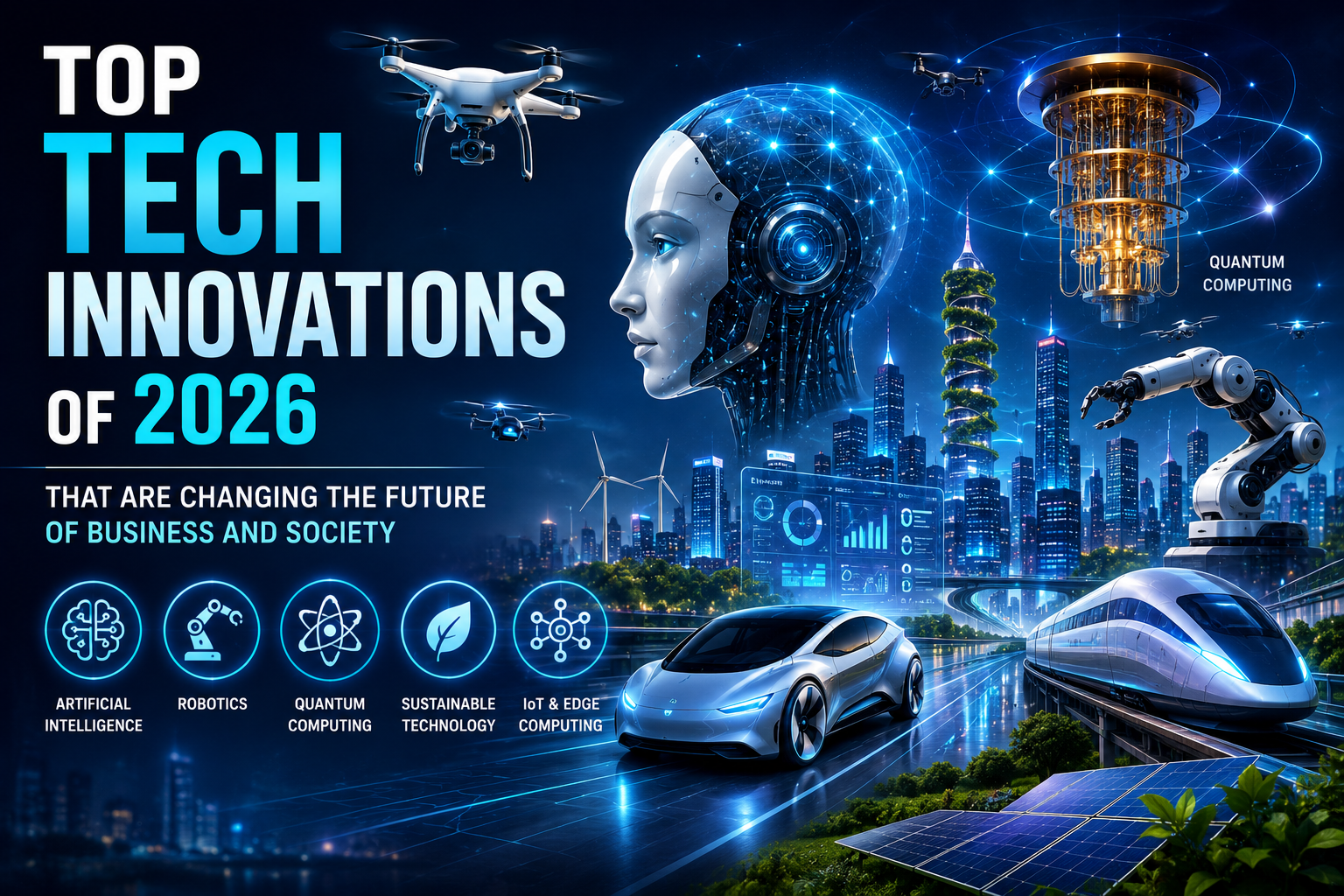
Top Tech Innovations of 2026 That Are Changing the Future of Business and Society

Table of Contents Introduction The Shift to Agentic Systems: The Evolution of AI Innovations Embodied AI and Intelligent Robotics: The Rise of Polyfunctional Humanoids Realizing Quantum Advantage: Computing Beyond Silicon Ambient Intelligence and Edge AI: Processing at the Source Biotech and Synthetic Biology: Engineering the Human Experience Green Technology and the Clean Energy Transition Autonomous Logistics and Transportation Networks Comparison of Emerging Technology Lifecycles Step-by-Step Business Playbook for Integrating Next-Generation Technologies The Broader Societal and Ethical Implications of Technology Trends Technical Demonstrations: Architectures of 2026 Innovations Edge AI Inference Engine Architecture Quantum Simulation Logic using Python Multi-Agent Orchestration Framework Config Comprehensive Glossary of Emerging Technology Terms Frequently Asked Questions (FAQs) Conclusion Introduction The relationship between business, technology, and society has reached a unique point of convergence in 2026. Digital infrastructure is transitioning from static, human-operated systems into active, autonomous ecosystems. Emerging innovations are no longer confined to localized lab experiments or experimental software tools; they have integrated directly into core global supply chains, financial markets, and daily administrative workflows. Driven by a combination of high-throughput computing, specialized hardware, and urgent environmental demands, the top tech innovations of 2026 represent a major shift in systemic design. Over 84% of international enterprises have moved past basic generative AI tools to establish active agentic workflows, while physical robotics and edge networks are bridging the gap between digital processing and real-world environments. For organizational leaders, investors, and policymakers, understanding these changes is essential. Navigating this landscape requires a deep look into the mechanics of these systems to assess their viability, performance limits, and societal impacts. This comprehensive guide provides an objective, analytical breakdown of the future technology trends and innovations shaping our world in 2026. The Shift to Agentic Systems: The Evolution of AI Innovations The AI landscape of 2026 has transitioned from passive, chat-based interfaces toward active, multi-agent frameworks that execute complex, multi-step workflows with minimal human oversight[1][2]. codeCode ┌────────────────────────────────────────────────────────┐ │ The Progression of AI Systems │ ├───────────────────┬──────────────────┬─────────────────┤ │ 2023–2024 │ 2025 │ 2026+ │ │ “Co-pilots” │ “Agentic Tools” │ “Multi-Agents” │ │ • Text generation │ • Basic APIs │ • Self-governed │ │ • Static prompts │ • Email automation│ • Dynamic loops │ │ • Manual feedback │ • Task triggers │ • Tool creation │ └───────────────────┴──────────────────┴─────────────────┘ From Interactive Prompts to Autonomous Action Loops Early AI tools operated strictly on a prompt-and-response basis, relying on human operators to manually copy and paste outputs between different software platforms. Today, modern agentic systems run on continuous execution loops: Objective Formulation: The user defines a high-level goal (e.g., “Audit our regional supply chain for carbon inefficiencies and recommend alternative logistics providers”). Autonomous Planning: The agent breaks the goal down into sequential tasks, writing custom code, queries, and API scripts to gather the necessary data. Dynamic Execution: The system queries internal ERP databases, parses vendor PDF contracts, and retrieves global carbon index data. Self-Correction: If an API call fails or a data format is incorrect, the agent analyzes the error, updates its code, and runs the query again without requiring human intervention. Multi-Agent Orchestration and Collaborative Problem Solving Instead of relying on a single, monolithic model to handle all operations, modern AI architectures use networks of specialized, cooperative agents[3]. The Orchestrator Agent: Manages the overarching workflow, translating complex user goals into tasks, allocating resources, and resolving conflicts between systems. The Analyst Agent: Focuses on data retrieval, parsing raw files, and performing statistical analysis. The Compliance Agent: Constantly audits the actions and outputs of other agents to ensure they align with strict corporate governance policies and privacy standards. The Emergence of Solo, Automated Enterprises This shift in AI capabilities has changed the economics of early-stage startups[1]. A single founder can now run and scale a profitable micro-business by managing a team of automated digital employees. These agentic networks can handle user acquisition, customer support, software engineering, and content generation autonomously, allowing small teams to compete directly with traditional, mid-sized organizations[1]. Embodied AI and Intelligent Robotics: The Rise of Polyfunctional Humanoids In 2026, robotics has moved beyond rigid, pre-programmed industrial arms to embrace adaptable, polyfunctional humanoid systems powered by advanced “physical AI” models[3][4][5]. codeCode ┌─────────────────────────────────────────────────────────┐ │ Physical AI Stack │ ├─────────────────────────────────────────────────────────┤ │ • Task Instruction (“Stack those boxes onto Palette B”) │ │ • Multi-Modal Foundation Model (Vision-Language-Action) │ │ • Dynamic Pathfinding & Spatial Mapping (LiDAR, Cameras) │ │ • Real-Time Joint Torque Adjustment (Force Feedback) │ └─────────────────────────────────────────────────────────┘ The Transition to Polyfunctional Humanoid Robotics Traditional factory robots were designed for highly repetitive tasks within sterile, predictable environments. Introducing an unmapped obstacle or changing a box’s orientation would cause the entire system to stop. Modern humanoids use Vision-Language-Action (VLA) models to operate safely and effectively in unstructured, dynamic environments: Generalist Hand-Eye Coordination: Advanced robots can identify, sort, and handle highly varied objects—from heavy metal parts to delicate glass bottles—without requiring custom programming for each item. Spatial Mapping: Using a combination of onboard LiDAR, stereoscopic cameras, and tactile sensor arrays, humanoids construct real-time 3D maps of their surroundings, allowing them to navigate busy warehouse floors and crowded workspaces safely. Force Feedback Control: Sensors in the robot’s joints measure resistance thousands of times per second, allowing the system to adjust its grip strength dynamically to avoid damaging delicate items. Key Humanoid Platforms of 2026 Figure 03: A highly advanced general-purpose humanoid designed to handle complex logistics, assembly, and maintenance tasks alongside human workers. Tesla Optimus Gen 3: Engineered for mass manufacturing, this platform is widely used to optimize repetitive materials-handling workflows within large automotive factories. Boston Dynamics Atlas (Electric): Known for its exceptional agility and precise torque control, this fully electric system handles heavy lifting and complex movement patterns in demanding industrial environments. Realizing Quantum Advantage: Computing Beyond Silicon As traditional silicon microchips approach their physical scaling limits, quantum computing has transitioned from theoretical physics into early commercial validation in 2026[6][7]. codeCode ┌────────────────────────┐ │ Classical Computer │ │ • Relies on bits │ │ • Explores paths │ │ one by one │ └───────────┬────────────┘ │ ▼ ┌────────────────────────┐ │ Quantum Computer │

AI & Technology

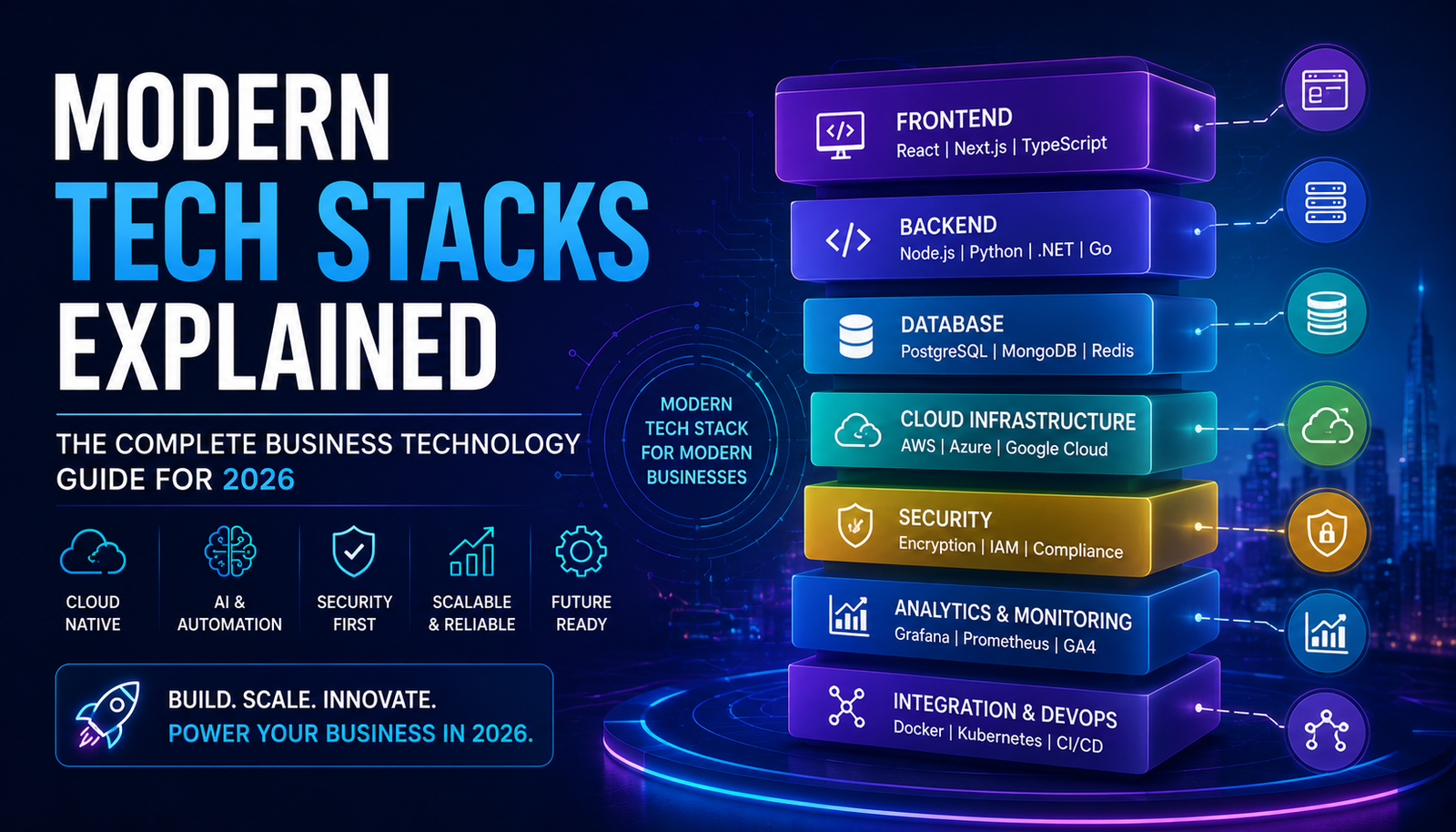
Modern Tech Stacks Explained

The baseline for digital infrastructure has undergone a fundamental shift. Today, a technology stack is no longer just an administrative arrangement of operating systems, databases, and web servers. In 2026, the global web development market has reached approximately $88 billion, growing at a compound annual rate of nearly 9% [1]. This growth is accompanied by a massive architectural shift: over 84% of developers now integrate AI-powered tools directly into their development and deployment pipelines. Selecting and managing the right business technology stack has evolved from an isolated IT decision into a core driver of business performance, directly influencing customer experience, system security, and operational overhead. Choosing an incompatible or outdated architecture can quickly lead to high maintenance costs, developer burnout, and slow release cycles. Conversely, a highly optimized, modern architecture enables organizations to scale services quickly, leverage real-time data, and seamlessly deploy intelligent capabilities. This guide provides an exhaustive, practical breakdown of modern tech stacks in 2026. Whether you are building a lightweight startup product or modernizing a complex enterprise system, this analysis covers the architectural patterns, components, real-world examples, and step-by-step decision frameworks required to build a highly competitive digital foundation. Table of Contents Introduction Anatomy of a Modern Tech Stack The Client-Side (Frontend Layer) The Server-Side (Backend Layer) The Data & Storage Layer The API & Integration Layer Cloud Infrastructure & DevOps Layer Cognitive & AI Integration Layer Architectural Patterns: Monoliths, Microservices, and Edge Monolithic Architecture Microservices Architecture Serverless Architecture Edge Computing Architectural Pattern Comparison Matrix Real-World Tech Stack Examples The B2B SaaS Startup (Optimized for Speed & Efficiency) High-Growth Fintech App (Optimized for Security & Compliance) The Enterprise E-Commerce Engine (Optimized for Scalability) The AI-First SaaS Stack (Optimized for LLM Workflows) Step-by-Step Workflow: Choosing & Evaluating Your Tech Stack Requirements Discovery & Technical Trade-offs Creating Architectural Decision Records (ADRs) Security, Regulatory, and Compliance Mapping Talent Pool Viability & Ecosystem Support Calculating Total Cost of Ownership (TCO) Technology Decision Matrix Business Benefits of Stack Modernization Challenges & Pitfalls: Navigating Legacy Debt Future Trends Beyond 2026 Comprehensive Glossary of Modern Tech Terms Frequently Asked Questions (FAQs) Conclusion Anatomy of a Modern Tech Stack A modern software architecture consists of multiple specialized layers. Unlike the rigid, vertical setups of the past, today’s applications rely on modular components that communicate through highly structured APIs. codeCode ┌─────────────────────────────────────────────────────────┐ │ Frontend Layer │ │ (Next.js 15, Svelte 5, React Native, Tailwind) │ └────────────────────────────┬────────────────────────────┘ │ (HTTPS / WSS / gRPC) ┌────────────────────────────▼────────────────────────────┐ │ API Gateway │ │ (GraphQL, Envoy, Kong, REST) │ └────────────────────────────┬────────────────────────────┘ │ ┌────────────────────────────▼────────────────────────────┐ │ Backend Services │ │ (Node.js/TypeScript, Go, Rust, Python) │ └────────────┬───────────────┬───────────────┬────────────┘ │ │ │ ┌────────────▼────┐ ┌───────▼──────┐ ┌─────▼────────────┐ │ Relational DB │ │ NoSQL / Cache│ │ Vector DB (RAG) │ │ (PostgreSQL) │ │ (Redis/Valkey)│ │ (Qdrant, Milvus) │ └─────────────────┘ └──────────────┘ └──────────────────┘ Below is a detailed analysis of the core layers that make up a contemporary software platform. The Client-Side (Frontend Layer) The frontend layer is responsible for rendering user interfaces, managing client-side state, and ensuring smooth user interactions. In 2026, frontend technologies prioritize fast rendering and reducing client-side execution overhead through strategies like hybrid rendering and partial hydration. React 19 & Next.js 15+: React continues to be a widely adopted frontend ecosystem. With the widespread adoption of the React Compiler, manual memoization (such as useMemo and useCallback) is largely automated. Next.js remains a leading meta-framework, utilizing Server Components and Server Actions to bridge frontend interfaces and database queries while keeping the client bundle small. Vue 3 & Nuxt: Nuxt provides a highly productive developer experience with automated routing, state management, and excellent support for static site generation (SSG) and server-side rendering (SSR). Svelte 5: Utilizing “Runes” for fine-grained reactivity, Svelte 5 avoids the virtual DOM entirely, compiling code into highly efficient, direct DOM updates. This makes it an excellent choice for performance-sensitive and interactive dashboard applications. Tailwind CSS & Utility-First Styling: Tailwind CSS remains a dominant styling solution. It is often paired with modern build engines like Vite and Rolldown to optimize CSS delivery and eliminate unused styles during compile time [2]. Frontend Rendering Strategies Choosing the right rendering model directly affects Core Web Vitals, initial load speeds, and search engine optimization (SEO). Rendering Strategy Mechanism Best Use Cases Pros Cons Server-Side Rendering (SSR) Pages are generated dynamically on the server for each request. Dynamic e-commerce sites, user dashboards. Up-to-date data, fast First Contentful Paint (FCP). Higher server load, potential latency under high traffic. Static Site Generation (SSG) Pages are compiled into static HTML files at build time. Documentation portals, public blogs, marketing landing pages. Extremely fast load times, low hosting costs, secure. Build times grow with site size; not suitable for real-time data. Incremental Static Regeneration (ISR) Static pages are regenerated in the background on a schedule or via webhooks. Large catalog sites, news publications. Combines the speed of SSG with the dynamic updates of SSR. Complex caching invalidation workflows. Resumability (e.g., Qwik) Eliminates hydration by serializing the application state into HTML and loading JavaScript execution on demand. High-traffic mobile-first web applications. Instant time-to-interactive (TTI) regardless of page complexity. Smaller ecosystem, requires learning new architectural paradigms. The Server-Side (Backend Layer) The backend handles core business logic, user authentication, data processing, and integration with databases and third-party APIs. Node.js & TypeScript: JavaScript and TypeScript remain foundational for web services, representing a significant portion of developer activity [2]. Frameworks like NestJS provide highly structured, enterprise-grade architectures, while minimalist setups like Fastify offer high-throughput routing. Go (Golang): Prized for its extreme efficiency, low memory footprint, and native concurrency primitives (goroutines). Go is widely used to build microservices, high-traffic API gateways, and distributed cloud-native utilities. Rust: Increasingly chosen for core infrastructure, high-performance data processing, and system tools due to its memory safety without a garbage collector. Companies use Rust to optimize critical paths where latency must be kept to a minimum. Python: Driven by the massive growth in AI and machine learning engineering, Python remains highly relevant. Modern frameworks like FastAPI leverage Python’s type hints to generate clean, highly performant asynchronous APIs that connect easily to vector databases and machine learning runtimes. The Data & Storage Layer Choosing a data layer is no

How AI Is Transforming Business Operations in 2026
AI & Technology

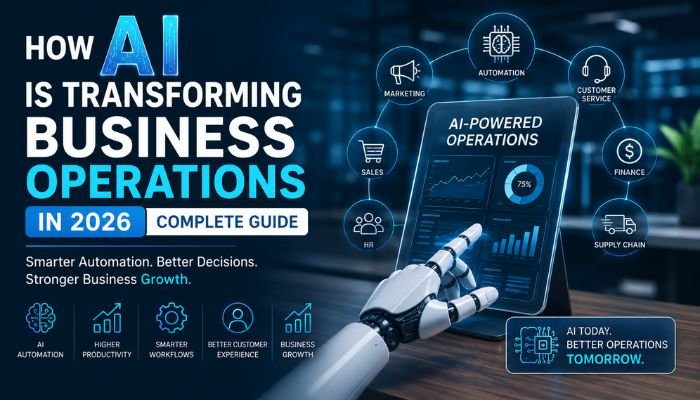
How AI Is Transforming Business Operations in 2026

In the current global market, technology is evolving at an incredible speed. Therefore, understanding How AI Is Transforming Business Operations in 2026 has become absolutely vital for modern organizations. Indeed, smart machines are no longer just a futuristic prediction [2]. Instead, they are actively running essential workflows, optimizing daily schedules, and cutting operating costs for companies worldwide [1, 2]. Consequently, digital marketing, sales, and manufacturing departments are undergoing massive structural shifts [3]. Because of these shifts, organizations can now automate repetitive tasks with very little human effort. For example, software can handle customer data entries, manage inventory levels, and write weekly business reports instantly. As a result, team members have more free time to focus on creative strategy and human connections. Moreover, these digital solutions are opening exciting growth opportunities for creative companies. Specifically, smart systems can analyze massive data sets to help managers make accurate decisions in seconds. In addition, they significantly improve the customer experience by offering personalized help around the clock. Thus, adopting these modern systems is the key to building a highly competitive, resilient organization. What Is AI in Business Operations? To begin, we should define what artificial intelligence in business actually means in simple terms. Specifically, it is the process of using smart software models to handle daily company tasks. Because these systems learn from historical data, they can perform tasks that previously required human thought. Therefore, this technology acts as a highly efficient assistant for your entire workforce. In 2026, companies use ai powered business solutions to manage many different administrative processes. First, they use smart tools to organize customer databases and track sales pipelines automatically. Secondly, they use predictive algorithms to schedule machinery maintenance in busy manufacturing plants. Furthermore, they rely on automated software to audit financial expenses and detect billing errors. Meanwhile, they use interactive platforms to guide new employees through their first week of training. Thus, these diverse tools help organizations run their daily operations with incredible speed and accuracy. Why AI Matters More Than Ever in 2026 First of all, market competition has reached an all-time high across every industry. Therefore, companies must move quickly to capture consumer interest and retain their market share. In fact, ignoring ai business transformation can cause your brand to fall behind your competitors. Indeed, modern buyers will quickly choose businesses that offer faster, highly automated digital experiences. Secondly, customer expectations are changing much faster than ever before. Specifically, modern users expect brands to understand their personal needs and answer questions instantly. Consequently, traditional, slow customer service methods can make your business look lazy and unhelpful. Thus, implementing modern automated tools helps you deliver immediate, personalized support at any hour. Thirdly, the sheer volume of digital data that companies collect is truly massive. However, human managers cannot analyze millions of database rows quickly or accurately. Therefore, you must use smart algorithms to process this information and uncover hidden operational trends. As a result, your company can turn raw data into highly profitable business plans. Finally, rising labor and resource costs are creating a massive demand for automation. Specifically, companies must optimize their resource spending to maintain healthy profit margins. Consequently, automated workflows have transitioned from optional tech tools to absolute business survival requirements. Clearly, adopting these modern systems is vital to secure your company’s long-term growth. How AI Is Transforming Business Operations in 2026 Currently, How AI Is Transforming Business Operations in 2026 is the central focus of modern corporate planning. In this section, we will analyze the overall impact of smart systems on standard company workflows. First, the integration of smart tools is breaking down traditional barriers between different departments. Specifically, data can now flow between marketing, sales, and customer service teams completely automatically. Consequently, this deep connectivity creates a unified source of truth for your entire workforce. Thus, your business operations run much faster and with significantly fewer communication errors. Secondly, we are witnessing a massive transition toward fully autonomous digital workflows. Specifically, modern tools can handle complex multi-step processes without requiring human clicks at each step. For example, a system can automatically identify a low inventory item and order it from suppliers. Therefore, your daily logistics can run smoothly in the background while you focus on expansion. Finally, smart technology is helping leaders make highly accurate, data-driven decisions. Specifically, predictive models can run simulations of major corporate choices to forecast potential results. This reduces the risk of making costly mistakes during product launches or market expansions. Thus, artificial intelligence serves as a highly reliable guide for your company’s future direction. Key Areas Where AI Is Used in Business To help you understand this transition better, let us examine where these systems are applied. The table below displays how different departments utilize ai in business operations. Business Function AI Application Business Benefit Marketing Predictive copy generation & audience division Higher ad click rates and lower customer acquisition costs. Sales Automated lead grading & customer profiling Shorter sales cycles and increased closed deal values. Customer Service Intelligent chat systems & instant translation Lower customer wait times and improved satisfaction scores. HR Automated resume filtering & digital training Faster candidate hiring times and better employee fit. Finance Fraud alerting & automated expense auditing Reduced financial losses and highly accurate tax records. Supply Chain Automated logistics planning & stock alerts Lower shipping fees and optimized inventory storage. Operations Smart process alerts & digital calendars Fewer manual administrative errors and high team speed. Analytics Predictive behavior models & data summaries Clear, highly actionable data insights for leadership teams. AI in Marketing Operations First, modern digital marketing requires a very high level of personalization. Therefore, companies use ai tools for businesses to study how their potential buyers behave online. For example, these tools can track what articles a user reads on your official blog. As a result, the system can automatically deliver tailored product suggestions to that specific user. Moreover, content creation has become much faster because of smart design and writing assistants. For instance, marketers can generate high-quality social captions and ad graphics in just a few seconds. However,

AI & Technology

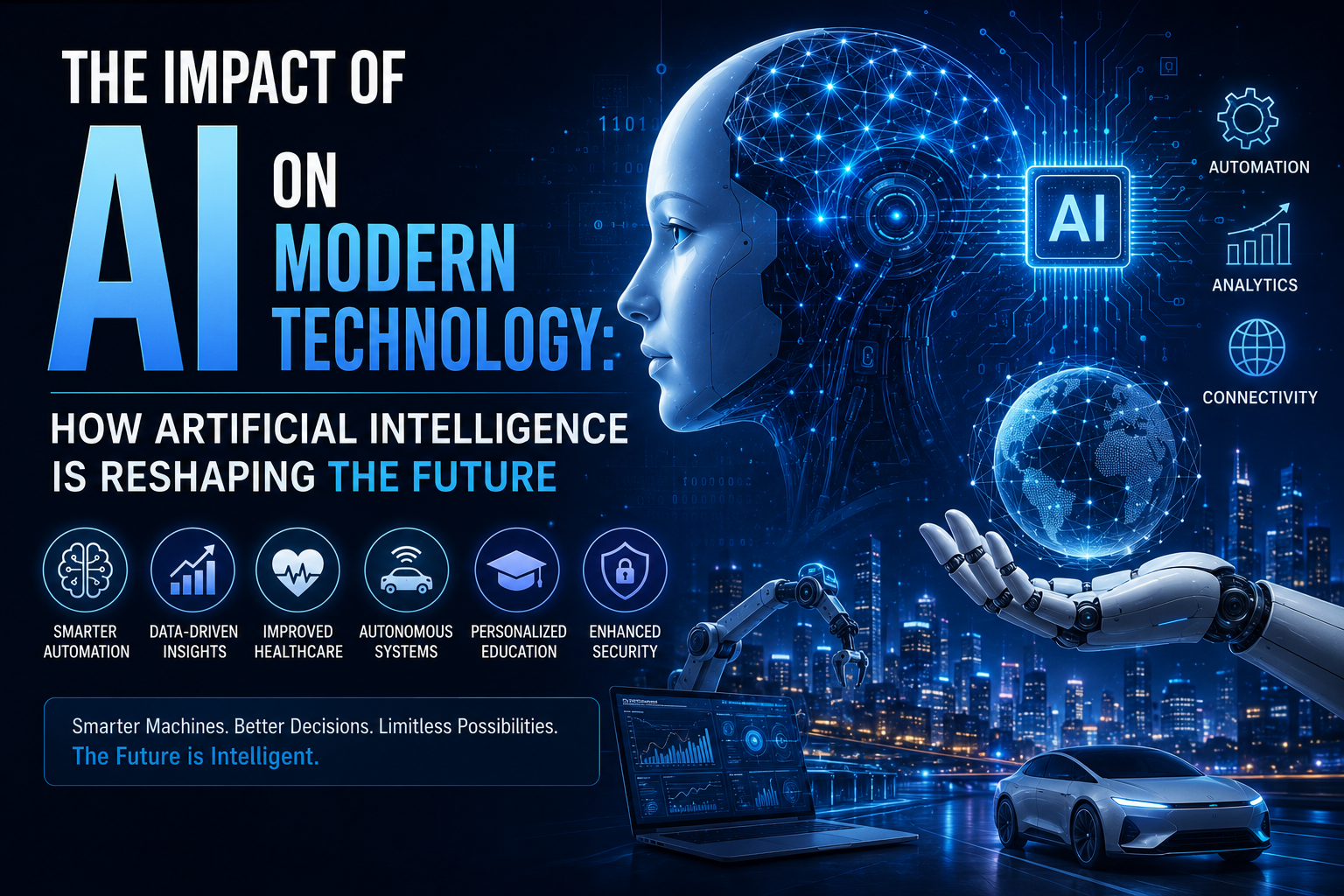
The Impact of AI on Modern Technology: How Artificial Intelligence Is Reshaping the Future

We are living in an era where technology does not just assist human decision-making; it anticipates, executes, and refines it. The impact of AI on modern technology has transitioned from an incremental progression of software efficiency to a fundamental paradigm shift[1]. In less than a decade, artificial intelligence has mutated from a back-end analytical tool into the primary interface and operating engine of global infrastructure[1][2]. Whether we look at generative design platforms, predictive diagnostics in medicine, autonomous agents executing complex multi-step supply chain decisions, or foundational models capable of reasoning across modalities, AI is no longer a localized trend[3][4]. It is the new substrate of the digital world[2]. The phrase “digital transformation” once referred to cloud migration, mobile app integration, and data centralization. Today, that definition has been overwritten by AI transformation[2][5]. Every modern application, database, and hardware stack is being re-engineered to support or integrate machine-learned cognitive capabilities[2]. To fully comprehend the depth of this transformation, we must analyze the specific mechanics of this technology, explore the sectors undergoing radical restructuring, examine the emerging challenges, and project the structural shifts that will characterize the coming decade[2][3]. This article provides a comprehensive, highly analytical examination of how AI is fundamentally rewriting the laws of technology, business, and daily human life[1]. 2. The Evolution of Artificial Intelligence: From Symbolic Rules to Generative and Agentic Paradigms To understand the impact of AI on modern technology, one must look back at its architectural evolution. The trajectory of AI can be divided into four distinct waves, each defined by how machines represent knowledge and learn from data[3]. codeCode +————————————————————————-+ | THE FOUR WAVES OF AI | +————————————————————————-+ | | | Wave 1: Symbolic AI (Rule-Based) | | – Hardcoded “if-then” logic, expert systems, brittle parameters. | | | | Wave 2: Statistical Machine Learning | | – Feature engineering, regression, SVMs, predictive classification. | | | | Wave 3: Deep Learning & Transformers | | – Neural networks, self-attention, foundation models, LLMs. | | | | Wave 4: Agentic & Multi-Agent AI (2026+) | | – Autonomous goal execution, tool use, self-correction, reasoning. | | | +————————————————————————-+ The First Wave: Symbolic AI and Expert Systems Historically, artificial intelligence relied on Symbolic AI—often called “Good Old-Fashioned AI” (GOFAI). These systems operated on explicit, hardcoded logic. Engineers mapped out complex “if-then” decision trees to build “expert systems.” While successful in highly constrained environments (such as basic chess engines or diagnostic flowcharts), these systems were fundamentally brittle. They could not generalize beyond their hardcoded parameters, lacked the capacity to learn from new data, and collapsed when confronted with the noise and ambiguity of real-world inputs. The Second Wave: Statistical Machine Learning The transition to statistical machine learning in the late 1990s and 2000s marked a shift from programming rules to programming learning algorithms. Instead of explicitly telling a machine how to identify a pattern, developers fed labeled datasets into algorithms like Support Vector Machines (SVMs), Random Forests, and Gradient Boosting trees. The machine learned to optimize mathematical functions to make classifications or predictions. However, this era was heavily dependent on “feature engineering”—the tedious, human-intensive process of manually identifying which variables (features) the algorithm should pay attention to. The Third Wave: Deep Learning and the Transformer Breakthrough The deep learning revolution, catalyzed by the availability of massive GPU compute and large-scale datasets (such as ImageNet), eliminated the need for manual feature engineering. Multi-layered Artificial Neural Networks (ANNs)—particularly Convolutional Neural Networks (CNNs) for vision and Recurrent Neural Networks (RNNs) for sequential data—allowed systems to learn hierarchical representations of data directly from raw pixels or text. The ultimate inflection point occurred in 2017 with the introduction of the Transformer architecture in the paper “Attention Is All You Need.” By replacing recurrence with self-attention mechanisms, Transformers allowed models to process sequence data in parallel, capture long-range dependencies, and scale to billions of parameters. This architecture laid the foundation for Large Language Models (LLMs) and modern Generative AI, enabling machines to understand, summarize, translate, and generate human-like text and code with unprecedented fluency[3]. The Fourth Wave: Agentic and Multi-Agent AI We have entered the fourth wave: Agentic AI[6][7]. While generative AI focuses on content generation and interactive search, agentic systems focus on execution[4][7]. Equipped with planning capabilities, memory, and tool integration (such as the ability to execute API calls, write and run Python scripts, browse the web, and operate desktop interfaces), autonomous AI agents do not merely answer prompts; they accomplish long-horizon goals[4][7]. This shift from passive conversational models to active, self-correcting agents represents the cutting edge of modern software design[7]. 3. Key Artificial Intelligence Innovations Reshaping Modern Systems The rapid integration of AI into contemporary software architectures is driven by several foundational artificial intelligence innovations[3]. These technologies serve as the building blocks for enterprise and consumer applications alike[2][3]. A. Multimodal Foundation Models Early AI models were highly specialized: one model processed text, another processed audio, and a third classified images. Modern foundation models are inherently multimodal[3]. Trained on heterogeneous datasets containing billions of images, audio files, videos, code repositories, and textual documents, these systems understand cross-modal relationships natively. A multimodal model can read a complex schematic diagram, generate the corresponding software control code, explain the diagram via synthetic voice, and generate a video demonstrating how the physical machine operates. This unified representation of diverse data streams has unlocked unprecedented flexibility across software interfaces. B. Retrieval-Augmented Generation (RAG) and Long-Context Windows To make LLMs useful in enterprise environments, developers had to solve the twin challenges of outdated training data and “hallucinations” (the tendency of models to invent facts). This led to the development of Retrieval-Augmented Generation (RAG). RAG acts as an intermediary layer: when a user asks a question, the system queries an external vector database containing proprietary, up-to-date documents, retrieves relevant text chunks, and feeds them to the LLM as a context anchor. Simultaneously, the dramatic expansion of model context windows—capable of holding millions of tokens—allows businesses to feed entire codebases, legal libraries, or historical financial reports directly into the active memory of the AI, yielding highly contextualized and

Scroll to Top