

AI is changing how companies work in 2026. At Today Business Trends, we explore how the best AI tools for business help with tasks like writing content and automating customer support. As a result, businesses can reduce costs and grow faster. In this guide, In this guide, we tested and compared the best AI tools for business based on features, pricing, and ease of use,
In today’s digital world, AI tools for business are changing the way companies work, compete, and grow. Businesses no longer need to rely only on manual work for repetitive tasks or handling large amounts of data.
From small startups to large enterprises, companies are using AI tools for business to automate workflows, improve customer experiences, and make better decisions.
If you are new to this concept, this guide will help you understand everything step by step. You will learn what AI tools are, why they matter, and how to use them effectively in your business.
What Are AI Tools for Business
AI tools for business are smart software programs that use artificial intelligence to help companies complete tasks faster, easier, and more accurately. These tools can learn from data, understand patterns, and make useful suggestions. These tools simplify workflows and increase output quality.
In simple terms, AI tools for business work like smart assistants that handle tasks such as writing content, replying to customer questions, creating reports, and organizing schedules. For example, they can quickly generate content or respond to queries without delay. Instead of managing every task by hand, businesses can rely on these tools to simplify daily work. As a result, teams can focus more on important goals and long-term growth.
Today, many small and large companies use AI tools for business to grow faster and stay competitive. Moreover, these tools are becoming more affordable and beginner-friendly in 2026.
How AI Tools for Business Work
AI tools work by collecting data, analyzing information, and giving smart outputs based on patterns. They use technologies like machine learning, automation, and natural language processing to perform tasks.
For example:
- A chatbot on a website can answer customer questions instantly, even at midnight.
- With AI writing tools, you can quickly generate blog articles, email drafts, and product descriptions without starting from scratch.
- For marketing, these tools analyze audience behavior and recommend the best times to post on social media.
- When it comes to data, AI analytics platforms review sales performance and highlight top-performing products.
- To manage time better, AI scheduling assistants handle meeting bookings and send timely reminders.
Because of these features, AI tools for business help owners make better decisions with less effort.
Real-Life Examples of AI Tools for Business
Many popular businesses already use AI every day. For instance, online stores use AI to recommend products based on customer behavior. Banks use AI to detect suspicious transactions and prevent fraud. Restaurants use AI chat systems to take bookings and answer customer queries.
Likewise, a small business owner can use ChatGPT to write content, Canva to create designs, and HubSpot to manage leads and emails.
AI Tools Overview Table
| Tool Name | Category | Difficulty | Pricing | Best For | Key Features | Business Impact |
| ChatGPT | Content | Easy | Free/Paid | Writing | Text generation, ideas | Saves time |
| Canva AI | Design | Easy | Free/Paid | Graphics | Templates, AI design | Better visuals |
| Jasper | Marketing | Medium | Paid | Copywriting | AI content, ads | Higher conversions |
| Surfer SEO | SEO | Medium | Paid | Ranking | Optimization tools | More traffic |
| Zapier | Automation | Easy | Free/Paid | Workflows | App integration | Time saving |
| HubSpot AI | CRM | Medium | Paid | Marketing | Automation, analytics | Lead generation |
| Notion AI | Productivity | Easy | Paid | Organization | Notes, tasks | Efficiency |
| Grammarly | Writing | Easy | Free/Paid | Editing | Grammar, tone | Better communication |
This table gives a quick overview of the most useful AI tools for business. Each tool serves a different purpose, and choosing the right one depends on your needs.
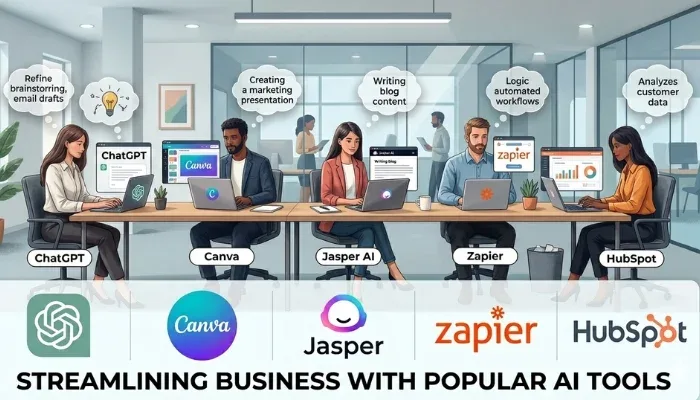
Best AI Tools for Business (Detailed Section)
Choosing the right AI tools for business can make a big difference in how efficiently your business operates. Below are some of the best tools explained in a simple and practical way. Each tool solves a specific problem and can be used by beginners as well as professionals.
ChatGPT
ChatGPT is one of the most popular AI tools for business today. It is widely used for writing content, answering questions, and generating new ideas quickly.
This tool can create blog posts, emails, product descriptions, and even social media content in minutes. It is especially useful for businesses that need regular content but have limited time or resources.
Features
- Generates high-quality text for different purposes
- Answers questions instantly with clear explanations
- Helps with research, planning, and brainstorming ideas
Pricing
Free version available, with advanced paid plans for better performance
Best use case
Ideal for bloggers, marketers, and small business owners who need fast and reliable content creation
Canva AI
Canva AI makes designing simple, even for beginners with no design experience. It provides ready-made templates and AI-powered features that help create professional visuals.
Businesses can use Canva to design social media posts, presentations, ads, and marketing materials quickly. This saves time and removes the need for hiring a designer.
Features
- Easy drag-and-drop design system
- AI-generated images and design suggestions
- Thousands of templates for social media and marketing
Pricing
Free plan available, with premium features in paid plans
Best use case
Perfect for small businesses, freelancers, and beginners who want professional designs without technical skills
Jasper AI
Jasper AI is a powerful tool focused on marketing content creation. It helps businesses create high-quality content that is optimized for engagement and conversions.
This tool is commonly used for writing blog posts, advertisements, email campaigns, and landing page content. It is especially helpful for businesses that focus on digital marketing.
Features
- Creates blog articles and long-form content
- Generates ad copy and marketing messages
- Supports SEO-friendly content writing
Pricing
Paid tool with different plans based on usage
Best use case
Best for marketing teams, agencies, and businesses that need high-quality promotional content
Surfer SEO
Surfer SEO is designed to help websites rank higher on search engines like Google. It analyzes top-ranking content and provides suggestions to improve your own content.
This tool is very useful for bloggers and website owners who want to increase traffic and visibility online.
Features
- Provides keyword suggestions based on search data
- Gives content scores to measure SEO performance
- Helps optimize articles for better rankings
Pricing
Paid tool with subscription plans
Best use case
Ideal for bloggers, SEO experts, and website owners who want to improve search rankings
Zapier
Zapier is an automation tool that connects different apps and allows them to work together automatically. It reduces manual work by creating workflows called “Zaps.”
For example, when someone fills out a form on your website, Zapier can automatically save the data and send an email response.
Features
- Connects thousands of apps easily
- Automates repetitive tasks and workflows
- Works without coding knowledge
Pricing
Free plan available, with advanced features in paid plans
Best use case
Best for businesses that want to automate daily tasks and improve efficiency
HubSpot AI
HubSpot AI is an all-in-one platform that combines marketing, sales, and customer relationship management (CRM). It helps businesses manage leads and automate marketing campaigns.
This tool is useful for tracking customer interactions and improving communication with potential clients.
Features
- Email marketing and automation tools
- Tracks leads and customer data
- Provides analytics and insights
Pricing
Paid tool with multiple plans
Best use case
Suitable for growing businesses that want to manage marketing and sales in one place
Notion AI
Notion AI is a productivity tool that helps organize work, manage tasks, and generate content. It combines note-taking, task management, and AI writing in one platform.
Teams can use Notion AI to plan projects, store information, and collaborate efficiently.
Features
- Generates content and summaries
- Organizes tasks and notes in one place
- Helps manage projects and workflows
Pricing
Paid plans available
Best use case
Great for individuals, teams, and businesses looking to improve productivity and organization
Grammarly
Grammarly is a writing assistant that helps improve grammar, spelling, and tone. It ensures that your content is clear, professional, and easy to understand.
This tool is useful for emails, blog posts, reports, and any type of written communication.
Features
- Corrects grammar and spelling mistakes
- Suggests better word choices
- Analyzes tone and clarity
Pricing
Free version available, with advanced features in paid plans
Best use case
Useful for writers, professionals, and anyone who wants to improve their writing quality
Tidio AI
Tidio AI is a customer support tool that uses chatbots and live chat to communicate with customers. It helps businesses provide quick responses and improve customer service.
This tool is especially useful for online stores and websites that receive frequent customer inquiries.
Features
- AI chatbots for instant replies
- Live chat support
- Integration with websites and ecommerce platforms
Pricing
Free and paid plans available
Best use case
Best for ecommerce businesses and websites that need fast customer support
Copy.ai
Copy.ai is designed to create marketing content quickly and easily. It helps businesses write emails, ads, and sales copy that attract customers.
This tool is helpful for marketers who need to create engaging content regularly.
Features
- Generates email campaigns and sales copy
- Creates social media content
- Provides multiple content variations
Pricing
Free and paid plans available
Best use case
Best for marketers and businesses focused on advertising and sales
Why Businesses Should Use AI Tools in 2026
The business environment is becoming more competitive every year. New businesses are entering the market, and customers expect faster and better services. Technology is also changing quickly, which makes it important for companies to adapt.
This is where AI tools for business play an important role. They help businesses work smarter, save time, and improve results. Even small businesses can now compete with bigger companies by using the right AI tools.
Types of AI Tools for Business
Businesses use different types of AI tools for business depending on their needs. Each type focuses on solving a specific problem, such as marketing, content creation, or automation. Understanding these categories helps beginners choose the right tools and use them effectively.
Below are the most important types of AI tools explained in a simple way.
AI Tools for Marketing and Sales
AI tools for marketing and sales help businesses attract customers, generate leads, and increase revenue. These tools use data to understand customer behavior and create targeted campaigns.
For example, AI can analyze what customers like, what they search for, and how they interact with content. Based on this, businesses can send personalized emails, ads, and offers that are more likely to convert.
Examples include:
- Jasper AI for content creation
- HubSpot AI for marketing automation
- Copy.ai for ad copy and emails
For instance, a small business can use HubSpot AI to automatically send emails to potential customers based on their interests. This improves engagement and increases sales without manual effort.
Content Writing AI Tools
Content plays a key role in online growth, especially for websites, blogs, and social media platforms. To make this process easier, content writing AI tools help generate high-quality material quickly and consistently.
These tools can generate blog posts, product descriptions, social media captions, and more. They also help improve grammar, tone, and readability.
Examples include:
- ChatGPT for blogs and articles
- Writesonic for marketing content
- Jasper for SEO writing
For example, a blogger can use ChatGPT to write a complete article in minutes instead of hours. This saves time and helps maintain regular content publishing, which is important for SEO.
Customer Support AI Tools
Customer support is a key part of any business. Customers expect quick and helpful responses to their questions. AI tools can handle customer queries instantly and provide support at any time of the day.
These tools use chatbots and AI assistants to answer common questions, guide users, and solve basic problems without human involvement.
Examples include:
- Tidio AI chatbots
- Intercom AI assistants
- Drift chat systems
For example, an ecommerce website can use a chatbot to answer questions about orders, delivery, and returns. This improves customer satisfaction and reduces the workload on support teams.
AI Tools for Business Automation
Automation tools help businesses save time by handling repetitive tasks automatically. These tools connect different apps and perform actions without manual input.
They are especially useful for tasks like sending emails, updating data, and managing workflows.
Examples include:
- Zapier for workflow automation
- Make for advanced integrations
- Power Automate for enterprise solutions
For example, a business can use Zapier to automatically save customer data from a website form into a spreadsheet and send a confirmation email. This reduces manual work and improves efficiency.
Analytics AI Tools
Analytics tools help businesses understand their performance by analyzing data. These tools provide insights into customer behavior, sales trends, and marketing results.
With this information, businesses can make better decisions and improve their strategies.
Examples include:
- Google Analytics
- Power BI
- Tableau
For example, a business can use Google Analytics to track website visitors and see which pages are performing well. This helps in improving content and increasing conversions.
By understanding these types of AI tools for business, you can choose the right tools based on your needs. Each category plays an important role in improving efficiency, productivity, and overall business growth.
How to Choose the Right AI Tool
Choosing the right AI tools for business requires careful planning and a clear understanding of your goals. Not every tool is suitable for every business, so it is important to choose wisely.
If you select the right tool, it can save time, improve productivity, and support business growth. The steps below will help you make the right decision in a simple and practical way.
Steps to Follow
Identify Your Business Needs
The first step is to understand what your business actually needs. Different businesses have different goals, such as marketing, content creation, customer support, or automation.
For example, if you run a blog, you may need a content writing tool like ChatGPT. If you manage customer queries, a chatbot tool like Tidio would be more useful. Knowing your needs helps you avoid choosing unnecessary tools.
Set a Budget
Before selecting any tool, decide how much you are willing to spend. Some AI tools for business are free, while others require a monthly or yearly subscription.
For beginners, it is better to start with free or low-cost tools. As your business grows, you can upgrade to paid plans with advanced features. This helps you manage costs effectively.
Compare Features
Not all AI tools offer the same features, even if they belong to the same category. It is important to compare different tools and see what they provide.
For example, one tool may offer basic content generation, while another may include SEO optimization and templates. Choosing a tool with the right features ensures you get maximum value for your investment.
Test Free Versions
Most AI tools offer free trials or basic plans. It is a good idea to test these tools before making a final decision.
By using a tool for a few days, you can understand how it works and whether it meets your needs. For example, you can try Canva for design or Zapier for automation to see how useful they are in your workflow.
Start with Simple Tools
If you are a beginner, it is better to start with simple and easy-to-use tools. Complex tools may take more time to learn and may not be necessary at the beginning.
For example, starting with ChatGPT or Canva is easier than using advanced enterprise tools. Once you gain experience, you can move to more advanced options.
By following these steps, you can choose the right AI tools for business that match your goals and budget. The key is to start small, learn gradually, and expand as your business grows.
Making the right choice in the beginning will save time, reduce costs, and help you achieve better results.
How to Start Using AI in Your Business
Starting with AI tools for business does not require technical skills or advanced knowledge. Most modern AI tools are designed to be simple and user-friendly, even for beginners.
The key is to start small and learn step by step. By following a clear process, you can easily integrate AI into your daily business activities and see real results.
Step-by-Step Guide
Choose One Tool Based on Your Needs
The first step is to select one tool that matches your business goal. Do not try to use multiple tools at once, as it can become confusing.
For example, if your goal is content creation, you can start with ChatGPT. If you want to improve design, Canva AI is a good choice. Starting with one tool helps you focus and learn faster.
Learn How It Works Using Tutorials
Once you choose a tool, take some time to understand how it works. Most AI tools for business offer tutorials, guides, and videos to help beginners.
You can watch YouTube tutorials or read simple guides to learn basic features. For example, learning how to write prompts in ChatGPT can improve your results significantly.
Use It Regularly in Your Workflow
Learning is not enough; you need to use the tool regularly in your daily work. This helps you become comfortable and confident with it.
For example, you can use AI to write emails, create social media posts, or plan tasks every day. Regular use makes the tool a natural part of your workflow.
Automate Simple Tasks
After you understand the basics, start using AI for simple automation. This can include tasks like sending emails, organizing data, or scheduling posts.
For example, tools like Zapier can automatically connect apps and perform tasks without manual effort. This saves time and reduces repetitive work.
Track Results and Improve
It is important to measure how well the tool is working for your business. Track results such as time saved, increased productivity, or better engagement.
For example, if you use AI for marketing, check if your content is getting more views or clicks. Based on the results, you can adjust your strategy and improve performance.
Key Benefits of AI Tools for Business Growth
Below are the major benefits of using AI tools for business, explained in a simple and practical way. These tools help companies save time, improve efficiency, and grow faster. Therefore, businesses of all sizes are adopting AI solutions.
AI Tools for Business Automation Save Time
Many daily business tasks are repetitive and time-consuming. These include data entry, replying to emails, scheduling meetings, and updating records.
However, AI tools for business automation can handle these tasks automatically. As a result, employees can focus on more valuable work such as planning, strategy, and growth.
For example, tools like Zapier can automatically send emails or update customer data without manual effort.
Best AI Tools for Small Business Improve Productivity
Productivity means completing more work in less time. The best AI tools for small business help improve productivity by speeding up routine tasks.
For instance, writing content, designing graphics, generating reports, or analyzing data can be done much faster with AI tools. Because of this, teams can complete more work without increasing effort.
Therefore, small businesses can grow faster while using the same resources.
Free AI Tools for Business Owners Reduce Costs
Running a business can be expensive, especially when hiring more staff. However, free AI tools for business owners help reduce costs by automating tasks that normally require human effort.
This means businesses can save money on salaries, training, and human errors. In addition, fewer mistakes lead to better financial management.
For example, ChatGPT and Canva offer free plans for beginners.
Top AI Software for Entrepreneurs Supports Better Decision-Making
Making the right decisions is very important in business. Top AI software for entrepreneurs can analyze large amounts of data quickly and provide useful insights.
These insights help businesses understand:
- Customer behavior
- Market trends
- Sales performance
- Growth opportunities
As a result, entrepreneurs can make smarter and more informed decisions.
AI Tools for Marketing and Sales Help Scale Businesses
As a business grows, operations become harder to manage. However, AI tools for marketing and sales make expansion easier by automating campaigns, lead generation, and customer communication.
Automation allows businesses to manage more customers, more leads, and more tasks without hiring a large team.
Therefore, companies can scale smoothly and grow steadily.
Common Mistakes to Avoid
Many beginners make mistakes when they start using AI tools for business. These mistakes can slow down progress and reduce the effectiveness of the tools.
Understanding these common issues will help you use AI tools more effectively and get better results in less time.
Using Too Many Tools at Once
One of the most common mistakes is trying to use too many tools at the same time. This can create confusion and make it difficult to manage your workflow properly.
For example, using multiple content tools together may lead to inconsistent results and wasted time. It is better to start with one or two tools and master them before adding more.
Not Understanding the Tool Properly
Many users start using AI tools without fully understanding how they work. This often leads to poor results and frustration.
For example, if you use ChatGPT without giving clear instructions, the output may not be useful. Taking time to learn the tool and its features can greatly improve the quality of results.
Ignoring Results and Analytics
Another mistake is not tracking performance after using AI tools. Without checking results, it is difficult to know if the tool is actually helping your business.
For example, if you use AI for marketing, you should monitor metrics like website traffic, clicks, and engagement. This helps you understand what is working and what needs improvement.
Expecting Instant Success
Some beginners expect immediate results after using AI tools for business, but this is not realistic. AI tools help improve efficiency, but success still takes time and effort.
For example, using AI for content creation will not instantly rank your website on Google. You need consistency, optimization, and patience to see long-term results.
Avoiding these common mistakes will help you use AI tools for business more effectively. Start simple, learn properly, and focus on steady improvement.
With the right approach, AI tools can become a powerful asset for your business growth.
AI Tools List
- ChatGPT
- Canva AI
- Jasper
- Copy.ai
- Surfer SEO
- Grammarly
- Notion AI
- Zapier
- HubSpot AI
- Tidio AI
- Drift
- Intercom
- Writesonic
- Pictory
- Lumen5
- Synthesia
- Runway ML
- Midjourney
Tools and Resources
Learning how to use AI tools for business becomes much easier when you use the right resources. Beginners do not need advanced knowledge, but they do need guidance from reliable sources.
Below are some of the best resources that can help you understand and use AI tools effectively.
Online Tutorials
Online tutorials are one of the easiest ways to learn AI tools step by step. Most tools provide official guides that explain how to use their features in a simple way.
For example, platforms like ChatGPT or Canva have built-in tutorials that show how to create content or designs. These tutorials help you quickly understand the basics and start using the tool without confusion.
Blog Articles
Blog articles provide detailed explanations and practical tips about AI tools for business. They often include real-world examples and case studies.
For example, many blogs explain how to use AI tools for SEO, marketing, or automation. Reading these articles regularly helps you stay updated and learn new strategies.
YouTube Guides
YouTube is a powerful platform for learning because it shows practical demonstrations. You can watch how a tool works instead of just reading about it.
For example, you can find videos showing how to create content using ChatGPT or automate tasks using Zapier. This makes learning faster and easier, especially for beginners.
Free Courses
Free online courses provide structured learning and cover topics in detail. These courses are useful if you want to understand AI tools more deeply.
For example, platforms like Coursera or Udemy offer beginner-friendly courses on AI and automation. These courses help you build confidence and apply AI tools in real business situations.
Advantages and Disadvantages of AI Tools for Business
Before using AI tools for business, it is important to understand both the benefits and limitations. This helps businesses use these tools wisely and avoid common problems. Although AI offers many advantages, it also comes with some challenges. Therefore, a balanced approach is always the best choice.
| Aspect | Advantages | Disadvantages |
| Productivity | AI tools for business complete tasks faster and help teams handle more work in less time. | Overdependence on AI may reduce human creativity and problem-solving skills over time. |
| Cost Savings | Businesses can save money by automating repetitive tasks and reducing manual labor costs. | Some advanced AI tools require monthly subscriptions or setup costs. |
| Time Management | AI helps save time by handling scheduling, emails, and routine processes automatically. | Initial setup and learning time may be required before seeing results. |
| Accuracy | AI can reduce human errors in data entry, reporting, and analysis. | Wrong inputs or poor data can lead to inaccurate results. |
| Customer Support | AI chatbots provide instant replies and 24/7 customer service. | Chatbots may fail to understand complex or emotional customer issues. |
| Marketing | AI tools improve ad targeting, email campaigns, and content ideas for better growth. | Poor strategy can still waste money even with AI assistance. |
| Decision Making | AI analyzes data quickly and gives useful insights for smarter business decisions. | AI recommendations should still be checked by humans before acting. |
| Scalability | Businesses can grow operations faster without hiring large teams immediately. | Rapid automation may create management challenges if not planned properly. |
| Ease of Use | Many modern AI tools are beginner-friendly and easy to use in 2026. | Some tools still require training or technical understanding. |
| Security | AI can detect fraud, spam, and suspicious activity quickly. | Storing business data in AI platforms may create privacy concerns if unmanaged. |
Future of AI in Business (2026–2030)
The future of AI tools for business looks very strong between 2026 and 2030. More companies will use artificial intelligence to improve efficiency, lower costs, and grow faster. As these tools become easier to use, small businesses and startups will also benefit.
During this period, AI will become a normal part of business operations rather than an optional tool. Companies that adopt AI early may gain better productivity and stronger market positions.
More Automation in Daily Tasks
Businesses will increasingly use AI to automate routine tasks such as email replies, scheduling, invoicing, inventory tracking, and customer follow-ups. This will save time and reduce workload for teams.
As a result, employees can focus more on planning, creativity, and customer relationships.
Smarter Customer Support
AI chatbots and virtual assistants will become more advanced and human-like. They will understand customer questions better, provide accurate responses, and solve issues quickly.
Because of this, businesses can offer 24/7 support while improving customer satisfaction.
Personalized Marketing Campaigns
AI tools for business will help companies create personalized ads, emails, and offers based on customer behavior. This means each customer may receive recommendations that match their interests.
For example, online stores can show products based on previous searches and purchases.
Faster Decision-Making with Data
Businesses collect large amounts of data every day. AI will help analyze this information quickly and turn it into useful insights.
Owners can use these reports to understand trends, forecast sales, and make smarter decisions with confidence.
Growth of AI for Small Businesses
In the past, many AI tools were expensive and complex. However, from 2026 onward, more affordable and beginner-friendly options will become available.
Small businesses can use tools like ChatGPT for writing, Canva for design, and HubSpot for marketing and customer management.
AI Working Together with Humans
AI will support workers instead of replacing every role. It can handle repetitive tasks, while people focus on strategy, creativity, and relationships.
This teamwork between AI and humans can improve overall business performance.
Better Security and Fraud Detection
Businesses will also use AI to monitor suspicious activity, detect fraud, and strengthen cybersecurity systems. This is especially important for banks, ecommerce stores, and online payment platforms.
Therefore, AI will play a major role in keeping business operations safe.
Rise of Voice and Visual AI
Voice assistants, image recognition, and smart cameras will become more common in business environments. Companies may use voice commands for task management or visual AI for store analytics and customer behavior tracking.
This can improve both convenience and customer experience.
Competitive Advantage for Early Adopters
Businesses that start using AI tools for business early may gain a strong advantage over competitors. They can work faster, reduce costs, and respond to customer needs more effectively.
By 2030, companies that combine human skills with AI technology are likely to lead in many industries.
Interesting Facts About AI Tools for Business
Over 80% of Businesses Use AI in Some Form
Many companies around the world already use AI for tasks like customer service, marketing, and data analysis. This shows that AI tools for business are becoming common in every industry.
AI Can Save Hundreds of Work Hours
Businesses use AI to automate repetitive tasks such as replying to emails, creating reports, and scheduling meetings. As a result, teams can save many hours every month.
Small Businesses Are Using AI Faster Than Before
Earlier, AI was mainly used by large corporations. However, affordable tools in 2026 now allow startups and small businesses to use AI for growth.
AI Chatbots Can Work 24/7
Unlike human teams, AI chatbots can answer customer questions day and night without breaks. This helps businesses provide instant support at any time.
AI Improves Marketing Results
Many brands use AI to study customer behavior and create better ad campaigns. Therefore, businesses often get more clicks, leads, and sales with smarter targeting.
AI Writing Tools Create Content in Minutes
Tools like ChatGPT can help create blog posts, product descriptions, and emails much faster than manual writing. This saves time for business owners.
AI Helps Detect Fraud Quickly
Banks and ecommerce companies use AI to identify unusual transactions in real time. Because of this, businesses can prevent losses and improve security.
AI Can Predict Customer Trends
AI analyzes buying habits and past data to predict what customers may want next. This helps businesses plan stock, offers, and future strategies.
AI Tools Are Becoming More Affordable
Many modern AI platforms now offer free plans or low-cost subscriptions. As a result, even beginners can start using AI tools for business without a big budget.
Businesses Using AI Often Grow Faster
Companies that use AI for automation, marketing, and analytics often improve productivity and scale operations more quickly than those using only manual methods.
Conclusion
AI tools for business are essential for growth in 2026. They help automate tasks, improve productivity, and support better decision-making.
If you are just starting, choose one tool and begin using it consistently. Over time, you can expand and integrate more tools into your workflow.
The key to success is not using many tools but using the right tools effectively.
FAQs About AI Tools for Business
- What are AI tools for business?
AI tools for business are software programs that automate tasks, improve productivity, and help companies grow faster.
- Which are the best AI tools for business in 2026?
Popular options include ChatGPT, Canva, HubSpot, and Zapier.
- How can small businesses use AI tools?
Small businesses use AI for content creation, customer support, marketing, and sales tracking.
- Are AI tools expensive for businesses?
No. Many AI tools offer free plans and budget-friendly subscriptions.
- Can AI tools help grow a business faster?
Yes, they save time, reduce costs, and improve business efficiency.

4 thoughts on “10 Best AI Tools for Business Growth In 2026”
Pingback: AI Integration: Transforming Business Operations
Pingback: Top Business Trends 2026 Shaping the Future of Business - Today Business Trends
Pingback: Latest Tech Info At Beaconsoft: Explore The Next Generation Of Digital Innovation - Today Business Trends
Pingback: Pushwiki Com Review: Is It Safe, Legit, Or Worth Using In 2026?