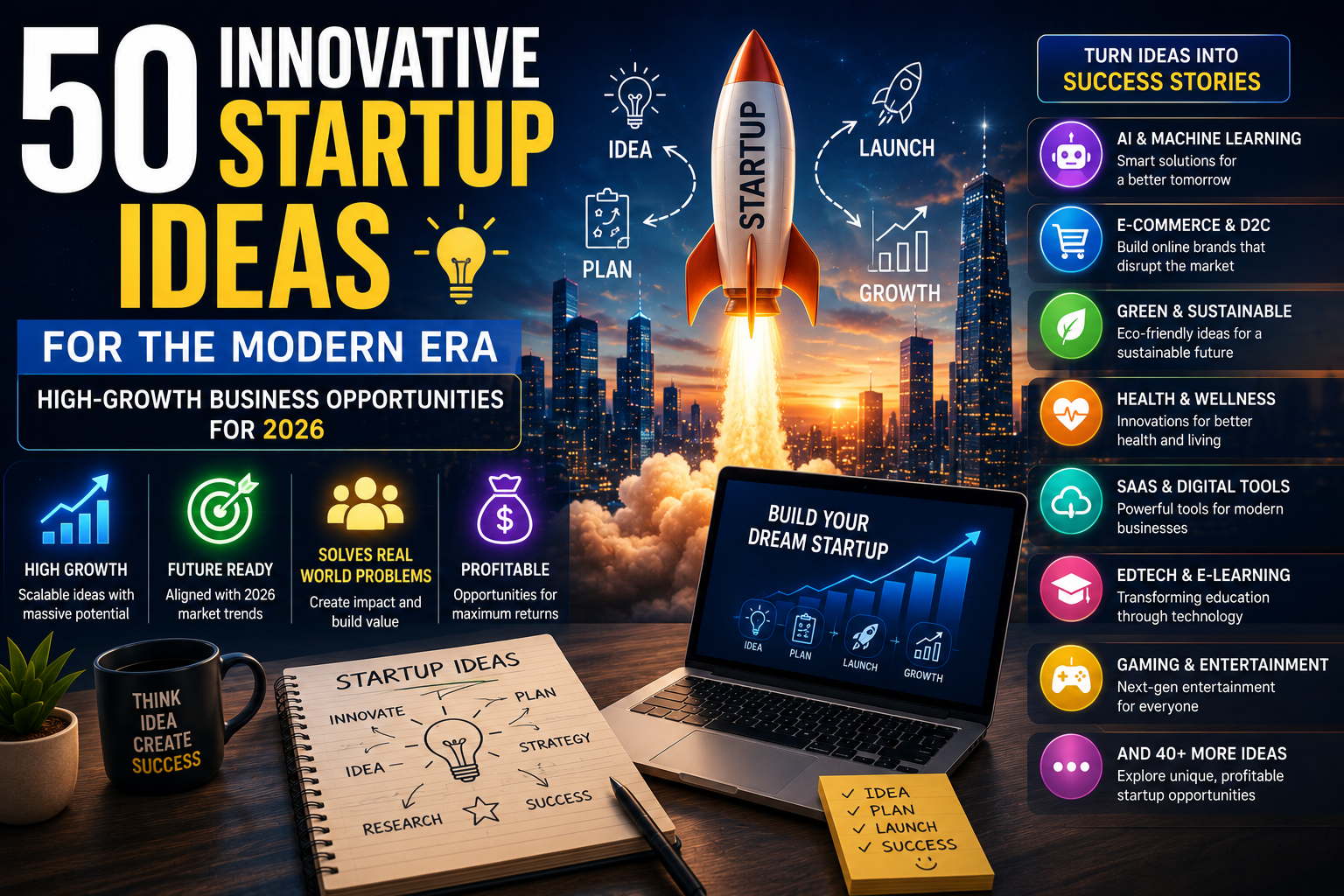
50 Innovative Startup Ideas for the Modern Era: High-Growth Business Opportunities for 2026

50 Innovative Startup Ideas for the Modern Era: High-Growth Business Opportunities for 2026

The entrepreneurial landscape is undergoing one of the most profound transitions in recent economic history. The initial wave of general-purpose artificial intelligence has matured[1], giving way to a pragmatic era defined by vertical integration, autonomous agent networks[2][3], physical AI[1][4], and a strict regulatory focus on sustainability and digital sovereignty[2]. Founders looking for high-growth startup ideas 2026 must move past superficial software layers. High-interest rates and disciplined capital markets mean that venture capitalists and bootstrappers alike are demanding clear paths to profitability, demonstrable unit economics, and defensible IP[5][6]. Whether you are an aspiring builder, an experienced operator, or an investor seeking the next wave of profitable business ideas, this comprehensive guide details 50 innovative business ideas across five high-growth sectors, accompanied by practical validation frameworks, funding strategies, and financial projections. Market Trends Shaping 2026 and Beyond To build a resilient enterprise, founders must align their startup opportunities with macro-technological and structural shifts. Key factors defining the market include: 1. The Rise of Agentic and Physical AI The era of simple prompt-and-response AI is behind us. Businesses are prioritizing agentic workflows—systems where multi-agent networks operate autonomously, make decisions, execute multi-step APIs, and self-correct[2][3][7]. Simultaneously, AI is moving into the physical realm[1][4]. The convergence of advanced computer vision, sensor technology, and low-cost robotics has made localized physical automation highly accessible to mid-market enterprises[1][4]. 2. Verticalization and the Disruption of Legacy SaaS Horizontal SaaS platforms that offer generic tools (such as general-purpose CRM or project management tools) are facing intense downward pricing pressure. High-growth future business ideas are centered on Vertical SaaS—deeply specialized software tailored to specific, highly regulated industries like maritime logistics, clinical trials, regional banking, and agricultural compliance. 3. Digital Sovereignty, Privacy, and Trust With the rise of sophisticated synthetic media, deepfakes, and stringent regional data laws, there is a massive market demand for trust infrastructure[2][3][8]. Technologies focused on digital provenance, confidential computing, and localized, sovereign data centers are transitioning from niche compliance needs to core enterprise requirements[2][3][8]. 4. Carbon Transparency and Circular Supply Chains Global environmental regulations now demand that corporations account not just for their direct emissions, but also for their Scope 3 emissions (indirect emissions from their upstream and downstream supply chains). This regulatory shift has transformed sustainability from a public relations asset into a hard compliance requirement, opening up vast B2B markets. Category 1: Artificial Intelligence & DeepTech Startups The market for specialized artificial intelligence has transitioned from foundation model development to the execution layer[1]. The following ten innovative startup ideas focus on high-impact, practical deployments of DeepTech. 1. Multi-Agent Coordination Platforms for Enterprise Workflows Concept: A platform that enables enterprise IT departments to orchestrate, monitor, and audit networks of autonomous AI agents working collaboratively to resolve multi-step business workflows[2][3]. Target Market: Operations and IT leaders in financial services, insurance, and supply chain logistics. Monetization Model: B2B SaaS model based on active agents, computational steps, or seat licenses. How to Get Started: Utilize open-source multi-agent frameworks (such as CrewAI or LangGraph) to construct a localized pilot for a specific back-office workflow, proving cost reduction to secure your initial enterprise client. 2. AI-Powered Scope 3 Carbon Accounting Software Concept: An automated data ingestion and analysis platform that plugs into enterprise ERPs and supply chain management systems to track and audit Scope 3 carbon emissions. Target Market: Multinational enterprises subject to global ESG reporting mandates. Monetization Model: Tiered annual enterprise software subscription. How to Get Started: Target mid-market manufacturing firms that need to supply emissions data to larger enterprise buyers. Build API integrations into common inventory databases to automate the estimation processes. 3. Physical AI Systems for Small-Scale Warehousing Robotics Concept: Softwares-as-a-Service that provides advanced computer vision and spatial mapping models to enable low-cost, off-the-shelf robotic arms to handle unstructured inventory[1][4]. Target Market: Boutique e-commerce fulfillment centers and regional distributors. Monetization Model: Hardware-enabled SaaS (Robotics-as-a-Service) with a monthly software licensing fee per active robot. How to Get Started: Partner with a local warehouse, purchase a standard robotic arm, and deploy custom computer vision models trained specifically on irregular retail packaging. 4. Domain-Specific Large Language Models for Regulatory Compliance Concept: Locally hostable, highly secure language models trained exclusively on specific legal and regulatory compliance databases (e.g., aviation safety, medical device approvals, maritime law)[3]. Target Market: Compliance officers, corporate legal counsels, and regulatory affairs specialists. Monetization Model: High-ACV (Annual Contract Value) enterprise software licenses with dedicated maintenance support. How to Get Started: Focus on a single highly complex regulation. Secure a partnerships with industry consultants to curate high-quality, verified training datasets for fine-tuning. 5. AI-Driven Personalized Medicine Formulation Systems Concept: A software suite that analyzes patient genomic, microbiome, and biometric data to generate personalized compound pharmaceutical recipes and supplement formulas. Target Market: Compounding pharmacies, longevity clinics, and private healthcare institutions. Monetization Model: Pay-per-formulation API model or monthly clinic licensing fees. How to Get Started: Develop a secure, HIPAA-compliant pipeline that aggregates peer-reviewed medical journals and genetic markers, starting with non-regulated longevity supplements to establish proof of concept. 6. Privacy-Preserving Synthetic Data Generators for FinTech Concept: An enterprise tool that ingests sensitive financial transaction histories and generates high-fidelity, completely anonymous synthetic datasets for machine learning model training. Target Market: Risk, fraud, and data science teams within retail banks and payment processors. Monetization Model: Enterprise software license based on the volume of data processed. How to Get Started: Build a prototype using Generative Adversarial Networks (GANs) on open financial datasets[9], demonstrating that models trained on your synthetic data perform comparably to those trained on real data. 7. Digital Provenance & Anti-Deepfake Verification APIs Concept: An API-first security platform that uses cryptographic watermarking and decentralized digital ledgers to verify the authenticity and source of video and audio media[3][8]. Target Market: Digital publishers, news organizations, political campaigns, and insurance claims processors. Monetization Model: Tiered API usage subscription based on the volume of media files verified. How to Get Started: Build a browser extension and developer SDK that checks files against established standards, focusing on verifying corporate executive video announcements. 8. Automated DevSecOps Vulnerability Patches via LLMs Concept: A continuous integration/continuous deployment (CI/CD) tool that not only scans codebases

Read More »
Scroll to Top