
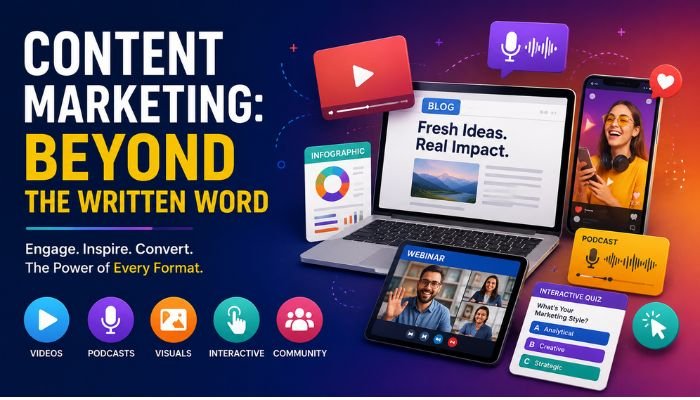
In the current digital age, standard business promotion is shifting at an incredible speed. Therefore, mastering Content Marketing: Beyond the Written Word has become a vital requirement for modern organizations. Indeed, long text documents like blogs and articles are no longer the only way to reach your audience [3]. Instead, modern companies use videos, podcasts, and infographics to capture consumer interest in 2026 [3].
Consequently, successful brands are building immersive multimedia experiences to communicate with their potential buyers. Because modern buyers prefer visual and auditory media, reliance on text alone can limit your brand’s growth [3]. For example, short vertical videos and audio stories are growing faster than traditional text documents. As a result, companies must expand their content creation methods to remain competitive and visible online [3].
Moreover, advanced artificial intelligence helps organizations manage these diverse media channels very easily. Specifically, modern software tools can automate transcription, video editing, and graphic design in seconds. Thus, this technological evolution helps small teams create highly advanced content experiences. In this detailed guide, we will explore how you can build a successful multimedia presence [3].
What Is Content Marketing?
To begin, we should define what content marketing actually represents in simple terms. Specifically, it is the practice of sharing helpful, relevant, and interesting media to attract and retain customers. Because you are sharing valuable resources, you do not need to use aggressive sales pitches. Therefore, this strategy focuses on building long-term trust rather than chasing quick, temporary transactions.
In 2026, companies use many different formats to keep their audience informed, engaged, and supported. First, they publish educational guides to answer common questions from potential buyers. Secondly, they distribute product videos to showcase how their tools solve specific real-world problems.
Furthermore, they use direct digital newsletters to build a secure community of loyal fans over time. Meanwhile, they use interactive calculators to help buyers calculate their potential cost savings. Thus, these diverse formats help organizations guide users through every step of their buying journey.
Why Content Marketing Matters in 2026
First of all, consumer behavior has shifted dramatically because of modern digital distractions. Therefore, capturing and holding customer attention has become a massive challenge for online brands [2, 3]. In fact, ignoring content marketing trends 2026 can cause your brand to lose its digital visibility. Indeed, modern users will quickly scroll past standard text ads that offer zero value.
Secondly, human attention spans are shorter than they have ever been. Consequently, modern buyers expect to receive helpful information in highly visual, easily digestible formats. Thus, implementing visual content marketing helps you deliver your core message in just a few seconds. For instance, a simple infographic can explain a complex industry report much faster than a ten-page PDF file.
Thirdly, the rise of conversational search engines is changing how people look for answers online. Specifically, smart systems are summarizing text content directly inside search results. Because of this, traditional website click-through rates are decreasing. Therefore, you must create unique multimedia content that smart engines cannot easily replace.

Finally, these innovations offer incredible opportunities for fast, organic business growth. Specifically, video and audio platforms allow you to connect with global audiences on an emotional level. Meanwhile, they help you build deep, lasting customer trust that drives consistent sales. Clearly, mastering these modern media formats is vital to building a highly resilient brand today. Expanding your media mix is essential as the top digital marketing trends for 2026 shift toward more immersive and visual-first experiences
The Evolution of Content Marketing
To understand where the industry is heading, let us analyze how content sharing has changed over time. The table below displays a detailed timeline of how media formats have evolved.
| Content Era | Main Format | Key Change |
| Print Content | Magazines & Brochures | Physical paper documents sent to large, untargeted geographic regions. |
| Blog Content | Websites & Articles | Basic online articles, search keyword targeting, and simple hyperlinks. |
| Social Media Content | Status Updates & Photos | Two-way visual discussions, community profiles, and quick photo updates. |
| Video Content | Youtube, Reels & TikTok | High visual engagement, vertical clips, and mobile-friendly storytelling. |
| Interactive Content | Quizzes & Calculators | Active user participation, personalized results, and real-time feedback. |
| AI-Powered Content | Smart Feeds & Personalization | Automatically customized media feeds based on individual user behaviors. |
Content Marketing: Beyond the Written Word
Currently, modern organizations are realizing that text alone is not enough to maintain a successful digital presence. In this section, we will explore why Content Marketing: Beyond the Written Word has become the absolute standard for online growth.
First, people learn and process information in many different ways. Specifically, some users are visual learners who prefer detailed graphs and video guides. Conversely, other users are auditory learners who enjoy listening to business podcasts during their daily commute. Therefore, using multiple formats ensures that your message reaches every type of buyer.
Secondly, relying on multiple media formats makes your brand highly resilient. For example, if search algorithms change, your video and podcast channels will continue to drive traffic. Consequently, you can maintain a steady flow of interested leads without depending on a single platform. Thus, a diverse multimedia strategy protects your business from sudden algorithm updates.
Finally, different platforms favor different media formats. Specifically, social media apps push video clips, while professional networks favor detailed PDF slideshows. Therefore, you must translate your core ideas into multiple formats to succeed on different channels. This process helps you maximize the overall reach and impact of your content.
Types of Modern Content Marketing
To help you design a balanced media strategy, let us look at the main options available today. The table below displays the key types of modern digital content marketing.
| Content Type | Purpose | Best Use Case |
| Blog Posts | Educate readers and rank for organic search terms. | Answering basic industry questions in detail. |
| Videos | Capture attention and demonstrate complex products visually. | Showcasing product tutorials and customer reviews. |
| Podcasts | Build deep brand authority and connect through audio. | Hosting interviews with respected industry experts. |
| Infographics | Explain complex statistics in a simple visual format. | Summarizing annual industry research reports. |
| Webinars | Gather warm business leads and offer live education. | Launching complex software or high-ticket services. |
| Interactive Tools | Invite active participation and collect customer data. | Helping buyers calculate their return on investment. |
| Social Media | Drive daily brand awareness and start conversations. | Sharing quick tips, memes, and daily updates. |
| User-Generated Content | Showcase real-world trust and social proof organically. | Reposting customer photos and video reviews. |
Rise of Video Content Marketing
First of all, video content marketing has become the single most dominant form of media online. Specifically, billions of users spend hours watching vertical clips on TikTok, Instagram Reels, and YouTube Shorts daily. Because video combines sight, sound, and motion, it is incredibly engaging.
Consequently, companies are investing a massive portion of their budgets into video production. For instance, teams use quick, three-second hooks to stop users from swiping past their updates. In addition, these videos must feel authentic, raw, and unedited to build real customer trust. Indeed, overly produced, corporate commercials do not perform well on social networks.
Furthermore, long-form video platforms like YouTube remain excellent for customer education. Specifically, you can publish detailed product tutorials, behind-the-scenes stories, and expert panel discussions. Because of this deep coverage, viewers stay on your channel for much longer. Thus, video is currently the absolute backbone of successful brand promotion. Visual assets like video and infographics are the primary drivers for mastering social media engagement strategies in a crowded digital landscape
Why Visual Content Drives More Engagement
To start, you must understand why visual content marketing works so incredibly well on a psychological level. Specifically, the human brain processes visual images much faster than written text. Therefore, a viewer can understand your message in a fraction of a second when you use a picture.
Additionally, visual graphics are highly effective at capturing short digital attention spans. Because social feeds are filled with distractions, simple text updates are easily ignored. However, a bold, high-contrast infographic can instantly stop a user from scrolling. Thus, visual elements help you stand out in crowded feeds.
Furthermore, visual storytelling helps you build a strong emotional connection with your audience. For example, showing a photo of your happy team builds immediate authenticity. Conversely, a plain-text corporate statement can feel cold, formal, and distant. Clearly, visual elements are essential to make your brand look approachable and friendly.
Interactive Content Marketing
First, passive consumption is losing its effectiveness as users demand more active online experiences. Therefore, interactive content marketing is experiencing massive growth in the industry. Specifically, these formats invite users to participate actively instead of just reading.
For example, companies use simple digital quizzes to guide users to the right products. In addition, interactive calculators, surveys, and assessments are highly popular on blog posts. Consequently, these tools keep users on your website for much longer, which improves your search rankings.
Furthermore, interactive content provides highly valuable customer data directly to your sales team. Specifically, you can see exactly how users answer quiz questions or calculate their costs. As a result, you can learn about their preferences and customize your future offers. Thus, interactive tools are excellent for both research and lead generation.
Podcast Marketing as a Content Strategy
First of all, podcasting has become an incredibly powerful tool for building professional authority. Because audio content is highly convenient, users can listen while driving, exercising, or cleaning. Therefore, you can capture your audience’s attention during times when they cannot look at a screen.
Consequently, hosting a weekly podcast helps you build a highly dedicated, intimate community. Specifically, hearing your voice regularly creates a deep sense of personal connection and trust. Thus, listeners are highly likely to purchase your recommended products or services over time.
Additionally, a podcast is an excellent tool for networking with other respected industry leaders. For instance, you can invite top experts to share their stories on your show. This process helps you share audiences with your guests, extending your organic brand reach significantly. Clearly, audio content is a highly valuable addition to any modern marketing plan.
User-Generated Content Marketing
To begin, consumer trust has become much harder to win through traditional business advertising. Therefore, companies are relying heavily on user-generated content (UGC) to build credibility. Specifically, this strategy involves sharing photos, videos, and reviews created by your actual customers.
Because real customer reviews carry immense social proof, they are highly convincing to potential buyers. For example, a video of a customer opening and using your product feels highly authentic. Consequently, sharing this content on your profile can boost your sales conversions significantly.
Furthermore, encouraging user-generated content helps you build a highly active, supportive community. Specifically, you can run contests that reward customers for sharing photos with your custom brand hashtag. As a result, you get a steady stream of free, high-quality media to use in your campaigns. Thus, UGC is a highly cost-effective growth tool. A comprehensive content strategy guide should always include a plan for repurposing written articles into podcasts and video series
AI and Content Marketing
First, managing multiple media channels manually can require a massive amount of time. Fortunately, modern artificial intelligence has made content creation strategies much faster and easier to run. Specifically, smart software can automate repetitive tasks across your video, audio, and text channels. According to the Content Marketing Institute , visual storytelling is now a top priority for B2B and B2C marketers looking to increase brand loyalty
For example, you can use smart tools to automatically generate written blog posts from video transcripts. In addition, algorithms can help you brainstorm content ideas, design graphics, and write social captions in seconds. Consequently, your team can maintain a highly consistent posting schedule with very little effort.
Furthermore, smart personalization tools can adjust your media feeds for individual website visitors. Specifically, the software can display custom videos and articles based on the user’s past browsing history. As a result, every visitor receives a highly tailored, helpful experience. Thus, AI dramatically improves your overall marketing performance. As search engines evolve, understanding the future of SEO in an AI world helps you optimize non-text assets for better discoverability.
Best Content Marketing Formats in 2026
To help you prioritize your resources, let us compare the most popular media formats. The table below details the engagement level and best platform for each format.
| Format | Engagement Level | Best Platform | Main Business Purpose |
| Short Videos | Extremely High | TikTok / Reels | Driving rapid, organic brand awareness to new audiences. |
| Long Videos | High | YouTube | Offering detailed tutorials and product demonstrations. |
| Podcasts | High | Spotify / Apple | Building deep authority and intimate audience trust. |
| Blogs | Medium | Your Website | Ranking for organic search terms and educating leads. |
| Infographics | High | Pinterest / LinkedIn | Explaining complex industry statistics visually. |
| Webinars | High | Zoom / HubSpot | Converting warm leads into paying premium customers. |
| Interactive Tools | Extremely High | Your Website | Collecting customer data and offering real-world help. |
| Email Content | High | Personal Inbox | Nurturing subscribers and driving repeat store sales. |
Real-World Content Marketing Examples
To understand how these strategies work in practice, let us look at seven detailed real-world scenarios.
1. Ecommerce Brand
An online cosmetic store encourages its customers to share video reviews of their skincare routines. Consequently, the store reposts these unedited videos on its official Instagram profile daily. As a result, customer trust reaches an all-time high, boosting sales by forty percent.
2. SaaS Company
A software startup builds a simple digital calculator on its official website. Specifically, the tool helps project managers calculate how many hours they waste on manual tasks. Consequently, the calculator goes viral on LinkedIn, driving thousands of trial signups.
3. Local Business
A local car repair shop films short, weekly TikTok videos explaining how to check car fluids. Because these videos offer simple, helpful advice, local car owners appreciate their honesty. Thus, the shop stays fully booked with local clients year-round.
4. Influencer
A travel influencer launches a weekly podcast sharing her personal mistakes and funny travel stories. Because she shares vulnerable, honest experiences, her audience connection grows immensely. Consequently, she easily sells out her premium group travel tours.
5. Marketing Agency
An advertising agency publishes a beautifully designed monthly infographic summarizing local retail sales trends. Because local business owners love sharing these clear visual statistics, the agency gets featured in local news. Thus, they secure five high-paying corporate clients. Incorporating video and interactive elements into your email marketing strategy 2026 can significantly boost click-through rates and user retention
6. Online Educator
A math tutor hosts a free weekly live stream on YouTube to solve complex test questions. During the stream, students can submit their questions directly in the chat for instant help. As a result, the tutor attracts hundreds of paying students to his premium courses.
7. Startup Company
A young healthy-snack startup partners with local fitness creators to design co-branded workout videos. Specifically, these creators show how they pack and eat the snacks during their training sessions. Therefore, the startup builds rapid, organic brand authority in the fitness market.
Content Marketing Workflow
To achieve consistent success, you must follow a structured plan. Below is a step-by-step workflow for modern multimedia content marketing.
[1. Research Audience]
           ↓
[2. Choose Content Format]
           ↓
[3. Create Content]
           ↓
[4. Optimize for SEO]
           ↓
[5. Distribute Content]
           ↓
[6. Promote Across Channels]
           ↓
[7. Measure Results]
           ↓
[8. Improve and Repurpose]
1. Research Audience
First, analyze your target customer preferences and pain points closely. Discover what social apps they use and what questions they ask online.
2. Choose Content Format
Secondly, select the media formats that match your business goals and resources. For example, choose between short videos, podcast episodes, or blog posts.
3. Create Content
Next, design high-quality visual graphics, record clear audio files, or write helpful articles. Ensure your media offers genuine, real-world value to your audience.
4. Optimize for SEO
Furthermore, add search metadata, keyword tags, and descriptive transcripts to your files. This helps search crawlers index your multimedia files with perfect accuracy.
5. Distribute Content
After that, publish your media on your official website and native hosting platforms. For instance, post videos on YouTube and audio files on Spotify.
6. Promote Across Channels
In addition, share short teasers and graphics across all your social media profiles. Consequently, you can drive your social followers to your main website.
7. Measure Results
Subsequently, monitor your key performance metrics like watch times, click rates, and sales. Identify what content formats generate the most customer engagement.
8. Improve and Repurpose
Finally, turn your successful media files into multiple new formats. For example, transform a popular podcast episode into a short video and a blog post.
Best Content Marketing Tools
To implement these strategies successfully, you must use the right software. The table below compares the best content marketing tools available this year.
| Tool | Best For | Main Features | Best Users |
| ChatGPT | Brainstorming content ideas | Writing scripts, captions, outlines, translations | Marketers of all levels |
| Canva | Designing visual graphics | Easy image templates, video clips, charts | Small business owners |
| Jasper AI | Writing draft blog articles | Copywriting templates, long-form content generation | Professional writers |
| Notion AI | Organizing content calendars | Task tracking, team notes, writing assistance | Project managers |
| Grammarly | Editing and polishing text | Grammar checks, tone adjustments, spelling fixes | Everyone |
| Semrush | Keyword and search research | Competitive tracking, search volume metrics | SEO professionals |
| Ahrefs | Site audits and link research | Backlink analysis, broken link alerts, audit tools | Technical SEO teams |
| HubSpot | Email automation and tracking | Contact lists, landing pages, email workflows | Medium to large companies |
Content Marketing ROI
Investing in multimedia content can deliver outstanding financial returns over time. The table below displays standard performance metrics for content marketing ROI in 2026.
| Content Type | Potential ROI | Key Benefit | Why It Matters |
| Short Videos | Extremely High | Drives rapid organic brand reach at zero ad cost. | Lowers your customer acquisition costs significantly. |
| Blog Posts | High | Ranks for search terms, driving steady traffic for years. | Delivers a consistent stream of passive business leads. |
| Podcasts | High | Builds deep, intimate trust with qualified buyers. | Increases customer lifetime value and product sales. |
| Interactive Tools | Extremely High | Collects valuable lead data while offering real help. | Improves your sales team close rates and conversions. |
| Webinars | High | Converts warm prospects into premium buyers in real-time. | Accelerates high-ticket service sales. |
| Infographics | Medium | Encourages social sharing and backlinks from other sites. | Improves your overall domain authority and SEO rankings. |
How Content Marketing Supports SEO
First, many business owners do not realize how closely content creation and search optimization work together. Specifically, search engines need high-quality, relevant media to show to users. Therefore, a strong multimedia strategy is essential to improve your overall search visibility.
First, publishing regular content helps you rank for a wider variety of search queries. For example, when you write about different subtopics, you capture different types of searchers. Consequently, your organic website traffic increases steadily over time.
Secondly, high-quality resources naturally attract valuable backlinks from other trusted websites. When other blogs link to your infographics or research studies, search engines notice. Thus, your overall website authority increases, boosting all your search rankings.
Finally, visual media improves user engagement metrics on your website. Specifically, when users watch a video or use a calculator on your page, they stay much longer. Consequently, this high dwell time signals to search engines that your website is highly valuable.
Content Distribution Strategies
First of all, creating high-quality media is only half the battle. Specifically, you must also distribute your content successfully to ensure people see your work. Therefore, you should use multiple distribution channels to reach your audience.
First, your official company website should act as the central hub for all your media. For example, host your blogs, embed your videos, and display your infographics on your site. This ensures you maintain complete ownership of your content.
Secondly, use social media platforms to share short teasers and highlights of your main pieces. For instance, post a thirty-second video clip on Instagram to promote your new podcast episode. Consequently, you can drive social traffic back to your website.
Finally, send direct email newsletters to your subscriber list regularly. Specifically, share links to your latest videos, tools, and guides directly to their personal inboxes. Thus, you can stay connected with your community without relying on social algorithms.
Common Content Marketing Mistakes
Even with the best intentions, many businesses make critical errors that limit their digital growth. The table below lists common mistakes and better approaches.
| Mistake | Better Approach | Why It Matters |
| Focusing only on text | Include short videos, simple infographics, and audio on your site. | Captures modern visual and auditory learning preferences. |
| Posting inconsistently | Use scheduling software and content calendars to stay steady. | Keeps your brand visible in search and social feeds. |
| Over-promoting products | Share helpful, educational content eighty percent of the time. | Prevents your audience from muting or unfollowing your brand. |
| Ignoring mobile layouts | Ensure all your videos and charts display perfectly on phone screens. | Mobile users represent over half of all digital traffic. |
| Not tracking performance | Review your watch times and click rates weekly to see what works. | Stops your team from wasting time on unpopular media formats. |
Future Content Marketing Trends
Looking further ahead, the future of content marketing will be shaped by highly advanced interactive technologies. Specifically, standard video and text will integrate with artificial reality to create immersive experiences.
First, augmented reality (AR) and virtual reality (VR) content will become highly popular. For example, customers will be able to place 3D virtual models of furniture inside their real living rooms. Consequently, this interactive visual marketing will make online shopping incredibly easy.
Secondly, hyper-personalized content experiences will run fully on smart systems. Specifically, websites will dynamically adjust their text, videos, and layouts for each individual visitor in real-time. Therefore, every user will receive a highly tailored, helpful journey.
Finally, voice and audio content will continue to grow rapidly. Specifically, we will see the rise of highly advanced, human-like voice assistants that can read and discuss articles with users. Clearly, these exciting digital innovations will redefine how we consume media online.
Statistics and Research About Content Marketing
To show the global impact of these multimedia shifts, let us examine some recent research findings from content marketing for businesses.
| Statistic | Why It Matters |
| 82% of all internet traffic is driven by online video | Creating video content is essential to attract modern audiences. |
| Interactive content gets 2 times more clicks than static text | Interactive tools are highly effective to boost your site engagement. |
| Podcasts reach over 500 million active listeners globally | Audio marketing is an excellent channel to build intimate brand trust. |
| 70% of companies invest in active multimedia content campaigns | Adopting a diverse media strategy is vital to stay competitive. |
| Infographics can boost website reading volumes by up to 80% | Clear visual graphics make your content much easier to understand. |
Expert Insight: Why Content Is Still King
According to leading digital consultants, high-quality, helpful content remains the absolute foundation of all online promotion. Indeed, while advertising channels and software tools change, human psychology remains exactly the same. People will always trust and support brands that offer real, honest value [2].
Furthermore, paid advertising is a temporary traffic source that stops the moment you stop paying. Conversely, a high-quality library of videos, podcasts, and articles is a permanent company asset. Specifically, these resources will continue to drive traffic, build trust, and close sales for years to come.
Therefore, the core goals of your marketing strategy should never change. You must focus on understanding your audience, answering their questions, and delivering extreme value across multiple media formats. Thus, by putting your customers first, you will secure lasting digital success.
How Businesses Can Build a Successful Content Strategy
If you want to protect your digital presence, you must plan your multimedia campaigns systematically. Below is a step-by-step preparation guide:
Define goals: First, decide exactly what you want to achieve, such as boosting website traffic or gathering sales leads.
Understand the audience: Secondly, research what social apps your target customers use and what questions they ask online.
Choose content formats: Furthermore, select the media formats that match your team’s budget, skills, and resources.
Create a content calendar: In addition, plan your topics, visual formats, and posting times two weeks in advance.
Publish consistently: Also, maintain a steady schedule across your channels to stay visible in algorithmic feeds.
Optimize for SEO: Specifically, add descriptive titles, transcripts, and schema code to help search engines index your files.
Measure performance: Subsequently, track your watch times, click rates, and sales conversions weekly to see what works.
Scale successful content: Finally, repurpose your popular pieces into multiple new formats to maximize your overall reach.
Pros and Cons of Modern Content Marketing
Before investing your budget, you should carefully analyze both sides of these strategies. The tables below show the key pros and cons of multimedia marketing.
Pros of Multimedia Content Marketing
| Pros | Why It Matters |
| Massive Organic Reach | Video and audio formats can reach millions of people globally for free. |
| Strong Customer Trust | Intimate media like podcasts and videos build deep personal relationships. |
| High Conversions | Interactive and helpful resources turn casual visitors into paying buyers. |
| Permanent Brand Assets | Your library of media continues to drive traffic and sales for years. |
Cons of Multimedia Content Marketing
| Cons | Why It Matters |
| High Creation Time | Recording clear audio and editing video clips takes hours of daily work. |
| Software & Gear Costs | Professional cameras, microphones, and editing tools require monthly budgets. |
| Slow Initial Progress | Building a loyal organic community takes months of consistent, steady effort. |
| Platform Compatibility | You must continuously adjust your files to match different social apps. |
Benefits of Multimedia Content Marketing
By updating your content strategies today, you can secure outstanding business advantages:
Lower customer acquisition costs: First, organic video reach reduces your reliance on expensive paid ads.
Higher customer lifetime value: Secondly, building a loyal audio community drives consistent repeat sales over time.
Improved search engine rankings: Furthermore, interactive visual media on your pages boosts your dwell times and SEO.
Complete digital independence: Also, building an email list through interactive quizzes protects your business.
Streamlined product education: Finally, clear product videos explain complex features much faster than written manuals.
How to Choose the Right Content Format
With so many media options available, choosing where to spend your energy can feel overwhelming. Therefore, you should consider the following factors.
First, analyze your target customer preferences closely. Specifically, discover if your audience prefers watching quick videos, listening to podcasts, or reading detailed reports. Choosing the format your audience already enjoys is the key to success.
Secondly, look at your available budget and team skills. For instance, if you do not have video editing skills, start with simple infographics and blog posts. As your business grows, you can hire professionals to launch your video and podcast channels.
Finally, consider the lifespan of the format. For example, social media updates are forgotten within hours, while YouTube videos can drive views for years. Therefore, you should balance short-term viral reach with long-term, passive assets.
Conclusion
In conclusion, Content Marketing: Beyond the Written Word is the ultimate key to building a highly successful, modern brand online. Indeed, the era of relying solely on written text is completely over. Today, organizations must use a diverse mix of videos, podcasts, infographics, and interactive tools to connect with their audience.
However, success today requires a balanced, long-term focus on quality and authenticity. Specifically, you must use smart technology to streamline your tasks while keeping your brand voice human, warm, and real. By putting your customers first, you can build a highly passionate community of loyal brand advocates.
Ultimately, the future of online business belongs to brands that deliver extreme value across multiple media formats. Therefore, take your first step today and expand your digital strategies to secure long-term online success.
Content Marketing: Beyond the Written Word FAQs
1. What is content marketing?
Specifically, it is the practice of sharing helpful, relevant, and interesting media to attract, educate, and convert customers without aggressive sales pitches.
2. Why is content marketing important?
Because it builds deep, lasting trust with your audience. It also lowers your customer acquisition costs and drives steady organic traffic to your website.
3. Is video content better than blog content?
Both are highly valuable. Video is excellent for quick social engagement, while blog posts remain essential to rank for detailed organic search terms.
4. What content format gets the most engagement?
Generally, short vertical videos on TikTok and Reels get the most views. In addition, interactive tools like quizzes and calculators get excellent clicks.
5. How does AI help content marketing?
Specifically, AI tools help brainstorm ideas, write captions, edit videos, transcribe audio, and automatically customize media feeds for individual users.
6. What is interactive content?
To explain, it is media that invites users to participate actively instead of just reading. Examples include digital quizzes, polls, calculators, and surveys.
7. How can small businesses use content marketing?
Small businesses can film quick, helpful video tips using their smartphones. They can also publish local infographics to build trust in their communities.
8. Does content marketing help SEO?
Yes, because publishing high-quality resources attracts valuable backlinks and keeps users on your website for much longer, boosting your search rankings.
9. What are the best content marketing tools?
Generally, tools like ChatGPT for writing scripts, Canva for graphic design, and HubSpot for email tracking are highly useful for modern teams.
10. What is the future of content marketing?
In the future, content marketing will integrate with augmented reality (AR) and virtual reality (VR) to deliver highly immersive, personalized experiences.

1 thought on “Content Marketing: Beyond the Written Word”
Pingback: Top 10 Essential Digital Marketing Strategies for Success in 2026