
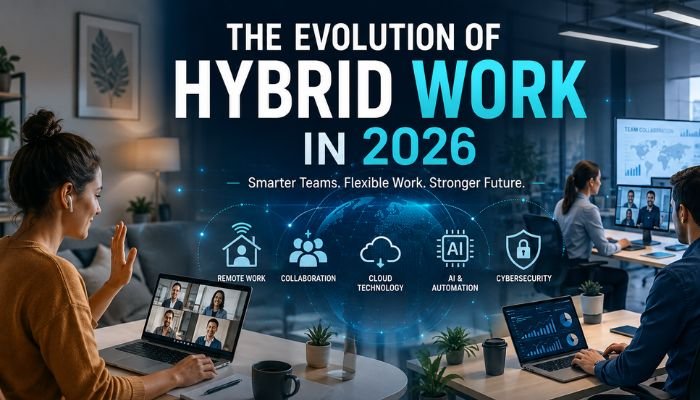
The way we work has changed forever. Gone are the days when everyone sat in an office from nine to five, Monday through Friday. In 2026, the modern workplace is flexible, dynamic, and increasingly digital. This shift is not a temporary trend; instead, it is a fundamental change in how businesses operate. At the center of this change is the evolution of hybrid work. This model has grown from a necessity during global disruptions into a preferred strategy for top companies. Understanding this evolution is vital for both business owners and employees. Therefore, this article will guide you through everything you need to know about hybrid work in 2026, exploring its history, current trends, technology, and future outlook.
What Is Hybrid Work?
Before diving into history and trends, let’s define exactly what we mean by hybrid work in 2026. Put simply, hybrid work is a flexible working model. It allows employees to split their time between working in a physical office and working remotely.
Remote work usually happens at home. However, it can also mean working from a coffee shop, a library, or a co-working space. It is the “middle ground” between fully remote companies (where no one ever goes to an office) and traditional companies (where everyone must be in the office every single day).
For example, a typical hybrid schedule in 2026 might involve an employee coming into the corporate office on Tuesdays and Thursdays for team meetings and collaborative brainstorming sessions. Then, they work from home on Monday, Wednesday, and Friday to focus on deep, individual tasks without distractions. This model aims to capture the best of both worlds: the social connection of the office and the focused flexibility of home.
Why Hybrid Work Is Growing in 2026
You might wonder why we didn’t just go back to the “old normal” of the pre-2020 era. In 2026, hybrid work is growing faster than ever for several key reasons that benefit both staff and companies.
First and foremost is employee flexibility. People have realized they can be highly productive without enduring long, stressful daily commutes. As a result, they demand better work-life balance to manage personal responsibilities like childcare or hobbies.
Secondly, businesses are seeing massive cost savings. By reducing the number of daily desks needed, companies can downsize to smaller, more efficient office spaces. This significantly cuts down on expensive real estate and utility costs.
Furthermore, hybrid work opens up global hiring opportunities. Companies are no longer limited to hiring talent living within a commuting radius of their headquarters. They can hire the best experts from anywhere in the world.
Finally, technology improvements have made this seamless. Fast internet and advanced collaboration tools make working from anywhere just as effective as being in the office. Consequently, this flexible work environment is here to stay.
Evolution of Hybrid Work
To understand where we are today, we must look back at the timeline. The evolution of hybrid work did not happen overnight; it was a journey through several distinct phases.
The Pre-Pandemic Era
Before 2020, traditional office culture was king. Remote work existed, but it was rare and often viewed with suspicion. It was seen as a special perk for a few trusted senior employees. Most managers believed people needed to be physically present and watched to be productive.
The Great Forced Experiment
The global pandemic forced almost the entire knowledge workforce to work remotely overnight. Suddenly, businesses had no choice but to adapt. This period proved that remote work was possible on a massive scale. However, it also highlighted significant challenges like loneliness, technology gaps, and communication breakdowns.
The “Return to Office” Struggles
As the world reopened, many companies tried to force employees back to the office full-time. This led to significant resistance, low morale, and high staff turnover. Companies realized the old way wouldn’t work and that they needed a compromise.
The Mature Hybrid Model
Now, in 2026, we have reached a mature stage. It is no longer about “forced” remote work. Instead, it is about intentional design. We now have AI-powered workplaces, smart digital collaboration tools, and management strategies designed specifically for complex hybrid schedules.
Timeline of Workplace Evolution
Here is a quick overview of how we got here:
| Era | Primary Work Model | Key Characteristic | Management Focus |
| Pre-2020 | Traditional Office | Remote work is rare and a special perk. | High visibility, hours in seats. |
| 2020–2022 | Forced Remote | Everyone works from home due to necessity. | Crisis management, basic connectivity. |
| 2023–2025 | Transitional Hybrid | Struggle to balance office vs. home days. | Finding a compromise, managing resistance. |
| 2026 & Beyond | Mature Intelligent Hybrid | AI-driven, intentional, and flexible models. | Output-based, employee experience. |
Top Hybrid Work Trends in 2026
The landscape continues to change rapidly. Here are the major hybrid work trends 2026 that are shaping how we operate right now.
AI Workplace Assistants: Artificial intelligence is now a standard coworker. AI tools handle scheduling across time zones, summarize missed meetings into bullet points, and draft basic responses. This allows human workers to focus on complex creative and strategic tasks.
Smart Immersive Meetings: Video calls are no longer just static grids of faces. Virtual reality (VR) and augmented reality (AR) technologies are making meetings feel more immersive, as if everyone is sitting around the same table, improving engagement.
The Rise of the “Hotel Office”: Physical offices look less like cubicle farms and more like collaborative social hubs. Employees “book” desks or meeting rooms for the specific days they come in via an app, rather than having a permanent, assigned spot.
Focus on Employee Wellness: Companies realize that burnout is a real risk in remote work due to blurred lines. Therefore, trends include “digital disconnect” policies, mental health days, and wellness programs integrated directly into the workflow.
Asynchronous Collaboration: There is less reliance on real-time, instant meetings. Instead, teams use advanced tools that allow them to contribute to projects via video, audio, or text at different times, accommodating global time zones without forcing late-night calls.
Benefits of Hybrid Work
The shift to remote and hybrid work models offers significant advantages. It is a win-win situation when implemented correctly, benefiting both the individuals doing the work and the organizations employing them.
Here is a comparison of how hybrid work benefits both sides of the employment relationship in 2026.
Hybrid Work Comparison: Employee vs. Employer Benefits
| Benefit Category | Employee Advantages | Employer Advantages |
| Financial & Time | Saves hours of commuting time and significant money on gas, transport, and lunches. | Reduces real estate costs, utility bills, office supplies, and maintenance expenses. |
| Flexibility & Talent | Better work-life balance, easier to manage personal responsibilities like childcare or elder care. | Access to a wider, limitless talent pool without geographic hiring restrictions. |
| Productivity & Output | Ability to do deep, focused work at home without constant office interruptions. | Often sees higher overall productivity and output, with less time wasted on commuting. |
| Well-being & Retention | Reduced stress from daily travel and more control over personal work environment. | Higher employee retention rates, increased job satisfaction, and stronger employer branding. |
Challenges of Hybrid Work
Despite the clear benefits, the evolution of hybrid work is not without its hurdles. In 2026, businesses still face significant challenges that require proactive management.
The biggest issue is often communication gaps. When half the team is on a video screen and the other half is in a physical conference room, remote workers can feel excluded from side conversations and crucial context. This is sometimes called “proximity bias,” where in-office workers are favored.
Furthermore, cybersecurity risks have increased enormously. With employees accessing sensitive company data from home networks, coffee shops, and personal devices, IT departments have a much harder job securing information.
Another major challenge is employee isolation. Without the daily social interaction of the “water cooler,” remote workers can feel lonely and disconnected from company culture, leading to lower morale.
Finally, productivity management can be tricky for traditional managers. They need to learn to trust their teams rather than watching over their shoulders. They must shift to focusing on output and results rather than just hours logged at a desk.
Hybrid Work Technology
The success of a hybrid workplace strategy depends almost entirely on the right technology stack. In 2026, the tech goes far beyond basic video calling. Digital workplace trends focus on creating a seamless, integrated experience regardless of physical location.
Advanced Communication Platforms: Tools like Microsoft Teams, Slack, and Zoom have evolved into full virtual headquarters. They integrate deeply with other apps to centralize communication.
Cloud Collaboration Suites: Google Workspace and Microsoft 365 allow real-time co-authoring of documents, spreadsheets, and presentations. This means version control issues are a thing of the past; everyone sees the latest update instantly.
Project Management Tools: Platforms like Asana, Jira, and Monday.com are essential. They provide clear visibility on who is doing what, by when. This is critical when teams aren’t sitting together to provide quick updates.
Virtual Whiteboards: Tools like Miro and Mural enable creative brainstorming sessions where remote and in-office participants can draw, add sticky notes, and ideate together instantly on an infinite canvas.
AI in Hybrid Workplaces
Artificial Intelligence is perhaps the biggest driver in the recent stage of the evolution of hybrid work. AI in hybrid workplaces is about augmenting human capability to make flexible work smoother.
In 2026, AI scheduling assistants automatically find meeting times that work for everyone across conflicting calendars and different time zones. This eliminates the frustrating back-and-forth of endless email chains.
Moreover, AI provides intelligent meeting summaries. If you miss a meeting because of a time difference or another conflict, AI gives you a concise summary of key decisions, action items, and owners. You don’t have to watch a whole hour-long recording.
AI also helps with remote productivity and well-being. Intelligent tools can analyze workflows to suggest better focus times for employees or nudge them to take breaks if they have been online for too long, helping to prevent burnout.
Best Industries for Hybrid Work
Not every industry can adapt easily to flexible models. Some jobs, like manufacturing or healthcare, simply require a physical presence. However, many knowledge-based sectors are thriving in the hybrid world of 2026.
Information Technology (IT): Given the digital nature of the work, IT was an early adopter and remains a leader. Developers, support staff, and engineers can easily work from anywhere.
Digital Marketing & Content Creation: Creative teams can brainstorm online and execute campaigns, write copy, and design graphics from anywhere with a good internet connection.
Professional Services & Consulting: Consultants can meet clients virtually, perform analysis, and deliver reports remotely, only traveling for critical client relationship-building.
Education & Training: Hybrid learning models for universities and corporate training are now standard, blending flexible online modules with intensive in-person workshops.
Customer Support: With advanced cloud-based contact center software, support agents can work effectively and securely from home.
Future of Hybrid Work (2026–2030)
Looking ahead, the future of hybrid work promises even more innovation between now and 2030 as technology continues to advance.
We expect to see the mainstream adoption of virtual reality (VR) offices. Instead of a 2D screen, you might put on a lightweight headset at home and “sit” next to your colleague’s avatar in a 3D virtual boardroom, interacting with objects together.
Additionally, the four-day work week will likely become more common. As AI boosts individual productivity, progressive companies will trade hours for results, offering more time off as a major benefit to attract top talent.
Offices will become even “smarter.” Sensors will track usage patterns in real-time to optimize heating, lighting, and desk allocation automatically based on who is actually coming in. The line between the physical office and the digital workspace will completely blur.
Tips for Successful Hybrid Work
Whether you are a manager leading a team or an employee navigating this new world, succeeding in a 2026 hybrid environment requires intentional effort. Here are some practical tips for both sides.
Practical Tips for Hybrid Success
| Target Audience | Key Tip 1: Communication & Clarity | Key Tip 2: Culture & Boundaries |
| For Managers & Companies | Establish Clear Guidelines: Define core hours for availability and clarify exactly which days or types of work are expected in the office to remove ambiguity. | Invest in Intentional Culture: Organize regular virtual social events and occasional all-hands in-person retreats to build bonds that digital tools can’t replace. |
| For Employees | Overcommunicate Digitally: When remote, don’t rely on assumptions. Be clear, concise, and frequent in your updates on projects and availability status. | Create Strict Boundaries: It is easy to work 24/7 when home is the office. Set a strict end time for your workday, turn off notifications, and “leave work” to avoid burnout. |
Hybrid Work Statistics
To understand the scale and impact of this shift, consider the general landscape of the workplace in 2026.
A significant majority of high-growth companies now offer some form of flexible or hybrid work option as a standard benefit to attract top talent. Surveys consistently show that a large percentage of knowledge workers prefer a hybrid model, valuing the mix of flexibility and connection over returning to the office full-time. Companies that have successfully adopted hybrid models report notable reductions in operational costs related to real estate footprints and utilities. Consequently, investment in digital collaboration tools and cybersecurity has tripled in the last five years as businesses upgrade their infrastructure to support this new way of working.
Conclusion
The workplace has undergone a massive transformation over the last decade. The evolution of hybrid work has moved from a niche concept for the few to the standard operating procedure for modern business in 2026.
It is a model that seeks to balance the human need for social connection and collaboration with the equally important desire for flexibility and autonomy. While challenges remain, particularly regarding maintaining culture and ensuring fair communication, the benefits for both people and profits are undeniable.
By embracing new AI-driven technology and focusing on intentional, human-centric strategies, businesses can thrive in this new environment. The future of work is not purely remote, and it is not purely in-office. The future is decidedly hybrid.
FAQs
Here are some common questions about the new hybrid world of work.
What is hybrid work?
Hybrid work is a flexible working model where employees split their working hours between a central corporate office and a remote location, such as their home or a co-working space.
Why is hybrid work important in 2026?
It is important because it meets modern employee demands for flexibility and work-life balance, significantly reduces company real estate costs, and opens up access to global talent pools. It is now a key competitive advantage for hiring.
What are the main benefits of hybrid work?
The main benefits include better work-life balance and reduced commute stress for employees, alongside increased productivity, access to wider talent, and lower overhead costs for employers.
How is AI changing hybrid workplaces?
AI is automating complex scheduling across time zones, summarizing missed meetings, improving asynchronous collaboration, and helping employees manage their focus and workflows more efficiently.
