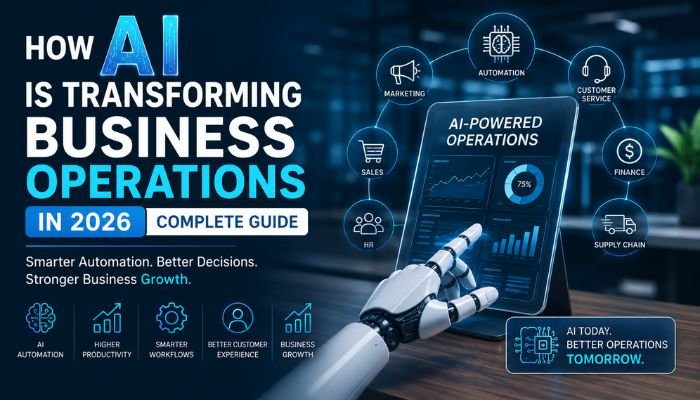
In the current global market, technology is evolving at an incredible speed. Therefore, understanding How AI Is Transforming Business Operations in 2026 has become absolutely vital for modern organizations. Indeed, smart machines are no longer just a futuristic prediction [2]. Instead, they are actively running essential workflows, optimizing daily schedules, and cutting operating costs for companies worldwide [1, 2].
Consequently, digital marketing, sales, and manufacturing departments are undergoing massive structural shifts [3]. Because of these shifts, organizations can now automate repetitive tasks with very little human effort. For example, software can handle customer data entries, manage inventory levels, and write weekly business reports instantly. As a result, team members have more free time to focus on creative strategy and human connections.
Moreover, these digital solutions are opening exciting growth opportunities for creative companies. Specifically, smart systems can analyze massive data sets to help managers make accurate decisions in seconds. In addition, they significantly improve the customer experience by offering personalized help around the clock. Thus, adopting these modern systems is the key to building a highly competitive, resilient organization.
What Is AI in Business Operations?
To begin, we should define what artificial intelligence in business actually means in simple terms. Specifically, it is the process of using smart software models to handle daily company tasks. Because these systems learn from historical data, they can perform tasks that previously required human thought. Therefore, this technology acts as a highly efficient assistant for your entire workforce.
In 2026, companies use ai powered business solutions to manage many different administrative processes. First, they use smart tools to organize customer databases and track sales pipelines automatically. Secondly, they use predictive algorithms to schedule machinery maintenance in busy manufacturing plants.
Furthermore, they rely on automated software to audit financial expenses and detect billing errors. Meanwhile, they use interactive platforms to guide new employees through their first week of training. Thus, these diverse tools help organizations run their daily operations with incredible speed and accuracy.
Why AI Matters More Than Ever in 2026
First of all, market competition has reached an all-time high across every industry. Therefore, companies must move quickly to capture consumer interest and retain their market share. In fact, ignoring ai business transformation can cause your brand to fall behind your competitors. Indeed, modern buyers will quickly choose businesses that offer faster, highly automated digital experiences.
Secondly, customer expectations are changing much faster than ever before. Specifically, modern users expect brands to understand their personal needs and answer questions instantly. Consequently, traditional, slow customer service methods can make your business look lazy and unhelpful. Thus, implementing modern automated tools helps you deliver immediate, personalized support at any hour.
Thirdly, the sheer volume of digital data that companies collect is truly massive. However, human managers cannot analyze millions of database rows quickly or accurately. Therefore, you must use smart algorithms to process this information and uncover hidden operational trends. As a result, your company can turn raw data into highly profitable business plans.
Finally, rising labor and resource costs are creating a massive demand for automation. Specifically, companies must optimize their resource spending to maintain healthy profit margins. Consequently, automated workflows have transitioned from optional tech tools to absolute business survival requirements. Clearly, adopting these modern systems is vital to secure your company’s long-term growth.
How AI Is Transforming Business Operations in 2026
Currently, How AI Is Transforming Business Operations in 2026 is the central focus of modern corporate planning. In this section, we will analyze the overall impact of smart systems on standard company workflows.
First, the integration of smart tools is breaking down traditional barriers between different departments. Specifically, data can now flow between marketing, sales, and customer service teams completely automatically. Consequently, this deep connectivity creates a unified source of truth for your entire workforce. Thus, your business operations run much faster and with significantly fewer communication errors.
Secondly, we are witnessing a massive transition toward fully autonomous digital workflows. Specifically, modern tools can handle complex multi-step processes without requiring human clicks at each step. For example, a system can automatically identify a low inventory item and order it from suppliers. Therefore, your daily logistics can run smoothly in the background while you focus on expansion.
Finally, smart technology is helping leaders make highly accurate, data-driven decisions. Specifically, predictive models can run simulations of major corporate choices to forecast potential results. This reduces the risk of making costly mistakes during product launches or market expansions. Thus, artificial intelligence serves as a highly reliable guide for your company’s future direction.
Key Areas Where AI Is Used in Business
To help you understand this transition better, let us examine where these systems are applied. The table below displays how different departments utilize ai in business operations.
| Business Function | AI Application | Business Benefit |
| Marketing | Predictive copy generation & audience division | Higher ad click rates and lower customer acquisition costs. |
| Sales | Automated lead grading & customer profiling | Shorter sales cycles and increased closed deal values. |
| Customer Service | Intelligent chat systems & instant translation | Lower customer wait times and improved satisfaction scores. |
| HR | Automated resume filtering & digital training | Faster candidate hiring times and better employee fit. |
| Finance | Fraud alerting & automated expense auditing | Reduced financial losses and highly accurate tax records. |
| Supply Chain | Automated logistics planning & stock alerts | Lower shipping fees and optimized inventory storage. |
| Operations | Smart process alerts & digital calendars | Fewer manual administrative errors and high team speed. |
| Analytics | Predictive behavior models & data summaries | Clear, highly actionable data insights for leadership teams. |
AI in Marketing Operations
First, modern digital marketing requires a very high level of personalization. Therefore, companies use ai tools for businesses to study how their potential buyers behave online. For example, these tools can track what articles a user reads on your official blog. As a result, the system can automatically deliver tailored product suggestions to that specific user.
Moreover, content creation has become much faster because of smart design and writing assistants. For instance, marketers can generate high-quality social captions and ad graphics in just a few seconds. However, human editing remains vital to keep your brand voice warm and authentic. Nevertheless, the initial creation phase is incredibly efficient now.
In addition, smart systems can optimize your advertising campaigns in real-time. Specifically, algorithms can adjust your ad budgets across different platforms to focus on the best ads. Consequently, your marketing team does not waste money on ineffective promotions. Thus, artificial intelligence dramatically improves your overall return on advertising spend.
AI in Sales Operations
In many traditional sales departments, representatives spend too much time on repetitive administrative tasks. Therefore, implementing ai workflow automation is a major benefit for growing sales teams. Indeed, smart tools can automatically log client calls, update CRM records, and write follow-up messages. Consequently, salespeople can spend their energy actually building human relationships.
Furthermore, smart lead grading systems help sales teams prioritize their daily client outreach. For instance, an algorithm can analyze a prospect’s website visits and email interaction history. Because of this analysis, the tool can calculate how likely they are to make a purchase. Thus, your sales reps can focus on calling the warmest prospects first, boosting your conversions.
Additionally, smart forecasting software helps corporate managers predict future sales revenue with incredible accuracy. Specifically, these tools analyze past sales trends and current market pipelines to forecast outcomes. As a result, leaders can make informed decisions about hiring, inventory orders, and business budgets. Consequently, your company can avoid unexpected financial shortfalls.
AI in Customer Service
Today, modern buyers expect immediate, helpful support whenever they encounter an issue with a product. Therefore, business automation with ai is highly critical inside customer service departments. Specifically, smart chatbots can resolve up to eighty percent of routine customer inquiries instantly. Consequently, your human support agents can focus on solving highly complex customer problems.
Moreover, these smart chat assistants can work in multiple different languages simultaneously. For example, a customer in France can get immediate support in French. Meanwhile, another customer in Japan can get help in Japanese from the exact same tool. Thus, your business can easily expand globally without needing to hire local support teams.
In addition, smart ticketing systems can analyze the emotional tone of customer messages in real-time. Specifically, if a customer is highly upset, the software can flag the ticket for priority attention. Consequently, the issue is routed to a human manager immediately to prevent customer loss. Therefore, smart systems help you maintain excellent customer satisfaction scores.
AI in Human Resources
To begin, finding the right talent for a growing company can take a massive amount of time. However, using ai integration in business has simplified the hiring process significantly. Specifically, smart screening tools can scan hundreds of job applications in just a few minutes. As a result, recruiters can identify the most qualified candidates very quickly.
Moreover, digital onboarding assistants can help new employees adjust to their roles easily. For instance, these systems can answer questions about corporate policies, insurance plans, and office rules. Therefore, HR managers do not have to repeat the same basic information to every new hire. Consequently, the onboarding process becomes much friendlier and faster.
Additionally, workforce analytics tools help corporate leaders track employee satisfaction and team engagement. For example, the software can analyze internal feedback surveys to find signs of employee burnout. Thus, managers can take action to support their team before people decide to quit. This improves employee retention rates and keeps your workplace highly positive.
AI in Finance and Accounting
First of all, manual accounting errors can be extremely costly for any business organization. Therefore, modern finance departments rely on ai business efficiency tools to manage their accounts. For example, smart software can match billing invoices with purchase orders completely automatically. As a result, the risk of human calculation errors is greatly reduced.
Furthermore, smart transaction monitoring systems can identify signs of financial fraud in real-time. Specifically, if a corporate credit card is used in an unusual location, the system flags it instantly. Consequently, the account is frozen immediately before major financial damage occurs. This protects your business assets and maintains high financial security.
Additionally, smart budgeting tools can analyze your historical corporate spending to suggest future budgets. Specifically, the software can point out redundant services or areas where your team is wasting money. Therefore, managers can cut unnecessary expenses and allocate resources much more wisely. This leads to healthier profit margins and higher overall savings.
AI in Supply Chain and Logistics
First, maintaining the right balance of product stock in warehouses is a highly delicate task. However, smart demand forecasting systems can predict stock needs with incredible accuracy. For example, they can analyze upcoming weather patterns, national holidays, and past sales trends. Consequently, companies know exactly when and how much inventory to order.
Moreover, route optimization software helps delivery companies save significant time and fuel costs. Specifically, these tools calculate the best travel paths for delivery trucks based on real-time traffic data. Therefore, drivers can complete more deliveries in less time, lowering your shipping fees. This keeps your logistics highly reliable and consistent.
Additionally, predictive maintenance sensors can monitor the physical health of warehouse machinery. For instance, a sensor can detect unusual heat levels in a conveyor belt motor. Thus, the system can automatically alert technicians to fix the issue before the machine breaks. This prevents costly operational delays and keeps your warehouse running smoothly.
AI-Powered Workflow Automation
First, manual administrative tasks can consume up to forty percent of an average employee’s workday. For example, workers often spend hours typing data from paper sheets into digital databases. However, implementing business process automation tools can eliminate these repetitive tasks completely. Therefore, your team can focus on creative growth tasks instead.
Furthermore, smart automation workflows can run in the background twenty-four hours a day. Because software does not need sleep, your business processes can continue running during weekends and holidays. For instance, a customer can submit an order at midnight and receive a tracking number instantly. Thus, your business stays active constantly, improving client satisfaction.
Additionally, these systems help ensure that your company policies are followed perfectly every single time. Specifically, automated workflows follow strict rules that prevent human shortcut attempts. For example, a purchase request must go through the correct approval path automatically. As a result, you maintain high corporate compliance and avoid operational mistakes.
Best AI Tools for Business Operations
To run highly successful campaigns and workflows, you must select the right software. The table below compares the best ai tools for businesses available in 2026.
| Tool | Best For | Main Features | Best Users |
| ChatGPT | Text drafting & coding | Advanced writing, custom bots, translation | Everyone |
| Microsoft Copilot | Office productivity | Excel data analysis, email summaries, Word drafts | Corporate office workers |
| Google Gemini | Web research & planning | Fast searches, document reading, visual mapping | Project managers |
| Salesforce Einstein | Customer CRM tracking | Smart lead grading, sales advice, client trends | Professional sales teams |
| HubSpot AI | Marketing workflows | Email generation, post scheduling, lead tracking | Digital marketers |
| Zapier | App connection automation | Simple drag-and-drop triggers, multi-app links | Operations teams |
| Make.com | Advanced data syncing | Visual data mapping, complex logic filters | Developers and experts |
| UiPath | Robotic process automation | Desktop task recording, invoice reading | Large enterprises |
| Notion AI | Knowledge organizing | Text summarization, outline generation, note sorting | Small creative teams |
| IBM Watson | Big data analysis | Deep machine learning, natural language analysis | Large corporate brands |
Real-World Examples of AI Business Transformation
To understand how these tools function in practice, let us analyze seven real-world scenarios of ai business transformation.
1. Small Business
A local bakery integrated a smart booking system on its official website. Specifically, the tool answers client questions and schedules cake consultations automatically. Consequently, consultation no-shows dropped by seventy percent, and sales increased significantly.
2. Ecommerce Company
An online clothing store connected an intelligent product recommendation tool to its checkout system. Because the tool displays matching shoes based on past buying habits, customers buy more items. Thus, the store’s average transaction value increased by twenty-five percent.
3. SaaS Company
A software company integrated a smart customer success system to monitor user accounts. Specifically, the tool flags users who stop logging into the app regularly. Consequently, the team can contact those users with special help, reducing customer loss rates.
4. Manufacturing Company
A car parts factory installed smart vibration sensors on its heavy pressing machines. Because of these sensors, the system can predict when a gear is wearing out. Thus, technicians can replace parts before a breakdown, saving thousands in repair fees.
5. Healthcare Organization
A family medical clinic integrated a smart voice assistant to handle patient phone calls. Specifically, the tool books appointments, answers basic questions, and updates medical records. As a result, clinic staff can spend more time helping in-person patients.
6. Marketing Agency
An advertising agency integrated smart tools to generate initial copy drafts for client social campaigns. Consequently, their copywriters only need to edit and polish the text rather than writing from scratch. Thus, the agency can handle twice as many clients.
7. Enterprise Business
A global logistics company integrated smart route optimization software across its shipping fleet. Specifically, the system automatically adjusts delivery paths in real-time based on traffic accidents. Therefore, the brand saved millions of dollars in fuel costs annually.
Benefits of AI in Business Operations
Adopting smart systems offers incredible operational advantages. The table below outlines the key benefits of ai driven business growth.
| Benefit | Why It Matters | Business Impact |
| High Productivity | Teams can complete their daily tasks much faster than before. | Lowers your overall operational costs. |
| Cost Reduction | Automation reduces the need for expensive manual processes. | Improves your company’s net profit margins. |
| Better Decisions | Real-time data analysis prevents guesswork during big planning. | Reduces the risk of launching bad products. |
| Improved Customer Experience | Clients receive immediate, helpful support at any hour. | Boosts customer loyalty and brand retention. |
| Faster Workflows | Software processes data instantly without manual delays. | Accelerates your overall sales and delivery speeds. |
| Revenue Growth | Personalized marketing and better sales leads drive high sales. | Boosts your overall annual company revenue. |
| Scalability | Automated systems can handle more work without needing more staff. | Allows your business to expand globally very easily. |
Challenges of AI Adoption
However, adopting new technology can introduce major difficulties if your team is not prepared. The table below lists common roadblocks and their solutions.
| Challenge | Solution | Why It Matters |
| Poor Data Quality | Clean and organize your databases before connecting smart tools. | Poor data can cause systems to make bad predictions. |
| Employee Resistance | Run hands-on workshops to show staff how tools help their jobs. | Staff buy-in is vital for successful implementation. |
| Security Concerns | Choose reputable software providers that offer strong data encryption. | You must protect sensitive client and company data. |
| High Setup Costs | Start with free or cheap tools and upgrade as you see results. | Prevents you from wasting budget on unnecessary systems. |
| Lack of Expertise | Partner with experienced tech consultants or hire external specialists. | Expert guidance ensures your systems are built correctly. |
| Integration Difficulties | Use modern integration platforms like Zapier to link old software. | Ensures data can flow between different apps smoothly. |
AI Integration Workflow for Businesses
If you want to adopt smart systems successfully, you must follow a structured plan. Below is a step-by-step workflow for business automation.
[1. Identify Business Goals]
            ↓
[2. Audit Current Processes]
            ↓
[3. Choose AI Tools]
            ↓
[4. Prepare Data]
            ↓
[5. Integrate Systems]
            ↓
[6. Train Employees]
            ↓
[7. Monitor Performance]
            ↓
[8. Optimize Continuously]
1. Identify Business Goals
First, define exactly what you want to achieve with automation. For instance, decide if you want to reduce customer support wait times or speed up billing.
2. Audit Current Processes
Secondly, analyze how your team currently handles daily tasks. Specifically, identify the most repetitive and time-consuming tasks to target for automation.
3. Choose AI Tools
Next, select software platforms that match your specific goals and budget. Ensure the tools can connect with your current database systems.
4. Prepare Data
Furthermore, clean and organize your company databases before connecting any tools. Remove duplicate customer entries and correct old records.
5. Integrate Systems
After that, connect your new tools with your existing software using APIs or platforms like Zapier. Make sure data flows between them without errors.
6. Train Employees
In addition, run hands-on training sessions to teach your staff how to use the new systems. Provide simple guidebooks they can reference.
7. Monitor Performance
Subsequently, track your key performance indicators to measure the success of your tools. For example, check if client response times have dropped.
8. Optimize Continuously
Finally, keep updating and improving your automated workflows over time. Stay informed about new software features to keep your business competitive.
AI Tools Comparison Table
To help you choose the right platform, let us compare some of the most popular business tools.
| Tool | Category | Ease of Use | Best For | Pricing |
| ChatGPT | Productivity | Very Easy | Creative writing & brainstorming | Free plan / $20 per month |
| Salesforce Einstein | CRM & Sales | Hard | Large sales team data tracking | Enterprise custom plans |
| HubSpot AI | Marketing | Medium | Email automation & lead scoring | Tiered monthly plans |
| Zapier | App Integration | Easy | Connecting daily office apps | Free plan / custom pricing |
| UiPath | Enterprise Tech | Very Hard | Large-scale desktop automation | Custom corporate pricing |
Free vs Paid AI Solutions
To begin, you do not need a massive budget to start using smart systems. Indeed, there are excellent options available for every budget level.
Free AI Tools
First, many software providers offer free versions of their platforms to individual users. For example, you can use basic search, writing, and graphic design tools for free. Consequently, these free versions are excellent for testing the technology and learning how it works.
Freemium AI Tools
Secondly, many platforms use a freemium pricing structure. Specifically, you get basic features for free, but you must pay for advanced limits. For instance, you might pay a small fee to remove the brand name from your website chatbot. This is highly suitable for growing small businesses.
Paid AI Software
Furthermore, paid options offer much higher usage limits and advanced features. Specifically, you can automate complex multi-step workflows and connect multiple apps. Consequently, these paid systems are highly suitable for established medium-sized companies.
Enterprise AI Platforms
Finally, large corporations use custom enterprise ai solutions to manage massive amounts of data. Because these systems are tailored to the company’s exact needs, they require custom development. Consequently, they are expensive but offer maximum security, reliability, and custom features.
AI Statistics and Market Research
To illustrate the global impact of these technologies, let us look at some recent findings from 2026.
| Statistic | Why It Matters | Business Impact |
| 85% of businesses use some form of smart automation | This shows that smart systems have become a standard corporate requirement. | You must adopt these tools to keep up with your competitors. |
| Automation can boost team productivity by up to 40% | Teams can accomplish much more work in less time with less effort. | Lowers your customer acquisition and operating costs. |
| 75% of buyers prefer brands that offer instant smart chat help | Quick support is a key driver of customer loyalty and satisfaction. | Improves your customer retention and repeat sales. |
| 65% of workers say automated tools reduce their daily work stress | Automation handles boring, repetitive tasks, leaving room for creativity. | Improves overall team morale and employee retention. |
| Clean databases improve automation accuracy by up to 30% | Organizing your data is vital to get the best results from your systems. | Prevents costly software calculation mistakes. |
Future of AI in Business Operations
Looking ahead, the future of ai in business is incredibly promising. Specifically, we are moving away from simple automated tasks and toward fully autonomous systems.
First, smart software agents will become much more common. Unlike basic chatbots, these agents can make independent decisions. For example, they can handle a customer return from start to finish, including checking the order and issuing refunds.
Secondly, autonomous workflows will run entire departments with very little human oversight. For instance, a system can automatically monitor market trends, write social posts, and launch ad campaigns. Thus, your marketing department can run smoothly in the background.
Thirdly, predictive decision-making software will help leaders run corporate simulations. Specifically, you can test a product price change in a digital model before launching it. Consequently, this will significantly reduce the risk of making expensive marketing mistakes.
Additionally, voice assistants will become highly human-like and conversational. Specifically, they will handle complex phone discussions with clients seamlessly. Thus, call center wait times will disappear completely, keeping your customers happy.
Furthermore, generative platforms will design products, write code, and create videos in seconds. Consequently, the speed of business innovation will increase dramatically.
Moreover, multimodal tools will process text, images, and audio files simultaneously. For instance, a support system can look at a photo of a broken item to suggest a fix.
Also, hyper-automation will sync your databases across all digital platforms. Specifically, your systems will update your client files, inventory, and accounts in real-time.
Finally, decision intelligence systems will help CEOs plan corporate merges and expansions. Consequently, leadership teams will rely on solid data rather than simple intuition.
Expert Insight: Why AI Will Define Future Businesses
According to leading digital consultants, technology is rewriting the foundational rules of corporate success. Indeed, companies that adopt smart tools are growing much faster than slow competitors. Because smart systems allow you to scale your operations without a massive increase in costs, the financial benefits are clear.
Furthermore, these tools help organizations build a highly agile, resilient structure. For example, during market disruptions, smart systems can spot changing trends immediately. Consequently, leaders can adjust their strategies in days rather than months.
Ultimately, this technology is not about replacing human creativity. Instead, it is about giving your team the tools they need to succeed. By handling boring, repetitive tasks, software allows humans to focus on innovation, connection, and growth.
How to Start Using AI in Your Business
If you want to implement smart systems successfully, follow this step-by-step guide:
First, define your specific business goals clearly. For instance, decide if you want to reduce customer wait times or speed up invoice processing. Having a clear goal helps you choose the right tools.
Secondly, identify the most repetitive and time-consuming tasks in your daily workflows. These are the best candidates for automation. For example, target data entry or email scheduling.
Thirdly, select AI software platforms that match your specific goals and budget. Start with simple, user-friendly tools that do not require complex coding.
Furthermore, start small before scaling up. Specifically, automate one single task, such as your welcome email sequence, and test it for a few weeks. Consequently, you can learn how the software works without risking your entire operation.
Additionally, run hands-on training sessions to teach your team how to use the new tools. Ensure they feel confident and supported during the transition.
Moreover, measure your results regularly. Specifically, track your key performance indicators to see if the tools are saving time or reducing errors.
Subsequently, scale your implementation gradually to other departments. For example, move from marketing automation to sales tracking.
Finally, continuously update and improve your automated workflows. Stay informed about new software features to keep your business running at peak efficiency.
Common Mistakes Businesses Make with AI
To ensure your integration goes smoothly, you must avoid these common errors.
| Mistake | Better Approach | Why It Matters |
| Rushing the setup process | Take your time to plan and test the systems. | Prevents technical bugs from hurting your daily operations. |
| Using low-quality data | Clean and organize your databases first. | Clean data ensures your software makes accurate predictions. |
| Forgetting to train staff | Run detailed workshops and provide clear guides. | Ensures your team actually uses the tools correctly. |
| Automating everything at once | Start with one small task and expand gradually. | Prevents your team from feeling overwhelmed. |
| Ignoring data security | Choose software providers that offer strong security. | Protects your sensitive corporate and client records. |
How to Choose the Right AI Solution
With so many software options available, choosing the right tool can feel overwhelming. Therefore, you should consider the following factors:
First, check the features of the software carefully. Specifically, ensure the tool can solve your most urgent business problem. For example, if you need support help, look for advanced chat features.
Secondly, prioritize ease of use. Because if a system is too complicated, your team will avoid using it. Therefore, choose platforms with simple, drag-and-drop interfaces.
Thirdly, check the scalability of the tool. Ensure the platform can handle more data and users as your company grows. This prevents you from needing to switch software later.
Furthermore, check the integration options. Specifically, make sure the tool can connect with your current databases and office software.
Additionally, prioritize data security. Choose reputable software providers that follow strict privacy regulations.
Moreover, test the provider’s customer support. Specifically, send a question to their help desk to see how quickly and helpful they reply.
Finally, check the pricing structure carefully. Ensure there are no hidden fees for extra users or data storage.
Pros and Cons of AI in Business Operations
Before investing your budget, you should carefully analyze both sides of this technology.
Pros of AI in Business Operations
| Pros | Why It Matters |
| Constant Availability | Software can process tasks and reply to clients 24/7. |
| Massive Time Savings | Automation handles repetitive tasks, freeing up your team. |
| Improved Calculation Accuracy | Smart systems make fewer math and data entry mistakes. |
| Highly Targeted Marketing | Personalization tools deliver ads to the warmest prospects. |
Cons of AI in Business Operations
| Cons | Why It Matters |
| High Initial Setup Costs | Custom enterprise platforms can be expensive to build. |
| Technical Complexity | Connecting old database systems can require skilled coders. |
| Staff Training Required | Employees must spend valuable time learning how to use tools. |
| Risk of Bad Predictions | If your data is unorganized, the software can make mistakes. |
Benefits of AI-Powered Business Operations
By updating your company’s workflows with smart technology, you can secure outstanding long-term advantages:
Lower operating costs: First, automation reduces the need for expensive manual processes, saving your budget.
Higher sales conversions: Secondly, personalized marketing and smart lead grading turn prospects into active buyers.
Faster delivery speeds: Furthermore, automated logistics and route optimization ensure your products arrive quickly.
Outstanding customer loyalty: Also, providing immediate, helpful chat support around the clock keeps clients happy.
Secure data control: Finally, utilizing first-party data capture tools protects your business from browser changes.
Conclusion
In conclusion, How AI Is Transforming Business Operations in 2026 is the key to building a highly efficient and modern organization. Indeed, the benefits of this technology are truly undeniable. From saving valuable time to improving customer experiences, smart tools are redefining how we work.
However, success requires a careful and structured approach. Specifically, you must define clear goals, clean your data, and support your team during the transition. By taking these steps, you can avoid common pitfalls and achieve outstanding results.
Ultimately, the future belongs to companies that learn to work alongside smart systems. Consequently, the sooner you start your integration journey, the better positioned you will be. Therefore, take your first step today and watch your business thrive.
How AI Is Transforming Business Operations in 2026 FAQs
1. What is AI in business operations?
Specifically, it is the process of integrating smart software models into your daily workflows to automate tasks and improve decision-making.
2. How does AI improve team productivity?
First, it automates high-volume, repetitive tasks like data entry and invoice auditing. Consequently, employees can focus on strategic, high-value tasks.
3. Which industries benefit most from AI?
Generally, every sector benefits, but ecommerce, SaaS, healthcare, finance, logistics, and digital marketing are seeing the most massive transformations.
4. What are the best AI tools for businesses?
Generally, tools like ChatGPT for brainstorming, Microsoft Copilot for office tasks, HubSpot for marketing, and Zapier for app connections are highly recommended.
5. Is AI expensive to implement?
No, because many software providers offer free or cheap plans for small teams. However, custom enterprise platforms can be expensive to develop.
6. Can small businesses use AI?
Yes, absolutely. Small businesses can use simple, affordable tools to automate customer booking, schedule emails, and write social captions easily.
7. What are the risks of AI adoption?
The main risks include poor data quality leading to mistakes, technical integration difficulties, and security risks if you choose unreliable software.
8. How does AI improve customer service?
Specifically, smart chatbots can resolve up to eighty percent of routine customer inquiries instantly, reducing wait times and boosting customer satisfaction.
9. What is business process automation?
To explain, it is the practice of using software to run multi-step workflows automatically without needing manual human intervention.
10. What is the future of AI in business?
In the future, we will see highly autonomous systems run entire workflows. Additionally, predictive decision-making software and voice assistants will dominate.