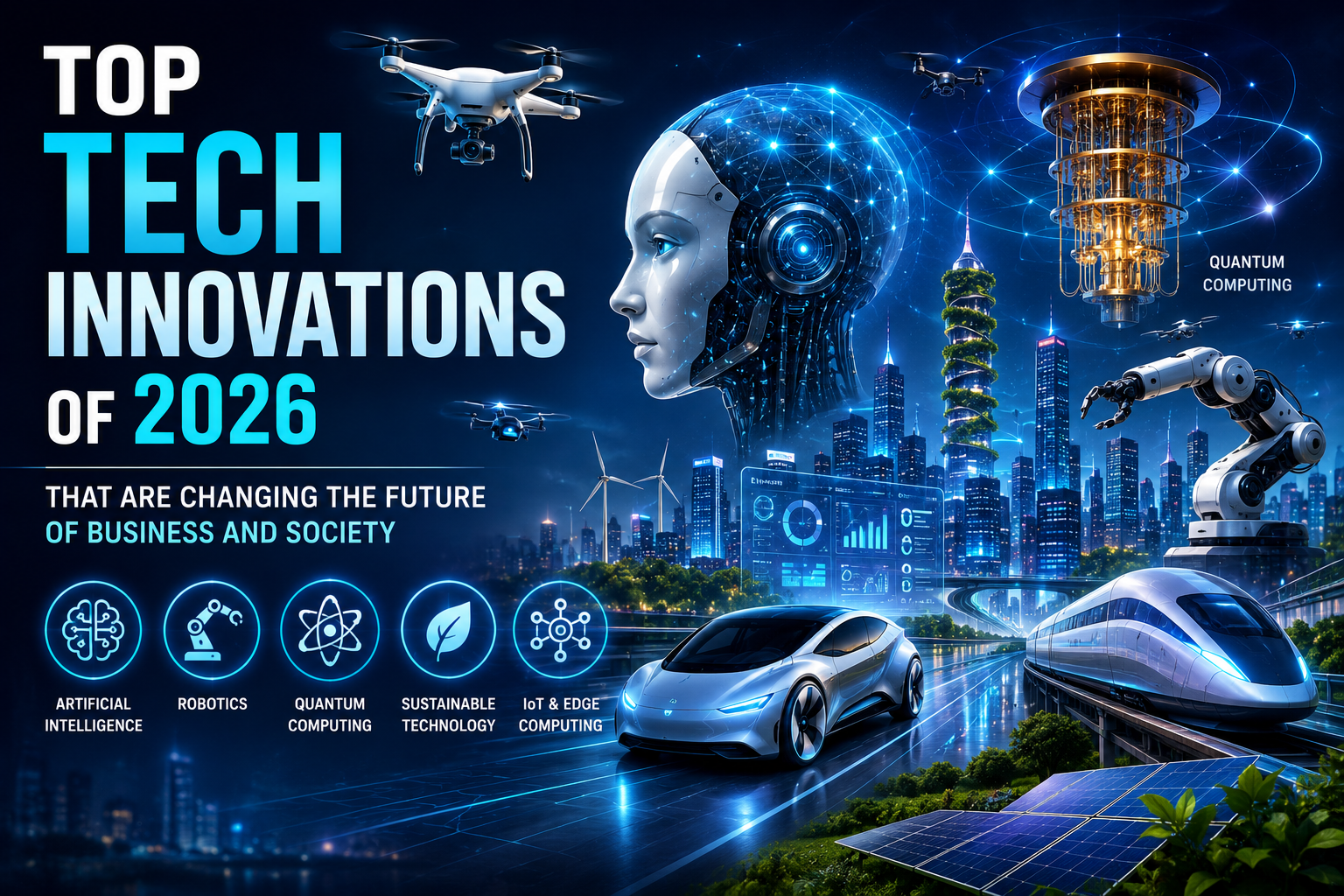
The relationship between business, technology, and society has reached a unique point of convergence in 2026. Digital infrastructure is transitioning from static, human-operated systems into active, autonomous ecosystems. Emerging innovations are no longer confined to localized lab experiments or experimental software tools; they have integrated directly into core global supply chains, financial markets, and daily administrative workflows. Driven by a combination of high-throughput computing, specialized hardware, and urgent environmental demands, the top tech innovations of 2026 represent a major shift in systemic design. Over 84% of international enterprises have moved past basic generative AI tools to establish active agentic workflows, while physical robotics and edge networks are bridging the gap between digital processing and real-world environments.
For organizational leaders, investors, and policymakers, understanding these changes is essential. Navigating this landscape requires a deep look into the mechanics of these systems to assess their viability, performance limits, and societal impacts. This comprehensive guide provides an objective, analytical breakdown of the future technology trends and innovations shaping our world in 2026.
Table of Contents
The Shift to Agentic Systems: The Evolution of AI Innovations
Embodied AI and Intelligent Robotics: The Rise of Polyfunctional Humanoids
Biotech and Synthetic Biology: Engineering the Human Experience
Step-by-Step Business Playbook for Integrating Next-Generation Technologies
The Broader Societal and Ethical Implications of Technology Trends
The Shift to Agentic Systems: The Evolution of AI Innovations
The AI landscape of 2026 has transitioned from passive, chat-based interfaces toward active, multi-agent frameworks that execute complex, multi-step workflows with minimal human oversight[1][2].
┌────────────────────────────────────────────────────────┐
│             The Progression of AI Systems              │
├───────────────────┬──────────────────┬─────────────────┤
│    2023–2024      │       2025       │     2026+       │
│  "Co-pilots"      │ "Agentic Tools"  │ "Multi-Agents"  │
│ • Text generation │ • Basic APIs     │ • Self-governed │
│ • Static prompts  │ • Email automation│ • Dynamic loops │
│ • Manual feedback │ • Task triggers  │ • Tool creation │
└───────────────────┴──────────────────┴─────────────────┘
From Interactive Prompts to Autonomous Action Loops
Early AI tools operated strictly on a prompt-and-response basis, relying on human operators to manually copy and paste outputs between different software platforms. Today, modern agentic systems run on continuous execution loops:
Objective Formulation: The user defines a high-level goal (e.g., “Audit our regional supply chain for carbon inefficiencies and recommend alternative logistics providers”).
Autonomous Planning: The agent breaks the goal down into sequential tasks, writing custom code, queries, and API scripts to gather the necessary data.
Dynamic Execution: The system queries internal ERP databases, parses vendor PDF contracts, and retrieves global carbon index data.
Self-Correction: If an API call fails or a data format is incorrect, the agent analyzes the error, updates its code, and runs the query again without requiring human intervention.
Multi-Agent Orchestration and Collaborative Problem Solving
Instead of relying on a single, monolithic model to handle all operations, modern AI architectures use networks of specialized, cooperative agents[3].
The Orchestrator Agent: Manages the overarching workflow, translating complex user goals into tasks, allocating resources, and resolving conflicts between systems.
The Analyst Agent: Focuses on data retrieval, parsing raw files, and performing statistical analysis.
The Compliance Agent: Constantly audits the actions and outputs of other agents to ensure they align with strict corporate governance policies and privacy standards.
The Emergence of Solo, Automated Enterprises
This shift in AI capabilities has changed the economics of early-stage startups[1]. A single founder can now run and scale a profitable micro-business by managing a team of automated digital employees. These agentic networks can handle user acquisition, customer support, software engineering, and content generation autonomously, allowing small teams to compete directly with traditional, mid-sized organizations[1].
Embodied AI and Intelligent Robotics: The Rise of Polyfunctional Humanoids
In 2026, robotics has moved beyond rigid, pre-programmed industrial arms to embrace adaptable, polyfunctional humanoid systems powered by advanced “physical AI” models[3][4][5].
┌─────────────────────────────────────────────────────────┐
│                    Physical AI Stack                    │
├─────────────────────────────────────────────────────────┤
│ • Task Instruction ("Stack those boxes onto Palette B") │
│ • Multi-Modal Foundation Model (Vision-Language-Action) │
│ • Dynamic Pathfinding & Spatial Mapping (LiDAR, Cameras) │
│ • Real-Time Joint Torque Adjustment (Force Feedback)    │
└─────────────────────────────────────────────────────────┘
The Transition to Polyfunctional Humanoid Robotics
Traditional factory robots were designed for highly repetitive tasks within sterile, predictable environments. Introducing an unmapped obstacle or changing a box’s orientation would cause the entire system to stop. Modern humanoids use Vision-Language-Action (VLA) models to operate safely and effectively in unstructured, dynamic environments:
Generalist Hand-Eye Coordination: Advanced robots can identify, sort, and handle highly varied objects—from heavy metal parts to delicate glass bottles—without requiring custom programming for each item.
Spatial Mapping: Using a combination of onboard LiDAR, stereoscopic cameras, and tactile sensor arrays, humanoids construct real-time 3D maps of their surroundings, allowing them to navigate busy warehouse floors and crowded workspaces safely.
Force Feedback Control: Sensors in the robot’s joints measure resistance thousands of times per second, allowing the system to adjust its grip strength dynamically to avoid damaging delicate items.
Key Humanoid Platforms of 2026
Figure 03: A highly advanced general-purpose humanoid designed to handle complex logistics, assembly, and maintenance tasks alongside human workers.
Tesla Optimus Gen 3: Engineered for mass manufacturing, this platform is widely used to optimize repetitive materials-handling workflows within large automotive factories.
Boston Dynamics Atlas (Electric): Known for its exceptional agility and precise torque control, this fully electric system handles heavy lifting and complex movement patterns in demanding industrial environments.
Realizing Quantum Advantage: Computing Beyond Silicon
As traditional silicon microchips approach their physical scaling limits, quantum computing has transitioned from theoretical physics into early commercial validation in 2026[6][7].
┌────────────────────────┐
                          │   Classical Computer   │
                          │   • Relies on bits     │
                          │   • Explores paths     │
                          │     one by one         │
                          └───────────┬────────────┘
                                      │
                                      ▼
                          ┌────────────────────────┐
                          │    Quantum Computer    │
                          │   • Relies on qubits   │
                          │   • Evaluates paths    │
                          │     simultaneously     │
                          └────────────────────────┘
Reaching Practical Quantum Advantage
Instead of replacing classical computers entirely, quantum systems act as specialized accelerators designed to solve highly complex mathematical problems that are impossible for standard silicon chips[7].
Superposition and Entanglement: Quantum bits (qubits) can exist in multiple states simultaneously, allowing quantum systems to evaluate billions of possible solutions to a problem at the same time.
Logical Qubit Scaling: By combining thousands of physical qubits to create highly stable, error-corrected “logical qubits,” developers have significantly reduced system noise, allowing quantum computers to run calculations reliably for much longer periods.
Real-World Quantum Applications in 2026
Molecular Simulation and Drug Discovery: Quantum systems can simulate the behavior of complex molecules at the atomic level, helping pharmaceutical researchers discover promising new drug candidates and vaccine formulations in days rather than years[7].
Advanced Logistics Optimization: Quantum algorithms can optimize complex, global supply chains, analyzing weather patterns, port congestion, fuel consumption, and delivery schedules simultaneously to find the most efficient routes[7].
Financial Portfolio Analysis: Investment firms use quantum computing to evaluate complex risk profiles and optimize global asset allocation in real time, particularly during periods of high market volatility.
Ambient Intelligence and Edge AI: Processing at the Source
To reduce latency, lower bandwidth costs, and protect data privacy, modern technology stacks are moving processing tasks away from centralized cloud servers and onto local edge devices[1][8].
┌─────────────────────────────────────────────────────────┐
│                    Edge AI Architecture                 │
└────────────────────────────┬────────────────────────────┘
                             │
            ┌────────────────┴────────────────┐
            ▼                                 ▼
┌────────────────────────┐        ┌───────────────────────┐
│  Central Cloud Server  │        │   Local Edge Device   │
│  • High latency        │        │   • Zero latency      │
│  • High bandwidth cost │        │   • Offline capability│
│  • Security risks      │        │   • High privacy      │
└────────────────────────┘        └───────────────────────┘
The Rise of Edge AI and Local Inference
Early AI implementations relied on sending every user input back to central cloud servers for processing, which introduced latency and created privacy concerns. In 2026, specialized hardware—including Neural Processing Units (NPUs) integrated directly into smartphones, laptops, and IoT devices—enables high-speed AI inference locally on the device[1][8]:
Zero-Latency Interactions: Local processing allows devices to run complex voice recognition, computer vision, and real-time translation models with near-instantaneous response times, even without an active internet connection[1][8].
Improved User Privacy: Sensitive biometric data, local coordinates, and personal documents never leave the device, helping organizations comply with strict data privacy laws like GDPR and CCPA[1].
Reduced Bandwidth and Server Costs: By running inference tasks locally, companies can significantly reduce their cloud infrastructure spending and network bandwidth demands[1].
Ambient Intelligence: Technology That Fades into the Background
Ambient intelligence combines Edge AI with smart sensor networks to create environments that adapt to human needs without requiring manual input or active voice commands[5]:
Responsive Workspaces: Smart office buildings monitor occupancy, air quality, natural light, and temperature in real time, automatically adjusting environmental controls to optimize comfort and energy efficiency.
Predictive Maintenance: Industrial IoT sensors monitor the acoustic signatures and vibration patterns of factory machinery, automatically alerting maintenance teams to potential issues before a breakdown occurs.
Biotech and Synthetic Biology: Engineering the Human Experience
The intersection of artificial intelligence and biology has unlocked unprecedented capabilities in genetic editing, synthetic manufacturing, and human-computer interaction[4].
┌─────────────────────────────────────────────────────────┐
│                  Synthetic Biology Stack                │
├─────────────────────────────────────────────────────────┤
│ • Neural Interfacing (Direct BCI motor control)         │
│ • Computational Protein Folding (Custom enzymes)        │
│ • Precise Gene Editing (Therapeutic CRISPR repair)      │
└─────────────────────────────────────────────────────────┘
Brain-Computer Interfaces (BCIs)
Brain-computer interfaces have transitioned from clinical research trials into reliable, life-changing assistive technologies[4]:
Neuralink and Synchron: Implants and non-invasive endovascular arrays decode neural motor intentions, allowing paralyzed individuals to control computer cursors, type messages, and operate robotic prosthetics using only their thoughts.
Neuroplastic Adaptation: Modern BCI systems use adaptive machine learning models to decode neural signals faster and more accurately, adapting to the user’s brain patterns in real time to ensure smooth, natural control.
Computational Biology and Synthetic Chemistry
Advanced AI models have mapped the structure of millions of proteins, allowing scientists to design completely custom biomolecules from scratch:
Custom Enzymes for Waste Breakdown: Biologists have engineered specialized enzymes capable of breaking down stubborn plastics and environmental pollutants in hours, offering a scalable solution to landfill waste.
Synthetic Medicine Manufacturing: Rather than relying on traditional chemical synthesis, pharmaceutical companies use engineered yeasts and bacteria to brew complex therapeutic compounds cleanly and at a fraction of the cost.
Green Technology and the Clean Energy Transition
Addressing the massive energy demands of modern computation—particularly the high power requirements of AI training clusters—has driven major innovations in clean energy and sustainability[4][9].
┌─────────────────────────────────────────────────────────┐
│                Powering High-Density AI                 │
├─────────────────────────────────────────────────────────┤
│ • Small Modular Nuclear Reactors (Co-located SMRs)      │
│ • High-Capacity Solid-State Batteries (Grid leveling)   │
│ • Automated Carbon Capture Systems                      │
└─────────────────────────────────────────────────────────┘
Small Modular Nuclear Reactors (SMRs)
To secure reliable, carbon-free electricity for high-performance computing centers, technology companies are investing heavily in advanced nuclear energy[9]:
Co-Located SMRs: Unlike traditional, massive nuclear power plants, Small Modular Reactors (SMRs) can be manufactured in centralized factories and shipped directly to data center sites. This modular design significantly reduces construction times and financing costs.
Passive Safety Systems: Modern SMR designs use natural convection and gravity-driven cooling systems that operate automatically without requiring external electrical power, virtually eliminating the risk of system failures under emergency conditions.
Next-Generation Battery Chemistry and Grid Storage
As renewable energy sources like wind and solar become a larger part of the global power grid, advanced storage systems are essential to maintain stable power delivery:
Solid-State Batteries: These next-generation batteries replace volatile liquid electrolytes with solid ceramic or polymer materials, offering significantly higher energy densities, faster charging times, and a much lower fire risk.
Sodium-Ion Batteries: By replacing scarce, expensive lithium with widely available sodium, manufacturers can produce low-cost, sustainable battery systems designed specifically for large-scale grid storage applications.
Autonomous Logistics and Transportation Networks
Autonomous vehicles have moved past experimental urban robotaxi trials to transform the economics of long-haul logistics and supply chain networks[9].
┌─────────────────────────────────────────────────────────┐
│              Autonomous Logistics Pipeline              │
├─────────────────────────────────────────────────────────┤
│ 1. Long-Haul Freight (Self-driving class-8 trucks)     │
│ 2. Regional Sorting (Automated distribution centers)    │
│ 3. Micro-Delivery (Autonomous drones and ground bots)   │
└─────────────────────────────────────────────────────────┘
Autonomous Long-Haul Trucking
Long-haul freight is a primary use case for autonomous driving technologies, helping companies address driver shortages and optimize fuel efficiency:
Hub-to-Hub Autonomous Freight: Self-driving Class-8 trucks operate autonomously along interstate highway routes, navigating safely between designated transfer hubs located near major highway exits.
Continuous Operations: Unlike human drivers who are restricted by safety-driven service hour limits, autonomous trucks can operate safely 24 hours a day, significantly accelerating delivery times for critical freight.
Last-Mile Autonomous Delivery
The final step of the logistics pipeline has seen widespread integration of lightweight, automated delivery systems:
Autonomous Ground Delivery Bots: Small, pedestrian-safe ground robots navigate neighborhood sidewalks autonomously to deliver groceries, meals, and small packages directly to consumers.
DDS-Equipped Drones: Drone delivery systems use advanced collision-avoidance radar to deliver urgent medical supplies and light retail packages to suburban areas in minutes.
Comparison of Emerging Technology Lifecycles
The table below outlines the development stage, primary industrial focus, and estimated economic impact of the core innovations shaping 2026.
| Technology Field | Current Maturity Stage (2026) | Primary Early Adopter Industries | Estimated Global GDP Impact by 2030 | Primary Technical Challenge |
| Agentic AI Networks | Mass Production & Integration | Software Engineering, Finance, Customer Service | $15.7 Trillion | Hallucination rates, secure tool execution[1][2] |
| Intelligent Humanoids | Early Commercial Deployment | Warehouse Logistics, Automotive Assembly, Heavy Industry | $3.2 Trillion | Joint actuator costs, battery life limits[4][5] |
| Quantum Advantage | Early Commercial Validation | Pharmaceuticals, Cybersec, Global Logistics | $1.3 Trillion | Cryogenic cooling needs, error rates[7] |
| Edge AI Devices | Mass Production & Integration | Consumer Electronics, Automotive, Healthcare | $4.1 Trillion | Local memory limits, thermal management[1][8] |
| Small Modular Reactors | Regulatory Review & Early Build | Data Centers, Heavy Industrial Processing | $850 Billion | Regulatory approval, nuclear waste management[9] |
| Brain-Computer Interfaces | Clinical Trials & Early Assistive | Healthcare, Neurorehabilitation, Assistive Tech | $420 Billion | Long-term electrode stability, surgery complexity[4] |
Step-by-Step Business Playbook for Integrating Next-Generation Technologies
For organizations aiming to integrate these advanced technologies successfully, this structured playbook provides a clear framework to manage risk and maximize return on investment.
┌────────────────────────────────────────────────────────┐
│               Technology Adoption Funnel               │
├────────────────────────────────────────────────────────┤
│ 1. Identify high-overhead manual workflows             │
│ 2. Audit data readiness and security permissions       │
│ 3. Run localized, low-risk pilot programs             │
│ 4. Evaluate performance against clear, objective KPIs │
│ 5. Scale successful integrations enterprise-wide      │
└────────────────────────────────────────────────────────┘
Phase 1: Identifying High-Overhead Workflows
Begin by analyzing your business operations to identify repetitive, high-overhead tasks that are prime candidates for automation:
Administrative Bottlenecks: Look for processes that require manual data entry, complex document cross-referencing, or multi-step software coordination.
Physical Operations Constraints: Identify tasks in your warehouses, factories, or logistics networks that are repetitive, physically demanding, or prone to safety risks.
Phase 2: Auditing Data Readiness and Security
Before introducing advanced AI or edge automation tools, ensure your data infrastructure is clean, secure, and well-organized:
Data Quality and Accessibility: Ensure your core operational databases (ERPs, CRMs) are structured, clean, and accessible via standardized APIs.
Access Control and Permissions: Implement strict, role-based access controls to ensure that autonomous agents or external systems can only access the specific data required for their tasks, protecting sensitive intellectual property.
Phase 3: Running Localized Pilot Programs
Avoid high-risk, site-wide rollouts. Instead, run localized, low-risk pilot programs to test and refine the technology in a controlled environment:
Define Clear, Narrow Scopes: Select a single team, warehouse, or workflow to test the new technology (e.g., automated customer invoice processing or local inventory sorting).
Partner with Specialized Providers: Work with experienced technology vendors or consulting teams to customize the tools to your specific business processes.
Phase 4: Evaluating Performance Against Clear KPIs
Establish objective, measurable metrics to evaluate the success of the pilot program:
Processing Speed and Lead Times: Track how the technology affects task completion times (e.g., time to resolve support tickets or process invoices).
Error Rates and Accuracy: Monitor the accuracy and reliability of automated systems, comparing them directly to legacy manual workflows.
Total Cost of Ownership (TCO): Compare the total implementation and maintenance costs of the technology against the savings generated by increased efficiency.
Phase 5: Scaling Successful Integrations Enterprise-Wide
Once a pilot program meets its performance targets, begin scaling the technology across your wider organization:
Train and Support Employees: Provide comprehensive training programs to help employees understand, trust, and collaborate effectively with the new automated systems.
Implement Continuous Auditing: Establish ongoing security and performance audits to ensure that systems continue to run safely and efficiently as they scale.
The Broader Societal and Ethical Implications of Technology Trends
While these technological advancements offer immense economic potential, they also introduce significant societal, ethical, and environmental challenges.
┌─────────────────────────────────────────────────────────┐
│                 Societal Impact Balance                 │
├───────────────────────────┬─────────────────────────────┤
│      Opportunities        │         Challenges          │
│ • Higher safety standards │ • Job displacement risks    │
│ • Scalable clean energy   │ • Digital divide expansion  │
│ • Personalized medicine   │ • Energy grid strain        │
└───────────────────────────┴─────────────────────────────┘
Workforce Displacement and the Evolution of Labor
The rapid rise of agentic AI and intelligent humanoids will inevitably reshape the global labor market[1][2]:
Displacement of Administrative Roles: Systems that can handle complex office tasks automatically may reduce demand for traditional data entry, customer service, and administrative support roles.
Demand for New Skills: Conversely, these technologies are driving demand for specialized professionals who can design, secure, and maintain advanced AI systems, robotics networks, and quantum-ready security frameworks.
Support for Transitioning Workers: Governments and enterprises must collaborate to provide robust reskilling programs, supporting workers as they transition from displaced roles into high-value, tech-enabled professions.
The Rise of the Digital and AI Divide
As advanced technologies become central to economic success, unequal access to these tools risks widening existing societal inequalities:
Access to Computation Resources: Smaller businesses and developing nations may struggle to access the expensive, high-performance computing power required to train and run state-of-the-art AI and quantum systems.
Disparities in Infrastructure: Regions lacking modern telecommunications networks, reliable power grids, and specialized educational systems risk falling further behind in the global digital economy.
Environmental Demands of High-Performance Computing
The massive computing clusters required to train next-generation AI models consume enormous amounts of electricity and water:
Energy Consumption Challenges: High-performance data centers strain local power grids, highlighting the urgent need to transition to clean, scalable energy sources like SMRs and advanced solar networks[9].
Resource Management: Designing data centers that use energy-efficient cooling technologies—such as liquid immersion cooling—is essential to reduce water consumption and minimize environmental impact.
Technical Demonstrations: Architectures of 2026 Innovations
To illustrate how these technologies operate in production, this section features functional system architectures and code examples representing key innovations of 2026.
Edge AI Inference Engine Architecture
The Python script below demonstrates a lightweight, localized AI inference engine designed to run on resource-constrained edge hardware. It includes local tokenization and mock model execution, bypassing the need for cloud API connectivity[1][8].
"""
==============================================================================
Edge AI Local Inference Engine Configuration
Optimized for low-memory NPUs and offline operation
==============================================================================
"""

import time
import json
import logging

logging.basicConfig(level=logging.INFO, format='%(asctime)s - %(levelname)s - %(message)s')

class LocalNPUTokenizer:
    """Mock edge-optimized tokenizer for text processing without external APIs."""
    def __init__(self):
        self.vocab = {"predictive": 101, "maintenance": 102, "needed": 103, "alert": 104}

    def tokenize(self, text: str):
        words = text.lower().split()
        return [self.vocab.get(w, 999) for w in words]

class EdgeAIInferenceEngine:
    def __init__(self, model_weight_path: str):
        self.model_path = model_weight_path
        self.tokenizer = LocalNPUTokenizer()
        logging.info("Initializing local NPU weights from %s", self.model_path)
        # Mocking the allocation of local NPU SRAM memory
        self.allocated_sram_mb = 512
        logging.info("NPU SRAM allocated: %d MB", self.allocated_sram_mb)

    def run_local_inference(self, sensor_payload: str) -> dict:
        """Executes low-latency inference on the local device, ensuring zero cloud dependency."""
        start_time = time.perf_counter()

        # 1. Tokenize input payload
        tokens = self.tokenizer.tokenize(sensor_payload)

        # 2. Simulate local neural network matrix multiplication
        time.sleep(0.012)  # Simulate 12ms local processing latency

        # 3. Formulate prediction based on tokens
        anomaly_detected = False
        if 101 in tokens and 102 in tokens:
            anomaly_detected = True

        latency_ms = (time.perf_counter() - start_time) * 1000

        return {
            "status": "Inference Complete",
            "anomaly_flag": anomaly_detected,
            "hardware_device": "Local NPU v4",
            "latency_ms": round(latency_ms, 2),
            "cloud_sync_required": False
        }

# Execution of local offline edge loop
if __name__ == "__main__":
    # Simulate data read from a factory sensor
    sensor_data = "Predictive maintenance alert: high vibration detected on Shaft B."

    engine = EdgeAIInferenceEngine("/opt/models/edge_bert_v1.bin")
    result = engine.run_local_inference(sensor_data)

    print("\n--- Edge AI Output ---")
    print(json.dumps(result, indent=4))
Quantum Simulation Logic using Python
The script below models a simple quantum search algorithm, simulating the state manipulation of superposition and phase inversion to demonstrate how quantum systems evaluate multiple paths simultaneously[7].
"""
==============================================================================
Quantum Simulation: Grover's Search Algorithm Concept
Simulates Quantum State superposition and phase inversion of target states
==============================================================================
"""

import math
import numpy as np

def run_quantum_simulation_grover(num_qubits: int, target_state: int):
    """
    Simulates a quantum search across a list of possible solutions,
    manipulating superposition states without querying each path individually.
    """
    num_states = 2 ** num_qubits
    print(f"Initializing quantum simulation across {num_states} states simultaneously.")

    # 1. Initialize qubits into an equal superposition state
    quantum_amplitude = 1.0 / math.sqrt(num_states)
    states = np.full(num_states, quantum_amplitude)

    # 2. Define the Quantum Oracle to mark our target state (phase inversion)
    def oracle(amplitudes, target):
        modified_amplitudes = np.copy(amplitudes)
        modified_amplitudes[target] *= -1  # Invert phase of the target solution
        return modified_amplitudes

    # 3. Apply the Diffusion Operator to amplify the target state's probability
    def diffusion_operator(amplitudes):
        mean_amplitude = np.mean(amplitudes)
        return 2 * mean_amplitude - amplitudes

    # 4. Run Grover iteration step
    # Phase inversion
    states = oracle(states, target_state)
    # Amplitude amplification
    states = diffusion_operator(states)

    # Calculate final probability distribution
    probabilities = np.abs(states) ** 2

    print("\n--- Quantum Search Results ---")
    print(f"Target Solution State ID: {target_state}")
    print(f"Target State Probability: {probabilities[target_state] * 100:.2f}%")
    print(f"Other States Probability (Avg): {np.mean(np.delete(probabilities, target_state)) * 100:.2f}%")

if __name__ == "__main__":
    # Simulate a 3-qubit quantum computer (representing 8 simultaneous states)
    run_quantum_simulation_grover(num_qubits=3, target_state=5)
Multi-Agent Orchestration Framework Config
The configuration setup below illustrates how modern platforms structure interactions, tasks, and data access permissions for cooperative, multi-agent AI networks[3].
# ==============================================================================
# Enterprise Multi-Agent System Orchestration Configuration
# Configures roles, communication channels, and secure data access boundaries
# ==============================================================================

version: "2026.1"
orchestrator_node:
  name: "MasterSchedulerAgent"
  llm_backbone: "claude-3-5-sonnet-v2"
  max_recursion_depth: 10
  security_context: "level-2-corporate"

agents:
  - name: "DataQueryAgent"
    role: "Database retrieval specialist"
    permissions:
      - read_only_access: "/v1/erp/inventory"
      - read_only_access: "/v1/erp/shipments"
    allowed_tools:
      - "sql_query_builder"
      - "json_parser"
    feedback_loop:
      escalation_target: "MasterSchedulerAgent"

  - name: "FinancialAnalystAgent"
    role: "Operational margin auditing"
    permissions:
      - write_access: "/v1/scratchpad/ledger"
    allowed_tools:
      - "python_numpy_sandbox"
      - "currency_exchange_calculator"

  - name: "EnterpriseGovernanceAgent"
    role: "Continuous security and privacy auditor"
    permissions:
      - monitoring_active: true
    allowed_tools:
      - "dlp_regex_checker" # Data Loss Prevention filter
      - "gdpr_compliance_evaluator"
    governance_rules:
      prevent_external_export: true
      mask_pii_data: true
Comprehensive Glossary of Emerging Technology Terms
Agentic AI: An AI system designed with the autonomy to formulate plans, execute multi-step workflows, use external tools, and correct its errors dynamically without human intervention[1][2].
Amplitude Amplification: A quantum computing technique that increases the probability of finding the correct solution state during a calculation[7].
Ambient Intelligence: A smart environmental model that uses sensor networks and Edge AI to adapt and respond to human needs automatically without requiring manual commands[5].
Actuator: The physical component of a robot responsible for moving and controlling its joints and mechanical structures.
Brain-Computer Interface (BCI): A communication system that translates neural signals from the brain directly into digital commands, allowing users to control devices using their thoughts[4].
Computational Biology: The use of computer simulation, data analysis, and machine learning to study and design biological systems.
Continuous Execution Loop: An autonomous operation cycle where an AI system repeatedly evaluates its actions against a goal and makes adjustments until the task is complete.
Confidential Computing: A technology that protects sensitive data during processing by executing calculations within secure, hardware-encrypted memory enclaves[3].
DDS (Dynamic Delivery System): An automated logistics network that uses drones and lightweight ground robots to handle local, last-mile deliveries safely.
Diffusion Operator: A quantum mathematical operation used to amplify the probability of correct solutions in quantum algorithms.
Edge AI: Running artificial intelligence processing tasks locally on a physical device, rather than sending the data to centralized cloud servers[1][8].
Embodied AI: Integrating advanced artificial intelligence models into physical robotic systems to enable them to navigate and interact with real-world environments dynamically[5].
HNSW (Hierarchical Navigable Small World): An efficient graph-based algorithm used by databases to search and index high-dimensional vector embeddings quickly.
Logical Qubit: A stable, error-corrected qubit made by combining multiple physical qubits to protect quantum calculations from systemic noise.
NPU (Neural Processing Unit): A specialized microprocessor designed specifically to accelerate artificial intelligence calculations and neural network operations on-device[1][8].
Oracle (Quantum): A specialized quantum operation that marks the correct solution state within a quantum search algorithm[7].
Phase Inversion: A quantum state manipulation technique used to mark and isolate the correct answer to a mathematical calculation.
Polyfunctional Robot: A versatile robotic system capable of performing a wide variety of tasks and adapting to dynamic environments without requiring custom physical retooling[5].
Small Modular Reactor (SMR): A compact, factory-assembled nuclear reactor design that offers a scalable, carbon-free energy source for high-power data centers[9].
Superposition: A fundamental quantum principle where a qubit can exist in multiple states simultaneously, allowing quantum systems to evaluate many possible solutions at once.
Synthetic Biology: The engineering of biological systems and organisms to perform specific, useful tasks, such as producing medicine or breaking down waste pollutants[4].
TACTILE Array: A grid of highly sensitive pressure sensors integrated into robotic fingertips to measure friction and grip resistance in real time.
Zero-Trust Security: A cybersecurity framework built on the principle of “never trust, always verify,” requiring continuous validation of every user, device, and request accessing corporate resources.
Frequently Asked Questions (FAQs)
What is the difference between Generative AI and Agentic AI?
Generative AI tools (such as early chat assistants) are designed to produce text, code, or images based on direct user prompts, requiring a human operator to copy, paste, and run the outputs manually[1][2].
Agentic AI systems possess the autonomy to formulate their own plans, run multi-step workflows, create and use tools, and correct their errors dynamically to achieve a high-level goal with minimal human intervention[1][2].
How do Small Modular Reactors (SMRs) benefit the technology industry?
High-performance computing centers—especially those training and running advanced AI models—consume massive amounts of electricity[9]. SMRs offer a scalable, reliable, and carbon-free source of electricity that can be built directly alongside data center facilities, securing stable power without straining local municipal electricity grids[9].
What is Edge AI, and why is it growing so quickly in 2026?
Edge AI involves running machine learning models locally on device hardware (such as phones, cars, or IoT sensors) instead of routing the data to centralized cloud servers[1][8]. This approach eliminates internet latency, reduces server bandwidth costs, and improves data privacy by keeping sensitive user inputs on the local device[1][8].
When will quantum computers replace classical computers?
Quantum computers are not intended to replace classical computers for daily tasks like word processing, web browsing, or video rendering. Instead, they operate as highly specialized co-processors designed to solve extremely complex mathematical problems—such as chemical simulations, cryptography, and logistical optimization—that are impossible for classical silicon chips[7].
How do Brain-Computer Interfaces (BCIs) work?
BCIs use surgically implanted microelectrode arrays or non-invasive sensors to record electrical activity directly from the brain[4]. Advanced machine learning models analyze these neural signals in real time, translating the user’s motor intentions into digital commands to control computers, smart home devices, or robotic prosthetics[4].
What is synthetic biology, and what are its practical applications?
Synthetic biology involves redesigning biological organisms to perform specific, useful tasks[4]. Practical applications in 2026 include engineering custom enzymes that can break down stubborn plastic waste, and using genetically modified yeasts to manufacture complex pharmaceuticals cleanly and sustainably[4].
What is a polyfunctional robot?
Unlike traditional industrial robots built for a single, repetitive task in a controlled environment, polyfunctional robots are versatile general-purpose systems[5]. Using multi-modal AI models and advanced sensor suites, they can safely navigate dynamic workspaces and perform a wide variety of tasks—such as sorting boxes, assembling electronics, and performing facility maintenance—alongside human workers[5].
How can small businesses leverage agentic AI networks?
Small businesses can use agentic AI networks to automate complex, multi-step workflows across their operations, such as handling customer support, generating marketing content, managing financial ledgers, and running data analysis pipelines[1]. This allows small teams and solo founders to run highly competitive, scalable businesses with minimal administrative overhead[1].
What are logical qubits, and why are they important?
Physical qubits are highly sensitive and prone to errors caused by temperature changes, electromagnetic interference, and physical vibrations. Logical qubits are stable, error-corrected qubits created by combining thousands of physical qubits together[7]. This error correction is essential to enable quantum computers to run complex calculations reliably over long periods[7].
How can companies prepare their data for advanced AI integrations?
To prepare for advanced AI integrations, companies should focus on organizing their data into structured, clean, and secure repositories accessible via standardized APIs. It is also essential to implement robust, role-based access control policies to ensure that autonomous agents can only access the specific information required for their tasks, keeping proprietary intellectual property safe.
Conclusion
The technological breakthroughs of 2026 represent a fundamental restructuring of how global businesses and societies operate. By shifting computation from centralized cloud networks to local edge devices, transitioning AI from passive chat assistants to active agentic networks, and bridging the gap between digital processing and real-world environments through intelligent robotics, these innovations are building a highly automated, resilient, and responsive world[1][2][5][8].
For business leaders and policymakers, success in this rapidly changing landscape depends on careful preparation, continuous learning, and a focus on objective performance metrics. By adopting a structured, risk-aware approach to technology integration, organizations can harness the immense potential of these next-generation innovations to drive sustainable growth and build a more efficient, resilient future.