

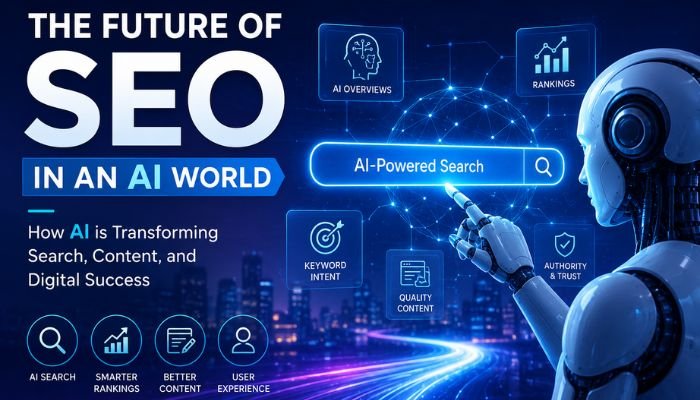
In the current era of technology, digital search channels are changing faster than ever before. Indeed, understanding The Future of SEO in an AI World is essential for any modern business online. While standard search features used to rely simply on keywords, modern systems focus deeply on user intent. Therefore, website owners must adapt to these new technological standards to remain visible [1].
Consequently, platforms like Google, Bing, and ChatGPT are redesigning how users discover information online. Because of this shift, generative search engines can now answer complex queries directly in search results. For example, Google AI Overviews provide complete summaries of information at the very top of the screen. As a result, creators must find new ways to connect with their target audiences.
Moreover, artificial intelligence is reshaping the foundational rules of the search landscape. Specifically, machines can now read web pages much more like human beings. In addition, user trust, real-world expertise, and high-quality content have become the most critical factors for online success. Thus, search engine optimization continues to be incredibly important for sustainable online growth. In this guide, we will explore how you can succeed in this new era.
As search becomes more conversational, following the official guidelines on the Google Search Central Blog is critical for understanding how AI-generated content is evaluated for quality.
What Is SEO?
To begin, we must define what search engine optimization actually means in simple terms. Specifically, it is the practice of making websites easy for search engines to find, read, and rank. Because billions of people search for answers online every day, ranking high is highly valuable. Therefore, this strategy acts as a free, organic traffic source for your business.
In the past, search engines worked by matching exact words on a page with a user query. However, modern platforms are much smarter and look at many other helpful factors. First, they analyze if your content actually answers the user’s specific questions. Secondly, they measure how fast your pages load and how easy your site is to navigate.
Industry experts at Search Engine Journal frequently highlight how machine learning is reshaping the technical SEO landscape for modern creators. Furthermore, search systems look at how many other trusted websites link back to your pages. Meanwhile, they measure how long users stay on your site after clicking a search result. Thus, optimization is about creating a truly wonderful experience for both human visitors and smart machine crawlers.
How AI Is Changing Search
Currently, ai powered search is completely redefining how people interact with the internet. In this section, we will analyze the specific ways this technology modifies daily search habits.
First, search engines are shifting from simple link directories to comprehensive answering engines. Specifically, systems use large language models to write conversational summaries for users. As a result, searchers often get the exact information they need without clicking on external links.
Secondly, the introduction of google ai search has modified the layout of search results pages. Because AI-generated answers now appear at the top, traditional organic links are pushed further down. Consequently, businesses must optimize their content to appear inside these smart summaries directly.
Thirdly, conversational search allows users to ask follow-up questions just like they are talking to a human. For example, a user might search for “best running shoes.” Subsequently, they can ask the system to “show only red options under one hundred dollars.” Thus, search queries are becoming much longer and highly specific.
Fourthly, search results have become highly personalized for individual users. Specifically, algorithms look at your previous search history, physical location, and personal preferences. Therefore, two different people might see completely unique search results for the exact same query.
Fifthly, voice search is experiencing rapid growth because of smart home devices and phone assistants. Because people speak differently than they type, voice queries are highly natural and conversational. As a result, writers must adapt their content to match natural spoken language patterns.
Finally, visual search allows users to find products by uploading photos instead of typing words. For instance, a user can take a picture of a chair to discover where to buy it online. Clearly, this incredible combination of voice, text, and image search is changing the rules of digital discovery.
Why SEO Still Matters in an AI World
Many website owners worry that smart machines will make traditional search strategies completely useless. However, the truth is that seo in the age of ai remains incredibly critical for digital survival. Indeed, search engines still depend on human-created websites to gather the data they present to users.
First, artificial intelligence does not create new knowledge out of nothing. Instead, smart models must read, index, and summarize high-quality web pages to learn. Therefore, without original content created by human experts, search engines would quickly run out of reliable data.
Secondly, users still need to visit websites to make purchases, hire services, and read detailed guides. Even if a smart bot provides a quick summary, buyers will click through to verify the source. Consequently, your brand must maintain high visibility to capture these high-intent prospective customers.
Thirdly, building online authority and trust cannot be automated by algorithms. Specifically, search systems rely on real-world signals like digital mentions and brand links to evaluate credibility. Thus, you must continue to optimize your online presence to build a strong, trusted digital reputation.
The Evolution of SEO
To understand where we are going, let us look at how search technology has changed over time. The table below shows the key eras of future of seo development.
| SEO Era | Main Focus | Key Changes |
| Early SEO | Keyword Stuffing | Repeating words on a page to trick basic search crawlers. |
| Keyword SEO | Links & Keywords | Analyzing backlink profiles and using simple on-page keywords. |
| Content SEO | Content Quality | Prioritizing long, helpful articles and answering user questions. |
| Mobile SEO | Mobile Optimization | Designing responsive pages that load quickly on mobile devices. |
| User Experience | Page Speed & Safety | Measuring site speed, core web vitals, and secure HTTPS links. |
| AI-Powered SEO | Intent & Trust | Using natural language models, semantic search, and E-E-A-T signals. |
The Future of SEO in an AI World
Currently, The Future of SEO in an AI World is moving toward a highly conversational, user-focused model. In this section, we will explore how search engines read and categorize web pages today.
First, generative ai search platforms are learning to understand the true context behind search queries. For example, instead of matching keywords, they analyze the relationship between different topics and ideas. Consequently, this semantic approach allows search engines to deliver highly accurate answers even for unusual queries.
Secondly, user intent has become the single most important factor for ranking success. Specifically, search systems try to figure out if a user wants to buy something, find a website, or learn. Therefore, if your page does not match the searcher’s current intent, you will not rank.
Thirdly, entity-based search is replacing traditional keyword matching. In simple terms, an entity is a specific person, place, thing, or concept. Because smart engines understand how these entities connect, they can build a highly advanced map of human knowledge. Thus, writers must cover topics comprehensively rather than focusing on single keywords.
Furthermore, contextual relevance means your content must match the surrounding ideas of your industry. For instance, if you write about fitness, your pages should naturally mention nutrition and sleep. Consequently, this deep topical coverage shows search systems that you are a highly knowledgeable source.
Finally, the future of search engines will prioritize websites that offer unique, original research. Because basic facts are easily summarized by smart bots, general content will lose organic traffic. Therefore, sharing original data and personal experiences is the best way to secure your digital future. To stay competitive, businesses must integrate these AI search strategies with the top digital marketing trends for 2026 to ensure a holistic online presence
How AI Impacts Search Engine Rankings
To help you understand this new ranking system, let us look at how algorithms evaluate websites. The table below explains the main AI factors and their impact.
| AI Factor | Impact on SEO | Why It Matters |
| Intent Matching | Replaces keyword matching with conceptual understanding. | Pages must answer the user’s specific problem directly. |
| Quality Evaluation | Flags thin, generic, or duplicate content instantly. | You must write highly detailed, original, and helpful articles. |
| Behavior Signals | Measures how users interact with your pages in real-time. | Low dwell times and fast bounces will hurt your rankings. |
| Personalization | Tailors results based on location and search history. | Your organic traffic will become more targeted and relevant. |
| E-E-A-T Analysis | Verifies author expertise and brand trustworthiness. | High authority sites will dominate competitive search terms. |
AI Search vs Traditional Search
While AI changes how users find information, mastering social media engagement strategies remains vital for building the brand authority that search engines crave. To highlight how drastically the search landscape is shifting, let us compare these two methodologies. The table below details the key differences.
| Feature | Traditional Search | AI Search |
| Search Results | Ten simple blue links on a page | Interactive conversational summaries with links |
| User Experience | User must click and read multiple sites | User gets a direct answer instantly in search |
| Key Ranking Factors | Keywords, backlinks, and simple metadata | Semantic relevance, E-E-A-T, and intent match |
| Personalization | Low (Similar results for most users) | Extremely high (Customized for every individual) |
| Content Discovery | Based on exact query word matching | Based on concepts, voice, and visual images |
New SEO Strategies for AI Search
Diversifying your traffic is essential; combining your SEO efforts with a robust email marketing strategy 2026 provides a direct line to your audience that algorithms cannot block. To succeed today, you must update your optimization methods to match modern technology. The table below shows the best seo strategies for ai search in 2026.
| Strategy | Why It Matters | Expected Benefit |
| Topic Authority | Covers an entire industry topic in deep detail. | Establishes your site as a trusted primary source. |
| Schema Markup | Uses structured code to explain your data to machines. | Helps smart bots read and display your content correctly. |
| Brand Mentions | Gets your business mentioned on other trusted sites. | Teaches AI models that your brand is an industry leader. |
| Real Experience | Shares actual case studies, photos, and personal stories. | Proves your content was written by a real human expert. |
| Clear Structure | Uses simple tables, bullets, and clear headings. | Allows smart crawlers to summarize your text easily. |
| Deep Content | Writes comprehensive guides that cover subtopics. | Answers follow-up queries before the user asks them. |
AI Search Optimization (AISO)
First, we must discuss a new concept called ai search optimization (AISO). In simple terms, this is the practice of optimizing your content so that conversational bots recommend your brand. Because many users now ask ChatGPT or Google Gemini for advice, appearing in these answers is highly valuable.
To achieve this, your content must be highly structured and easy for machines to read. Specifically, you should use clear heading tags and bullet points to break down complex ideas. Consequently, smart bots can quickly extract your facts and quote your website as a source.
Secondly, you must focus on building a strong digital footprint across the web. Because AI models learn by reading public forums, news sites, and reviews, digital mentions are critical. Therefore, getting featured in industry directories and news articles will train these models to trust your brand.
Finally, you should answer common industry questions directly and clearly. For example, if you sell software, write simple definitions for common technical terms. As a result, when a user asks a bot to explain a term, the bot will use your exact definition.
Best Practices for Ranking in AI Search Results
To ensure your pages consistently appear in generative search results, implement these essential practices:
Publish original research: First, collect and share your own business data. Because unique statistics cannot be copied easily, other sites will link back to your pages.
Feature real-world experts: Secondly, make sure your articles are written or reviewed by qualified professionals. Consequently, this builds immense credibility with search engines.
Use structured data: Furthermore, always add schema markup to your web pages. This special code helps search engines understand the exact meaning of your content.
Answer questions instantly: Specifically, place a direct, simple answer to your target question in the first paragraph. Thus, search bots can grab it easily for summaries.
Improve page loading speed: In addition, optimize your images and clean your website code. Because fast-loading pages improve user experience, they rank much better.
Format with clear tables: Also, present comparison data in clear, simple tables. Consequently, search engines can display your data directly in featured snippets.
Keep your content updated: Finally, review and refresh your old articles every six months. This ensures your facts remain completely accurate and relevant.
Role of E-E-A-T in Future SEO
Today, Google relies heavily on a special guideline called E-E-A-T to evaluate content quality. Specifically, this acronym stands for Experience, Expertise, Authoritativeness, and Trustworthiness. Because ai driven seo makes it easy to generate cheap, generic text, proving real human credibility is vital.
+-------------------------------------------------------+
|                    E-E-A-T FRAMEWORK                  |
|                                                       |
|  [EXPERIENCE]       ===>  Real-world, hands-on testing|
|  [EXPERTISE]        ===>  Formal education & skills   |
|  [AUTHORITATIVENESS]===>  Industry links & reputation |
|  [TRUSTWORTHINESS]  ===>  Secure site & honest facts  |
+-------------------------------------------------------+
First, Experience means you have actual, hands-on history with the topic you write about. For example, if you review a camera, show original photos you took with it. This proves to search systems that you did not just summarize other reviews.
Secondly, Expertise requires the writer to have professional knowledge or formal education in their field. Specifically, you can demonstrate this by including detailed author bios on your blog posts. Link these bios to professional profiles like LinkedIn to verify your identity.
Thirdly, Authoritativeness is built when other trusted websites talk about your brand. For instance, if major news sites link to your articles, your authority increases significantly. Thus, you must focus on creating content that people naturally want to share.
Finally, Trustworthiness is the most critical part of the framework. Specifically, ensure your website uses secure HTTPS links, displays clear contact info, and states honest facts. When search systems trust your brand, they will gladly display your pages in ranking in ai search results.
How AI Helps SEO Professionals
Effective AI-driven SEO relies heavily on content strategy and optimization to ensure your articles provide the high-value answers that generative engines prioritiz. To start, you do not have to fight against modern technology. Instead, you can use seo and artificial intelligence together to improve your daily workflows. The table below lists the best tools and their business use cases.
| AI Tool | SEO Use Case | Benefit |
| ChatGPT | Content brainstorming and outline creation | Saves hours of planning time and suggests creative topic ideas. |
| Surfer SEO | On-page content optimization | Analyzes competitor sites to suggest the perfect word count and terms. |
| Semrush AI | Keyword research and trend tracking | Discovers hidden search terms and analyzes search volume patterns. |
| Ahrefs AI | Link building and competitor analysis | Finds broken link opportunities and tracks competitor growth. |
| Jasper AI | Draft writing and paraphrasing | Generates quick content drafts that you can edit and personalize. |
| Frase | Brief creation and answer optimization | Identifies common questions users ask on forums like Quora and Reddit. |
Benefits of AI for SEO
Using smart technology offers incredible advantages for growing companies. The table below highlights the key benefits of adopting these tools.
| Benefit | Why It Matters |
| Faster Research | You can discover competitive keywords and content ideas in seconds. |
| Deeper Content Analysis | Algorithms can scan thousands of pages to find topical gaps on your site. |
| Automated Metadata | Software can write optimized page titles and descriptions instantly. |
| Better User Tracking | Analytics tools can predict user behavior patterns on your pages. |
| Continuous Monitoring | Systems can alert you immediately if your rankings drop or pages break. |
Challenges of SEO in an AI World
However, the rapid growth of technology also introduces major challenges for digital marketers. The table below lists common roadblocks and their solutions.
| Challenge | Solution |
| Too Much AI Content | Focus on sharing highly original, human-written stories and real case studies. |
| Fewer Organic Clicks | Optimize your content to appear directly inside smart generative answers. |
| Fast Algorithm Changes | Follow core search guidelines instead of trying to trick the systems. |
| High Target Competition | Focus on long-tail conversational keywords that competitors ignore. |
| Technical Complexity | Hire experienced developers to ensure your site is perfectly structured. |
Real-World Examples of AI and SEO
To understand how this technology works in practice, let us look at seven real-world examples.
1. Bloggers
A travel blogger uses smart tools to discover what questions tourists ask about Rome. Consequently, she writes a highly detailed guide that answers those questions directly. As a result, her blog post gets featured inside Google’s smart summaries, driving massive organic traffic.
2. Local Businesses
A local plumbing company adds structured schema code to its service pages. Because of this code, search systems can read their operating hours and pricing instantly. Thus, when users search for “emergency plumber near me,” the company’s info displays directly in the local map pack.
3. Ecommerce Stores
An online tea shop writes unique, highly detailed descriptions for every single product they sell. In addition, they host customer reviews and real product photos. Consequently, they easily outrank competitors who use generic, manufacturer-provided descriptions.
4. SaaS Companies
A software startup publishes an annual industry survey based on data from their platform. Because they share original charts and statistics, hundreds of tech blogs link to their study. Therefore, their domain authority increases, boosting their overall rankings.
5. Digital Marketing Agencies
An agency uses smart analytics tools to monitor client websites for technical errors. Specifically, the system automatically flags broken links and slow-loading pages. Thus, the agency can resolve technical issues before they hurt the client’s search rankings.
6. News Websites
A local news site uses structured schema code to label its breaking news articles. Consequently, search engines can display their stories inside the “Top Stories” carousel instantly. This helps the site attract millions of readers during major events.
7. Enterprise Brands
A global retail brand integrates smart search tools to analyze customer search queries across different countries. As a result, they can automatically translate and customize their web pages for local markets. Thus, they maintain a highly successful global search presence.
How Businesses Can Prepare for the Future of SEO
If you want to protect your organic traffic, you must adapt your strategy systematically. Below is a step-by-step workflow to help you prepare for the future of digital marketing.
[1. Understand AI Search]
            ↓
[2. Focus on User Intent]
            ↓
[3. Build Topic Authority]
            ↓
[4. Improve E-E-A-T]
            ↓
[5. Create Helpful Content]
            ↓
[6. Use Structured Data]
            ↓
[7. Track Performance]
            ↓
[8. Adapt Continuously]
1. Understand AI Search
First, spend time testing conversational search platforms yourself. Specifically, pay close attention to how they summarize information and recommend brands.
2. Focus on User Intent
Secondly, analyze the search intent behind your target keywords. Ensure your pages give readers exactly what they want, whether it is an answer, product, or link.
3. Build Topic Authority
Next, write multiple related articles about your main industry topics. Connect these pages using clean internal links to prove your deep expertise.
4. Improve E-E-A-T
Furthermore, build real trust by showcasing qualified authors and real case studies. Never publish thin, generic text that lacks human experience.
5. Create Helpful Content
In addition, focus on writing the absolute best resources available online. Share unique statistics, professional designs, and helpful downloadable tools.
6. Use Structured Data
After that, add schema markup to all your important pages. This helps search crawlers index your business information with perfect accuracy.
7. Track Performance
Subsequently, monitor your organic search rankings and click rates weekly. Pay close attention to how your pages perform inside generative summaries.
8. Adapt Continuously
Finally, keep learning about new algorithm updates and seo trends 2026 developments. Be ready to pivot your strategy as technology evolves.
Future SEO Trends for 2026 and Beyond
Looking ahead, search engine optimization in 2026 will expand far beyond traditional search engines. Specifically, digital discovery is moving to multiple different platforms.
First, voice and conversational search will dominate daily life. Because smart home devices are highly popular, users will ask voice assistants for local recommendations. Consequently, your business must optimize for natural, spoken keywords.
Secondly, visual search will become an essential channel for retail brands. Users will naturally take photos of items they see in public to find them online. Therefore, optimizing your product images with clear file names and alt tags is vital.
Thirdly, search everywhere optimization will become highly important. Specifically, people are now searching for information directly on social platforms like TikTok and YouTube. Thus, your company must create helpful video content to capture these users.
Finally, hyper-personalization will deliver custom search experiences for everyone. Specifically, systems will predict what you want to search for before you even finish typing. Consequently, businesses must build strong brand loyalty to ensure users search for their brand names directly.
Adapting to the new search landscape is not just a technical requirement but a fundamental driver for long-term business growth in an automated economy.
Statistics and Research About AI Search
To illustrate the fast growth of this technology, let us look at some recent research findings.
| Statistic | Why It Matters |
| 75% of users prefer conversational search answers | This shows that direct summaries are highly popular with modern searchers. |
| Over 50% of search queries are now conversational | Writers must use natural, spoken language patterns in their articles. |
| E-E-A-T signals can affect up to 80% of search terms | Verifying author credibility is absolutely vital to maintain your rankings. |
| 40% of young users search on social media instead of Google | Brands must optimize their social profiles to remain visible to young buyers. |
| Structured data improves rich snippet clicks by 30% | Adding schema code is a highly effective way to boost organic traffic. |
Expert Insight: Why SEO Will Not Die
Many tech bloggers love to claim that search engine optimization is dead. However, leading experts agree that search optimization will simply evolve rather than disappear. Indeed, as long as people need to find products and information online, search systems will exist.
Furthermore, search engines will always need high-quality, human-created websites to learn from. If platforms stop sending traffic to creators, those creators will stop publishing. Consequently, search engines would quickly become useless search boxes filled with outdated facts.
Therefore, the core goals of search optimization remain exactly the same. You must build a fast, secure website, create helpful resources, and establish real-world trust. As long as you focus on helping users, your brand will succeed in any search era.
Common SEO Mistakes in the AI Era
When trying to adapt to new technology, many businesses make critical mistakes. The table below lists common errors and better approaches.
| Mistake | Better Approach |
| Mass-producing cheap text | Focus on quality over quantity by writing deep, expert articles. |
| Ignoring schema markup | Always add structured data code to help machines read your pages. |
| Targeting single keywords | Build topic clusters to cover entire industry subjects comprehensively. |
| Neglecting user experience | Keep your site fast, mobile-friendly, and free of annoying pop-ups. |
| Forgetting author bios | Display clear credentials and professional links for every writer. |
| Relying only on search traffic | Diversify your traffic by building an email list and social presence. |
How to Choose the Right SEO Strategy in 2026
To begin, you must select an optimization plan that matches your company’s resources. Specifically, you should balance technical updates with content creation.
First, prioritize your technical foundation. Ensure your pages load in under two seconds and work perfectly on smartphones. Because technical errors can block search crawlers, a clean site structure is highly essential.
Secondly, invest in high-quality, expert writers. If you write about complex topics like health or finance, hire certified professionals. Consequently, this investment will protect your rankings during major quality updates.
Finally, analyze your competition regularly. Specifically, look at what pages currently rank for your target terms. Discover what helpful details they missed, and make your content much more complete.
Pros and Cons of AI-Powered SEO
Before adopting smart tools, you should carefully weigh their advantages and disadvantages. The tables below outline the key factors.
Pros of AI-Powered SEO
| Pros | Why It Matters |
| High Efficiency | You can research, analyze, and optimize your pages much faster. |
| Smart Insights | Algorithms can discover hidden search patterns that humans miss. |
| Automated Tasks | Software can write meta descriptions and alt tags automatically. |
| Better Targeting | Personalization tools help you connect with highly relevant buyers. |
Cons of AI-Powered SEO
| Cons | Why It Matters |
| Lack of Creativity | Generated text often sounds generic, thin, and robotic. |
| Inaccurate Facts | Large language models can make up false facts and statistics. |
| High Software Costs | Professional tools can require expensive monthly subscriptions. |
| Constant Updates | You must continually update your workflows as the technology changes. |
Benefits of Preparing for Future SEO
By updating your search strategies today, you can secure outstanding business advantages:
Secure organic traffic: First, your pages will rank high inside both smart summaries and traditional results.
Build high trust: Secondly, displaying real experience and credentials will make your brand highly respected.
Lower ad costs: Furthermore, organic traffic reduces your reliance on expensive paid advertising campaigns.
Gain competitive edges: Also, you will easily outrank competitors who refuse to adapt to new technology.
Improve conversions: Finally, matching user intent perfectly will turn casual readers into active buyers.
Conclusion
In conclusion, The Future of SEO in an AI World is not about fighting technology. Instead, it is about learning to work alongside smart systems to deliver maximum value to users. While the layout of search results pages will continue to evolve, the foundational goal remains completely unchanged. You must build a secure website, create helpful resources, and establish real-world trust.
However, success today requires a dedicated focus on real human experience and structured data. By avoiding cheap shortcuts and prioritizing quality, you can protect your organic traffic and grow your brand.
Ultimately, the future belongs to businesses that focus deeply on helping their audience. Therefore, update your digital strategies today and secure your long-term online success.
FAQs
1. Will AI replace SEO entirely?
No, it will not replace optimization. Instead, it will change how search engines evaluate content, making high-quality, human-expert pages more important.
2. What is AI Search Optimization (AISO)?
Specifically, it is the practice of optimizing your content so that conversational bots recommend your brand in their answers.
3. How does Google AI search affect website traffic?
It can reduce organic clicks for simple, factual queries by answering them directly. However, it drives highly targeted traffic to detailed resources.
4. Can AI-generated content rank high on Google?
Yes, but only if the content is highly accurate, helpful, and edited by human experts to ensure real-world quality.
5. What is the future of search engines?
In the future, search engines will become highly conversational, personalized assistants that handle text, voice, and visual queries.
6. Is keyword research still important?
Yes, but you must focus on semantic topics, conversational phrases, and search intent rather than just matching exact single words.
7. How can businesses prepare for AI search?
First, focus on building deep topic authority. Additionally, use structured schema markup and showcase real expert credentials on your site.
8. What SEO skills are most valuable in 2026?
Specifically, understanding user intent, managing technical site structures, implementing schema markup, and creating unique, high-quality content.
9. Does E-E-A-T matter more in the age of AI?
Yes, because search systems need to verify real human experience and trustworthiness to avoid ranking generic, computer-generated spam.
10. What is the best SEO strategy for the future?
The best strategy is to publish original research, share real-world case studies, and maintain a fast, highly secure website







One Response