

How to Make Money Online: A Practical Guide 2026
The opportunity to make money online has never been greater than it is in 2026. What was once considered a side hustle or a niche career path has evolved into a thriving global digital economy worth trillions of dollars. Today, entrepreneurs, freelancers, creators, and professionals can build profitable online businesses from virtually anywhere. Thanks to user-friendly no-code platforms, AI-powered productivity tools, and secure global payment systems, starting an online business has become more accessible than ever. Whether you’re looking to generate extra income or create a full-time career, there are countless legitimate ways to make money online in today’s rapidly growing digital marketplace. However, the ease of access also means that competition is fiercer than ever. The old-school methods of starting low-quality blog networks, spamming affiliate links, or launching basic dropshipping stores with long shipping times are no longer viable. Today, building a digital footprint requires strategy, dedication, and an understanding of how to provide genuine value to an audience. If you want to make money online in 2026, you need a realistic, step-by-step roadmap tailored to modern trends. Whether you are looking for part-time online income ideas, trying to build a reliable source of passive income online, or aiming to establish a full-time venture through freelancing or online business ideas, this guide covers 25 proven avenues to kickstart your journey. The Landscape of the Online Economy in 2026 The shift toward decentralized and remote work is a permanent fixture of the global workforce. Recent data highlights the scale and growth of this market: The Global Creator Economy: The global creator economy is valued at over $323 billion in 2026, up from $205 billion in 2024, with more than 207 million active creators monetizing content worldwide[1]. The Rise of Freelancing: According to reports, approximately 39% of the U.S. workforce engaged in freelancing in some capacity, contributing to a global freelance platforms market that is expected to exceed $21 billion by the early 2030s[2][3]. E-Commerce Maturity: Globally, e-commerce retail sales continue to capture a massive share of total retail sales, with consumers preferring personalized, micro-brand experiences over generic mass-market storefronts. The AI Revolution: Rather than replacing human workers, artificial intelligence has become a powerful collaborative partner. Creators and freelancers who learn to integrate AI into their workflows are outperforming those who resist technology, saving hours of work on research, drafting, and asset creation. Transitioning to an online career requires patience. While the earning potential is significant, most beginners find that their first few dollars take time and persistent effort to secure. Earning Potential & Skill Requirements Summary To help you navigate the 25 methods listed below, here is a comparative overview of each business model, detailing the estimated start-up costs, technical difficulty, potential earnings, and time commitment. # Method Primary Category Tech Difficulty Start-Up Capital Monthly Earning Potential (Beginner to Pro) 1 AI-Augmented Copywriting Freelancing Low to Mid Low ($0 – $50) $500 – $5,000+ 2 Virtual Assistance & Automation Freelancing Low to Mid Low ($0 – $100) $800 – $4,000+ 3 Social Media Management Freelancing Low Low ($0 – $50) $1,000 – $6,000+ 4 Short-Form Video Editing Freelancing Mid Medium ($100 – $300) $1,500 – $8,000+ 5 Web Dev & No-Code Building Freelancing Mid to High Low ($50 – $200) $2,000 – $10,000+ 6 Online Tutoring & Coaching Service-Based Low Low ($0 – $100) $500 – $4,000+ 7 Blogging & Niche Sites Content Creator Mid Low ($50 – $150) $0 – $10,000+ 8 YouTube & Video Creator Content Creator Mid to High Medium ($100 – $500) $0 – $15,000+ 9 Paid Newsletters Content Creator Low Low ($0 – $50) $200 – $8,000+ 10 Podcasting Content Creator Mid Medium ($150 – $400) $100 – $5,000+ 11 Affiliate Marketing Content Creator Low to Mid Low ($20 – $100) $0 – $12,000+ 12 Selling Notion Templates / Assets Digital Products Low Low ($0 – $50) $100 – $3,500+ 13 Building Micro-SaaS Platforms Digital Products High Medium ($100 – $500) $500 – $20,000+ 14 Creating Online Courses Digital Products Mid Low ($50 – $200) $300 – $15,000+ 15 Publishing E-books & Audiobooks Digital Products Low Low ($0 – $100) $50 – $3,000+ 16 Print on Demand (POD) E-Commerce Low Low ($0 – $100) $100 – $4,000+ 17 High-Ticket Dropshipping E-Commerce Mid to High Medium ($200 – $800) $500 – $12,000+ 18 Selling Digital Goods on Etsy E-Commerce Low Low ($20 – $50) $200 – $5,000+ 19 Amazon FBA / Private Label E-Commerce High High ($1,000+) $1,000 – $20,000+ 20 Digital Real Estate & Flipping Investment High Medium ($500+) Variable (Project-Based) 21 Licensing Stock Audio & Music Passive Income Mid to High Medium ($100 – $400) $100 – $3,000+ 22 Crowdfunded Real Estate & Stocks Passive Income Low Variable ($100+) $50 – $1,500+ (Yield) 23 AI Prompt Engineering Consulting Emerging Tech Mid Low ($0) $1,000 – $8,000+ 24 Data Labeling & AI Training Emerging Tech Low Low ($0) $200 – $1,500+ 25 Custom AI Agent Setup for SMBs Emerging Tech Mid to High Low ($0 – $100) $1,500 – $10,000+ Category 1: Freelancing & Service-Based Businesses If you want to make money online as fast as possible, selling a skill directly to clients is the most reliable path. Unlike business models that require building an audience or testing advertising budgets, freelancing allows you to trade your time and skills for direct payment. 1. AI-Augmented Freelance Copywriting The demand for written content has evolved. Businesses no longer hire writers to churn out generic, low-effort articles, because AI can generate basic drafts instantly. Instead, clients in 2026 seek writers who can act as “editors-in-chief” or specialized copywriters who know how to prompt AI, inject brand voice, verify facts, and structure content for SEO conversion. How to Get Started: Familiarize yourself with advanced LLMs. Create a portfolio showcasing your ability to write highly engaging, human-edited newsletters, landing page copy, or email sequences. Platforms to Use: Upwork, Fiverr, LinkedIn, Contra. Pro Tip: Specialize in a high-paying niche such as finance, healthcare, or SaaS. Generalist writers face intense fee pressure, while specialized subject matter experts command high premium rates. 2. Remote Virtual Assistance
Read More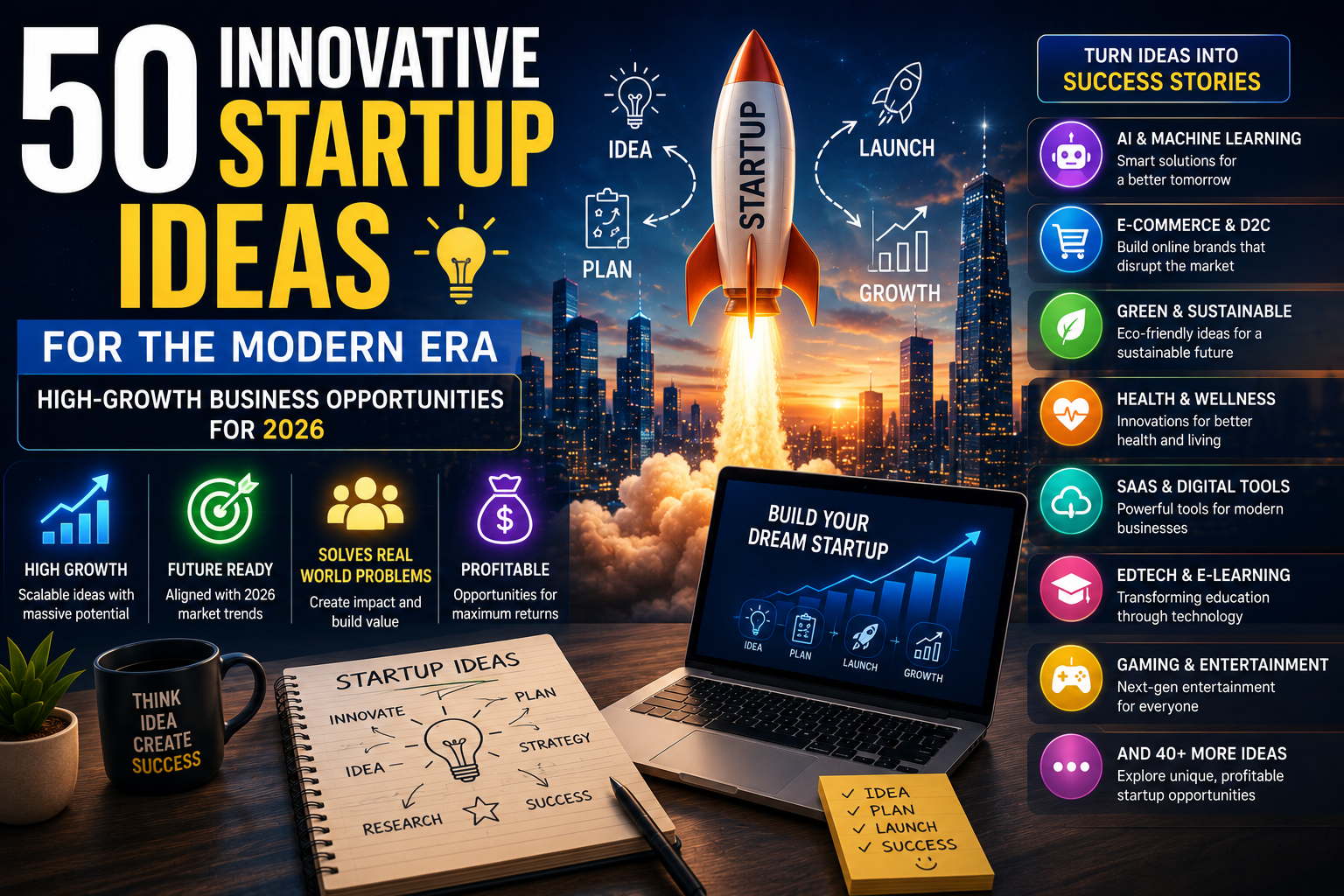
50 Innovative Startup Ideas for the Modern Era: High-Growth Business Opportunities for 2026
The entrepreneurial landscape is undergoing one of the most profound transitions in recent economic history. The initial wave of general-purpose artificial intelligence has matured[1], giving way to a pragmatic era defined by vertical integration, autonomous agent networks[2][3], physical AI[1][4], and a strict regulatory focus on sustainability and digital sovereignty[2]. Founders looking for high-growth startup ideas 2026 must move past superficial software layers. High-interest rates and disciplined capital markets mean that venture capitalists and bootstrappers alike are demanding clear paths to profitability, demonstrable unit economics, and defensible IP[5][6]. Whether you are an aspiring builder, an experienced operator, or an investor seeking the next wave of profitable business ideas, this comprehensive guide details 50 innovative business ideas across five high-growth sectors, accompanied by practical validation frameworks, funding strategies, and financial projections. Market Trends Shaping 2026 and Beyond To build a resilient enterprise, founders must align their startup opportunities with macro-technological and structural shifts. Key factors defining the market include: 1. The Rise of Agentic and Physical AI The era of simple prompt-and-response AI is behind us. Businesses are prioritizing agentic workflows—systems where multi-agent networks operate autonomously, make decisions, execute multi-step APIs, and self-correct[2][3][7]. Simultaneously, AI is moving into the physical realm[1][4]. The convergence of advanced computer vision, sensor technology, and low-cost robotics has made localized physical automation highly accessible to mid-market enterprises[1][4]. 2. Verticalization and the Disruption of Legacy SaaS Horizontal SaaS platforms that offer generic tools (such as general-purpose CRM or project management tools) are facing intense downward pricing pressure. High-growth future business ideas are centered on Vertical SaaS—deeply specialized software tailored to specific, highly regulated industries like maritime logistics, clinical trials, regional banking, and agricultural compliance. 3. Digital Sovereignty, Privacy, and Trust With the rise of sophisticated synthetic media, deepfakes, and stringent regional data laws, there is a massive market demand for trust infrastructure[2][3][8]. Technologies focused on digital provenance, confidential computing, and localized, sovereign data centers are transitioning from niche compliance needs to core enterprise requirements[2][3][8]. 4. Carbon Transparency and Circular Supply Chains Global environmental regulations now demand that corporations account not just for their direct emissions, but also for their Scope 3 emissions (indirect emissions from their upstream and downstream supply chains). This regulatory shift has transformed sustainability from a public relations asset into a hard compliance requirement, opening up vast B2B markets. Category 1: Artificial Intelligence & DeepTech Startups The market for specialized artificial intelligence has transitioned from foundation model development to the execution layer[1]. The following ten innovative startup ideas focus on high-impact, practical deployments of DeepTech. 1. Multi-Agent Coordination Platforms for Enterprise Workflows Concept: A platform that enables enterprise IT departments to orchestrate, monitor, and audit networks of autonomous AI agents working collaboratively to resolve multi-step business workflows[2][3]. Target Market: Operations and IT leaders in financial services, insurance, and supply chain logistics. Monetization Model: B2B SaaS model based on active agents, computational steps, or seat licenses. How to Get Started: Utilize open-source multi-agent frameworks (such as CrewAI or LangGraph) to construct a localized pilot for a specific back-office workflow, proving cost reduction to secure your initial enterprise client. 2. AI-Powered Scope 3 Carbon Accounting Software Concept: An automated data ingestion and analysis platform that plugs into enterprise ERPs and supply chain management systems to track and audit Scope 3 carbon emissions. Target Market: Multinational enterprises subject to global ESG reporting mandates. Monetization Model: Tiered annual enterprise software subscription. How to Get Started: Target mid-market manufacturing firms that need to supply emissions data to larger enterprise buyers. Build API integrations into common inventory databases to automate the estimation processes. 3. Physical AI Systems for Small-Scale Warehousing Robotics Concept: Softwares-as-a-Service that provides advanced computer vision and spatial mapping models to enable low-cost, off-the-shelf robotic arms to handle unstructured inventory[1][4]. Target Market: Boutique e-commerce fulfillment centers and regional distributors. Monetization Model: Hardware-enabled SaaS (Robotics-as-a-Service) with a monthly software licensing fee per active robot. How to Get Started: Partner with a local warehouse, purchase a standard robotic arm, and deploy custom computer vision models trained specifically on irregular retail packaging. 4. Domain-Specific Large Language Models for Regulatory Compliance Concept: Locally hostable, highly secure language models trained exclusively on specific legal and regulatory compliance databases (e.g., aviation safety, medical device approvals, maritime law)[3]. Target Market: Compliance officers, corporate legal counsels, and regulatory affairs specialists. Monetization Model: High-ACV (Annual Contract Value) enterprise software licenses with dedicated maintenance support. How to Get Started: Focus on a single highly complex regulation. Secure a partnerships with industry consultants to curate high-quality, verified training datasets for fine-tuning. 5. AI-Driven Personalized Medicine Formulation Systems Concept: A software suite that analyzes patient genomic, microbiome, and biometric data to generate personalized compound pharmaceutical recipes and supplement formulas. Target Market: Compounding pharmacies, longevity clinics, and private healthcare institutions. Monetization Model: Pay-per-formulation API model or monthly clinic licensing fees. How to Get Started: Develop a secure, HIPAA-compliant pipeline that aggregates peer-reviewed medical journals and genetic markers, starting with non-regulated longevity supplements to establish proof of concept. 6. Privacy-Preserving Synthetic Data Generators for FinTech Concept: An enterprise tool that ingests sensitive financial transaction histories and generates high-fidelity, completely anonymous synthetic datasets for machine learning model training. Target Market: Risk, fraud, and data science teams within retail banks and payment processors. Monetization Model: Enterprise software license based on the volume of data processed. How to Get Started: Build a prototype using Generative Adversarial Networks (GANs) on open financial datasets[9], demonstrating that models trained on your synthetic data perform comparably to those trained on real data. 7. Digital Provenance & Anti-Deepfake Verification APIs Concept: An API-first security platform that uses cryptographic watermarking and decentralized digital ledgers to verify the authenticity and source of video and audio media[3][8]. Target Market: Digital publishers, news organizations, political campaigns, and insurance claims processors. Monetization Model: Tiered API usage subscription based on the volume of media files verified. How to Get Started: Build a browser extension and developer SDK that checks files against established standards, focusing on verifying corporate executive video announcements. 8. Automated DevSecOps Vulnerability Patches via LLMs Concept: A continuous integration/continuous deployment (CI/CD) tool that not only scans codebases
Read More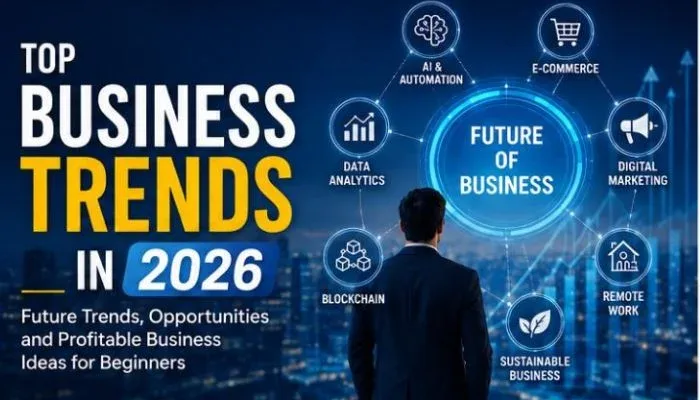
Top Business Trends 2026 Shaping the Future of Business
The business world is entering a new digital era. In 2026, technology, Artificial Intelligence, customer behavior, and online platforms are changing how companies operate faster than ever before. Businesses that adapt quickly to these changes are expected to grow much faster than those that resist innovation. That is why understanding business trends 2026 is essential for entrepreneurs, startups, freelancers, and small business owners. Today’s customers expect convenience, speed, personalization, and digital experiences. Businesses are now investing heavily in AI automation, online services, sustainable solutions, digital marketing, and remote work systems. At the same time, social media and creator-driven businesses are opening new income opportunities for beginners worldwide. According to several industry reports, global AI adoption, digital commerce, and automation spending are expected to rise significantly between 2026 and 2030. Experts believe businesses that combine technology with customer-focused experiences will dominate the future market. Whether you want to start a small online business, launch a startup, or simply understand the future of business, this complete beginner’s guide will help you explore the most important future business trends, emerging industries, and profitable opportunities shaping 2026. Table of Contents What Are Business Trends? Why Business Trends Matter in 2026 Top Business Trends to Watch in 2026 AI-Powered Businesses Remote and Hybrid Work Growth Creator Economy Expansion Sustainable and Eco-Friendly Businesses Personalized Customer Experience Automation and Smart Tools Rise of Online Learning Businesses Digital Payments and Cashless Economy Health and Wellness Industry Growth Subscription-Based Business Models Small Business Trends 2026 Business Trends in Entrepreneurship Current Business Trends in India Top IT Trends Shaping Today’s Business Social Media Trends in Business E-commerce Trends in 2026 Most Profitable Business Ideas in 2026 Skills Entrepreneurs Need in 2026 How AI Is Changing Small Businesses Top Business Trends by Industry Business Trends Statistics for 2026 How to Identify New Business Trends How Businesses Can Adapt to New Trends Advantages and Disadvantages of Business Trends Expert Predictions for Future Business Trends Mistakes Businesses Should Avoid in 2026 Future of Business Trends (2026–2030) Interesting Facts About Business Trends Challenges Businesses May Face in 2026 Tips to Start a Future-Proof Business Best Industries for Beginners How Entrepreneurs Can Stay Ahead Beginner Action Plan FAQs Conclusion What Are Business Trends? Business trends are major changes in customer behavior, technology, industries, and market demand that influence how businesses operate. These trends affect products, services, marketing strategies, customer expectations, and overall business growth. In simple words, business trends help companies understand what customers want and how markets are evolving over time. In today’s digital world, business trends 2026 are changing faster than ever before. As technology continues to improve, businesses must adapt to new tools, customer preferences, and online platforms to remain competitive. Therefore, companies that follow future business trends early often gain a major advantage in their industry. For example, online shopping became one of the biggest digital business trends after smartphones, internet access, and digital payment systems became widely available. As a result, many traditional stores started creating e-commerce websites and mobile shopping apps to serve customers more efficiently. Similarly, AI business trends are now transforming industries like healthcare, education, finance, e-commerce, and digital marketing by improving automation, customer support, and decision-making. Another important example is the rise of remote work and online businesses. After businesses discovered the benefits of flexible working models, many companies started hiring remote employees and using cloud-based tools for communication and productivity. Consequently, freelancing, digital agencies, and online service businesses are growing rapidly across the world. Understanding future business trends helps businesses prepare for upcoming market changes and discover profitable business opportunities in 2026 before competitors do. In addition, following business trends allows entrepreneurs to identify customer problems early, improve services, and create innovative solutions that match future market demand. Businesses that ignore changing trends often struggle to survive because customer expectations continue evolving. However, businesses that adapt quickly to technology trends in business can improve efficiency, attract more customers, and achieve long-term success in the modern digital economy. Why Business Trends Matter in 2026 Business trends matter because the global market is evolving faster than ever before. New technologies, changing customer expectations, and digital innovation are transforming how businesses operate across every industry. Therefore, companies that identify and follow business trends 2026 early often grow faster, improve customer satisfaction, and increase long-term profits. In today’s competitive environment, customers expect businesses to provide faster services, better convenience, and more personalized experiences. As a result, companies can no longer rely only on traditional business methods. Instead, they must continuously adapt to future business trends to remain relevant and competitive in the digital economy. In 2026, consumers expect: Faster customer service Mobile-friendly experiences Personalized recommendations Digital convenience Secure online payments Eco-friendly products and services For example, many customers now prefer shopping online instead of visiting physical stores. Similarly, people expect instant replies through chatbots, quick delivery services, and personalized product suggestions while shopping online. Consequently, businesses that fail to adapt to these changing behaviors may struggle to attract and retain customers. At the same time, AI business trends and automation tools are helping businesses improve productivity and reduce operational costs. Companies using Artificial Intelligence for customer support, marketing, and analytics can often make faster and smarter business decisions. Therefore, businesses that embrace modern technology trends in business usually gain a strong competitive advantage. Another reason business trends are important is because they create new business opportunities in 2026. Emerging industries such as online education, creator economy businesses, AI services, digital marketing, and health-tech startups are growing rapidly worldwide. Entrepreneurs who identify these opportunities early can build profitable businesses before markets become overcrowded. Additionally, current business trends in India show massive growth in digital payments, e-commerce, remote work, and startup culture. Because internet access and smartphone usage continue increasing rapidly, more people are starting online businesses and digital service companies than ever before. Businesses that follow future business trends can also improve customer trust and loyalty. For instance, eco-friendly businesses are becoming increasingly popular because modern consumers care more
Read More