

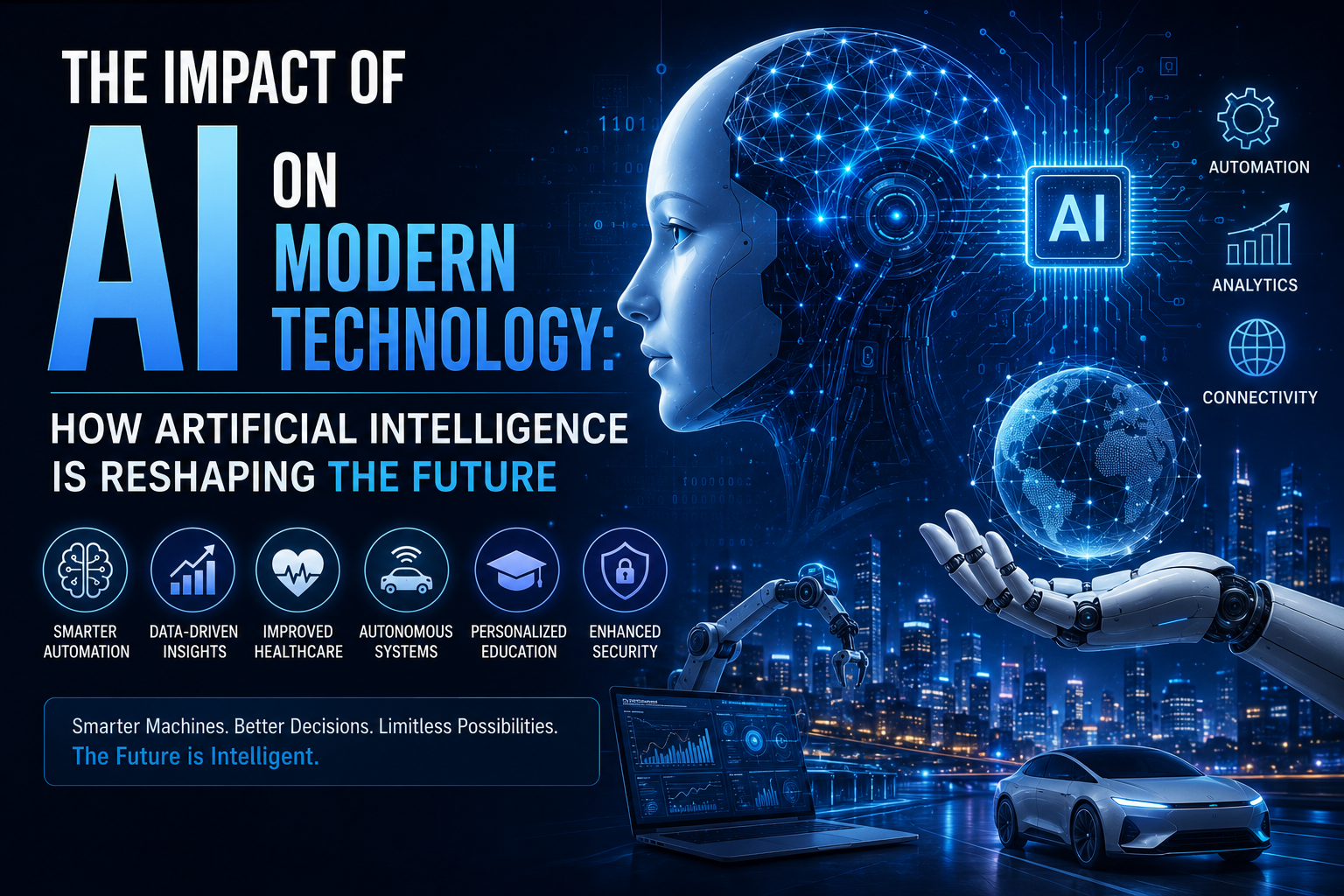
We are living in an era where technology does not just assist human decision-making; it anticipates, executes, and refines it. The impact of AI on modern technology has transitioned from an incremental progression of software efficiency to a fundamental paradigm shift[1]. In less than a decade, artificial intelligence has mutated from a back-end analytical tool into the primary interface and operating engine of global infrastructure[1][2]. Whether we look at generative design platforms, predictive diagnostics in medicine, autonomous agents executing complex multi-step supply chain decisions, or foundational models capable of reasoning across modalities, AI is no longer a localized trend[3][4]. It is the new substrate of the digital world[2].
The phrase “digital transformation” once referred to cloud migration, mobile app integration, and data centralization. Today, that definition has been overwritten by AI transformation[2][5]. Every modern application, database, and hardware stack is being re-engineered to support or integrate machine-learned cognitive capabilities[2].
To fully comprehend the depth of this transformation, we must analyze the specific mechanics of this technology, explore the sectors undergoing radical restructuring, examine the emerging challenges, and project the structural shifts that will characterize the coming decade[2][3]. This article provides a comprehensive, highly analytical examination of how AI is fundamentally rewriting the laws of technology, business, and daily human life[1].
2. The Evolution of Artificial Intelligence: From Symbolic Rules to Generative and Agentic Paradigms
To understand the impact of AI on modern technology, one must look back at its architectural evolution. The trajectory of AI can be divided into four distinct waves, each defined by how machines represent knowledge and learn from data[3].
+-------------------------------------------------------------------------+
|                          THE FOUR WAVES OF AI                           |
+-------------------------------------------------------------------------+
|                                                                         |
|  Wave 1: Symbolic AI (Rule-Based)                                       |
|  - Hardcoded "if-then" logic, expert systems, brittle parameters.       |
|                                                                         |
|  Wave 2: Statistical Machine Learning                                    |
|  - Feature engineering, regression, SVMs, predictive classification.     |
|                                                                         |
|  Wave 3: Deep Learning & Transformers                                   |
|  - Neural networks, self-attention, foundation models, LLMs.            |
|                                                                         |
|  Wave 4: Agentic & Multi-Agent AI (2026+)                               |
|  - Autonomous goal execution, tool use, self-correction, reasoning.     |
|                                                                         |
+-------------------------------------------------------------------------+
The First Wave: Symbolic AI and Expert Systems
Historically, artificial intelligence relied on Symbolic AI—often called “Good Old-Fashioned AI” (GOFAI). These systems operated on explicit, hardcoded logic. Engineers mapped out complex “if-then” decision trees to build “expert systems.” While successful in highly constrained environments (such as basic chess engines or diagnostic flowcharts), these systems were fundamentally brittle. They could not generalize beyond their hardcoded parameters, lacked the capacity to learn from new data, and collapsed when confronted with the noise and ambiguity of real-world inputs.
The Second Wave: Statistical Machine Learning
The transition to statistical machine learning in the late 1990s and 2000s marked a shift from programming rules to programming learning algorithms. Instead of explicitly telling a machine how to identify a pattern, developers fed labeled datasets into algorithms like Support Vector Machines (SVMs), Random Forests, and Gradient Boosting trees. The machine learned to optimize mathematical functions to make classifications or predictions. However, this era was heavily dependent on “feature engineering”—the tedious, human-intensive process of manually identifying which variables (features) the algorithm should pay attention to.
The Third Wave: Deep Learning and the Transformer Breakthrough
The deep learning revolution, catalyzed by the availability of massive GPU compute and large-scale datasets (such as ImageNet), eliminated the need for manual feature engineering. Multi-layered Artificial Neural Networks (ANNs)—particularly Convolutional Neural Networks (CNNs) for vision and Recurrent Neural Networks (RNNs) for sequential data—allowed systems to learn hierarchical representations of data directly from raw pixels or text.
The ultimate inflection point occurred in 2017 with the introduction of the Transformer architecture in the paper “Attention Is All You Need.” By replacing recurrence with self-attention mechanisms, Transformers allowed models to process sequence data in parallel, capture long-range dependencies, and scale to billions of parameters. This architecture laid the foundation for Large Language Models (LLMs) and modern Generative AI, enabling machines to understand, summarize, translate, and generate human-like text and code with unprecedented fluency[3].
The Fourth Wave: Agentic and Multi-Agent AI
We have entered the fourth wave: Agentic AI[6][7]. While generative AI focuses on content generation and interactive search, agentic systems focus on execution[4][7]. Equipped with planning capabilities, memory, and tool integration (such as the ability to execute API calls, write and run Python scripts, browse the web, and operate desktop interfaces), autonomous AI agents do not merely answer prompts; they accomplish long-horizon goals[4][7]. This shift from passive conversational models to active, self-correcting agents represents the cutting edge of modern software design[7].
3. Key Artificial Intelligence Innovations Reshaping Modern Systems
The rapid integration of AI into contemporary software architectures is driven by several foundational artificial intelligence innovations[3]. These technologies serve as the building blocks for enterprise and consumer applications alike[2][3].
A. Multimodal Foundation Models
Early AI models were highly specialized: one model processed text, another processed audio, and a third classified images. Modern foundation models are inherently multimodal[3]. Trained on heterogeneous datasets containing billions of images, audio files, videos, code repositories, and textual documents, these systems understand cross-modal relationships natively.
A multimodal model can read a complex schematic diagram, generate the corresponding software control code, explain the diagram via synthetic voice, and generate a video demonstrating how the physical machine operates. This unified representation of diverse data streams has unlocked unprecedented flexibility across software interfaces.
B. Retrieval-Augmented Generation (RAG) and Long-Context Windows
To make LLMs useful in enterprise environments, developers had to solve the twin challenges of outdated training data and “hallucinations” (the tendency of models to invent facts). This led to the development of Retrieval-Augmented Generation (RAG). RAG acts as an intermediary layer: when a user asks a question, the system queries an external vector database containing proprietary, up-to-date documents, retrieves relevant text chunks, and feeds them to the LLM as a context anchor.
Simultaneously, the dramatic expansion of model context windows—capable of holding millions of tokens—allows businesses to feed entire codebases, legal libraries, or historical financial reports directly into the active memory of the AI, yielding highly contextualized and accurate outputs.
C. Agentic Workflows and Multi-Agent Orchestration
Instead of relying on a single monolithic model to solve a problem, modern system architectures deploy networks of specialized AI agents[7]. In a multi-agent system, different agents are assigned specific roles (e.g., a “Researcher Agent,” a “Writer Agent,” and a “Critic Agent”)[7]. They collaborate, critique each other’s work, execute sub-tasks, and iterate until the objective is achieved[7]. This decentralized, collaborative methodology drastically reduces error rates and allows for the automation of complex workflows that previously required cross-departmental human coordination[7][8].
D. Edge AI and On-Device Processing
The computation required to run state-of-the-art AI models has traditionally been confined to massive, power-hungry cloud datacenters. However, innovations in model quantization (reducing precision without major loss in accuracy), structural pruning, and dedicated hardware (Neural Processing Units or NPUs) have enabled Edge AI.
We now see highly capable LLMs, vision transformers, and speech recognition systems running locally on smartphones, automobiles, medical devices, and smart factory sensors. Edge AI offers critical advantages: zero latency, reduced cloud computing costs, offline functionality, and absolute data privacy.
E. Neuro-Symbolic AI
While deep learning models are exceptional at pattern recognition and intuitive generation, they often struggle with strict logical reasoning, mathematics, and rule compliance. Neuro-symbolic AI seeks to combine the pattern-matching power of deep neural networks with the logical rigor of symbolic (rule-based) systems. By embedding formal logic and semantic knowledge graphs into neural network training and execution, researchers are building systems that can reason systematically, explain their decisions step-by-step, and adhere strictly to deterministic safety boundaries.
4. Industry-by-Industry Breakdown of the AI Transformation
The impact of AI on modern technology is not distributed evenly, yet no sector remains untouched[1]. By examining specific industries, we can observe how the convergence of these innovations is driving a wholesale AI transformation[5].
+--------------------------------------------------------------------------------------------------+
|                                    INDUSTRIES TRANSFORMED BY AI                                  |
+--------------------------------------------------------------------------------------------------+
|                                                                                                  |
|   HEALTHCARE                 FINANCE                    MANUFACTURING           EDUCATION        |
|   - AI diagnostics           - Algorithmic trading      - Predictive maint.     - Hyper-personal |
|   - AlphaFold drug design   - Automated compliance     - Cobot orchestration   - Adaptive paths |
|   - Synthetic clinical trials - Fraud pattern detection - Generative design     - Real-time asst |
|                                                                                                  |
+--------------------------------------------------------------------------------------------------+
1. Healthcare and Life Sciences
The integration of AI applications in medicine is transitioning the field from reactive treatment to proactive, hyper-personalized precision care[7][9].
Drug Discovery and Molecular Design: Historically, bringing a new drug to market took over a decade and cost billions of dollars, largely due to the trial-and-error nature of finding viable chemical compounds. AI models like DeepMind’s AlphaFold have revolutionized biology by predicting the 3D folding structures of proteins with atomic accuracy. Building on this, generative molecular models design entirely new, synthetic proteins targeted at specific disease receptors, reducing the preclinical discovery phase from years to weeks.
Medical Imaging and Clinical Diagnostics: AI algorithms, powered by computer vision and trained on millions of labeled medical scans, are now capable of identifying anomalies—such as early-stage lung nodules, diabetic retinopathy, and breast cancers—often before they are visible to human radiologists. These tools act as a collaborative second set of eyes, reducing diagnostic oversight and standardizing care quality across under-resourced clinics[7].
Synthetic Clinical Trials and Personalized Treatment: By analyzing massive databases of electronic health records (EHRs) and genomic data, AI can simulate patient cohorts for clinical trials, identifying potential adverse reactions or optimal treatment subgroups long before physical testing begins. In clinical practice, this allows oncologists to design personalized chemotherapy regimens tailored specifically to the unique genetic profile of a patient’s tumor.
2. Finance, Banking, and Fintech
In the financial sector, where millisecond delays translate to millions of dollars, AI has become the primary mechanism for risk mitigation, efficiency, and market analysis[5].
Algorithmic Trading and Quantitative Analysis: Modern quantitative trading models leverage deep reinforcement learning to analyze unstructured data—such as real-time news feeds, geopolitical events, satellite imagery of shipping ports, and social media sentiment—alongside traditional market feeds. These models execute high-frequency trades and dynamically adjust portfolio risk allocations in response to micro-signals invisible to human analysts.
Advanced Fraud Detection and Prevention: Traditional fraud detection relied on rigid rule sets (e.g., triggering an alert if a transaction exceeded a certain dollar value). AI systems analyze behavioral biometrics, network graph relationships, and transactional histories in real-time. They can detect subtle, highly distributed fraud patterns—such as structured money laundering schemes or compromised digital identities—instantly blocking transactions with high precision and low false-positive rates.
Automated Regulatory Compliance (RegTech): Financial institutions must navigate a dense maze of global compliance laws. Agentic AI tools can continuously ingest changing regulations, analyze internal corporate practices, identify gaps, draft compliance reports, and flag potential violations, saving compliance departments thousands of hours of manual audit work.
3. Manufacturing, Logistics, and Industrial Robotics
Industrial environments are evolving from rigid automation to highly adaptive, self-optimizing ecosystems[2].
Predictive Maintenance and IoT Analytics: By embedding smart vibration, thermal, and acoustic sensors across factory machinery, AI systems can monitor equipment health continuously. Machine learning models analyze these telemetry streams to predict component failures before they occur. This allows factories to schedule maintenance during planned downtimes, avoiding costly unscheduled production halts and extending the operational lifespan of expensive capital assets.
Collaborative Robotics (Cobots) and Computer Vision: Unlike traditional industrial robots that operate in safety cages because they are blind to their surroundings, modern “cobots” use computer vision, spatial mapping, and reinforcement learning to work safely alongside humans. They can identify misaligned parts on an assembly line, adapt to changing tasks on the fly, and learn complex physical manipulation skills through demonstration rather than explicit reprogramming.
Global Supply Chain Optimization: Generative and predictive AI models analyze global weather forecasts, port congestion metrics, fuel prices, labor conditions, and consumer demand signals to dynamically optimize supply chain routing[4]. If a major storm threatens a key shipping corridor, AI agents can autonomously re-route raw materials, adjust factory production schedules, and update inventory allocations across regional distribution centers to minimize disruption.
4. Education, Training, and Learning Systems
The classical “factory model” of education—one teacher delivering a static curriculum to thirty students—is being systematically dismantled by adaptive learning technologies[1][9].
Hyper-Personalized Learning Frameworks: AI-powered educational platforms act as real-time private tutors. By monitoring a student’s response patterns, reading speed, and struggle points, the system dynamically adjusts the difficulty level, explains concepts using different metaphors (tailored to the student’s hobbies), and introduces spaced-repetition reviews. This ensures that students master foundational concepts before progressing, preventing learning gaps.
Administrative and Grading Automation: Teachers spend an estimated 30-50% of their working hours on administrative duties, such as lesson planning, grading assignments, and responding to routine emails. Advanced AI assistants can automatically draft rubrics, grade essay drafts with highly detailed formative feedback, structure customized lesson modules, and answer parental inquiries, allowing educators to focus their energy on direct, high-value student mentorship.
Virtual Reality (VR) and AI-Driven Simulations: For high-stakes professional training—such as surgical residencies, aviation engineering, or emergency response management—generative AI populates immersive VR simulations with dynamic, unpredictable scenarios and responsive synthetic agents. Trainees can practice complex procedures in a safe, repeatable environment that realistically simulates real-world stress and failure states.
5. Creative Industries, Media, and Design
The creative sector is undergoing a profound structural shift as AI becomes a primary collaborator in visual arts, literature, music, and engineering design[10].
Generative Asset Creation and Interactive Design: Graphic designers, game developers, and filmmakers utilize generative AI models to create high-fidelity assets—textures, character models, background music, and storyboards—in a fraction of the time previously required[10]. This allows independent creators and small studios to produce AAA-quality content with limited budgets[4].
AI-Assisted Engineering and Generative Design: In physical engineering (such as aerospace, automotive, and architectural design), engineers feed structural performance requirements, weight constraints, and material budgets into generative AI models. The system runs physics-informed neural networks to generate hundreds of optimized, highly unconventional, lightweight designs (often resembling organic structures) that a human engineer would not have conceived, which are then fabricated via 3D printing.
Hyper-Personalized Curation and Streaming: Streaming services leverage deep collaborative filtering and deep reinforcement learning to curating real-time content feeds. These algorithms analyze subtle user interactions (e.g., how long a user hovers over a thumbnail, the volume levels they prefer, skip rates, and temporal habits) to not only recommend existing media but actively edit or alter thumbnails and video previews to maximize engagement.
5. The Core Benefits of Integrating AI into Modern Technology
The systemic rush toward AI integration is not merely a chase after novelty; it is a calculated response to the tangible, quantifiable benefits these technologies deliver[5].
+-----------------------------------------------------------------------------+
|                          CORE BENEFITS OF AI SYSTEMS                        |
+-----------------------------------------------------------------------------+
|                                                                             |
|  1. Exponential Operational Efficiency                                      |
|     - Automation of high-volume, cognitive-overhead tasks.                  |
|                                                                             |
|  2. Unprecedented Scalability                                                |
|     - Software can scale complex decision-making processes instantly.       |
|                                                                             |
|  3. Precision, Consistency, and Risk Mitigation                             |
|     - Elimination of human fatigue, cognitive bias, and diagnostic lag.     |
|                                                                             |
|  4. Accelerated Scientific and R&D Breakthroughs                            |
|     - High-speed simulation of physical and chemical systems.               |
|                                                                             |
+-----------------------------------------------------------------------------+
1. Exponential Operational Efficiency
The most immediate benefit of AI is the elimination of cognitive friction from routine tasks. By automating high-volume, low-variability operations—such as data entry, email sorting, basic programming, customer support triage, and report generation—organizations can redeploy their human capital to focus on strategic thinking, complex problem-solving, and creative innovation[4][8].
2. Unprecedented Scalability
Human labor is inherently difficult to scale; it requires recruiting, training, office infrastructure, and management layers. AI systems, once trained and deployed, can be duplicated across cloud servers instantaneously to handle massive surges in demand. A system that processes 10 customer service queries an hour can scale seamlessly to process 10,000 queries concurrently without a degradation in response quality or a linear increase in operational costs[4][8].
3. Precision, Consistency, and Risk Mitigation
Human decision-making is prone to cognitive fatigue, emotional bias, hunger, and distraction (a phenomenon known as noise). AI models operate with mathematical consistency. An image classification algorithm analyzes its millionth X-ray with the exact same level of microscopic precision as its first, drastically reducing human error in high-consequence industries like medical diagnostics, structural engineering, and aviation safety[1][7].
4. High-Speed Scientific and Product Discovery
By processing and simulating physical systems—such as molecular interactions, fluid dynamics, and thermodynamic reactions—at speeds millions of times faster than physical laboratory experiments, AI is accelerating the pace of human scientific progress[7][9]. It enables researchers to bypass years of iterative laboratory work, leading to rapid breakthroughs in materials science, battery chemistry, climate mitigation technologies, and pharmaceutical design[7].
6. Challenges, Risks, and Ethical Dilemmas
Despite the immense promise, the impact of AI on modern technology has introduced critical vulnerabilities, systemic risks, and intense ethical debates that society must navigate[1].
A. The Challenge of Hallucination and Model Brittleness
Modern deep learning systems are statistical prediction engines; they do not possess a conscious, conceptual model of the physical world. Consequently, they can “hallucinate”—generating plausible-sounding but completely fabricated facts, statistics, or software code with absolute authority. In fields like medicine, law, or structural engineering, relying on hallucinated information can have catastrophic real-world consequences, requiring rigorous human-in-the-loop oversight.
B. algorithmic Bias, Fairness, and Cultural Homogenization
AI systems are trained on historical, human-created data. If that data contains systemic biases, cultural prejudices, or unequal representation, the AI model will mathematically codify, amplify, and automate those biases under the guise of scientific objectivity. We see this play out in biased facial recognition systems, discriminatory automated hiring systems, and predictive policing algorithms that disproportionately target marginalized communities.
C. The Energy Crisis of Big Compute
Training and running advanced AI models is incredibly energy-intensive[11]. Training a single cutting-edge foundational model can consume millions of kilowatt-hours of electricity, generating a massive carbon footprint. As tech giants build hyper-scale datacenters to power the AI boom, they are straining regional electrical grids and challenging corporate carbon-neutrality pledges[11].
The industry is caught in a race to develop more efficient hardware (such as neuromorphic chips) and algorithmic architectures that can achieve high performance with a fraction of the compute overhead[3][4].
D. Data Privacy, Copyright, and Intellectual Property Infringement
The vast datasets used to train foundational AI models are scraped from the public internet, containing copyrighted novels, proprietary source code, personal social media accounts, and artistic illustrations. This has sparked intense legal and ethical disputes.
Creators argue that AI companies are engaging in wholesale intellectual property theft by training commercial products on their uncompensated work. Concurrently, issues of data privacy emerge when models inadvertently memorize sensitive or personally identifiable information from their training sets and reveal it to users during interaction.
E. Workforce Disruption and Economic Stratification
While AI will undoubtedly create new employment categories (such as AI orchestrators, prompt engineers, and algorithmic ethicists), the velocity of the current shift could trigger massive structural unemployment[8][11].
White-collar professions that previously seemed immune to automation—such as paralegals, junior software developers, copywriters, graphic designers, and customer support staff—are seeing rapid contraction[8][12]. Without robust educational retraining programs and proactive economic policies, this shift risks driving wealth inequality, concentrating capital in the hands of a few dominant technology cartels[5][11].
7. Comparative Analysis: Traditional Technology vs. AI-Powered Technology
The structural differences between legacy deterministic systems and modern probabilistic, AI-driven technologies are fundamental to engineering and design.
| Parameter | Traditional Technology (Deterministic Stack) | AI-Powered Technology (Probabilistic Stack) |
| Logic Construction | Human engineers manually write explicit “if-then” code. | The system learns patterns directly from data features[3]. |
| Data Requirements | Operates on highly structured relational databases. | Excels with unstructured data (text, video, audio, code)[3]. |
| Adaptability | Brittle; fails when input varies from strict expectations. | Highly adaptive; generalizes to novel, noisy environments[4]. |
| Computational Footprint | Extremely low; runs efficiently on standard CPUs. | High; requires specialized accelerators (GPUs, TPUs, NPUs)[11]. |
| Transparency | High; code can be audited step-by-step (white box). | Low to Moderate; neural weights are difficult to interpret (black box). |
| Primary Failure Mode | Logic bugs, edge cases, system syntax crashes. | Hallucinations, statistical drift, adversarial exploitation[9]. |
| Scalability of Intelligence | Requires manual coding to add new capabilities. | Scales exponentially by adding parameter count and data[3][13]. |
| Decision-Making Style | Rigid, rule-based, categorical. | Fluid, contextual, probabilistic, creative[4]. |
8. The Future of AI: Impending Technology Trends (2026–2035)
As we peer into the next decade, several key AI technology trends are poised to shift from academic laboratories to global standard deployments[3].
+---------------------------------------------------------------------------------------------------+
|                                     THE FUTURE OF AI: ROADMAP                                     |
+---------------------------------------------------------------------------------------------------+
|                                                                                                   |
|   Phase 1: Agentic Ecosystems (Current - 2028)                                                    |
|   - Autonomous multi-agent orchestration, self-governing workflows, desktop automation.            |
|                                                                                                   |
|   Phase 2: Quantum-AI Fusion (2028 - 2031)                                                        |
|   - Quantum acceleration of neural network training, molecular simulation breakthrough.           |
|                                                                                                   |
|   Phase 3: Toward Artificial General Intelligence (AGI) (2031+)                                   |
|   - Broad-spectrum logical reasoning, cross-domain common sense, self-updating codebases.         |
|                                                                                                   |
+---------------------------------------------------------------------------------------------------+
A. The Proliferation of Autonomous Multi-Agent Orchestration
We will see a decline in isolated, chat-based AI interfaces[3][7]. Instead, the future of AI will be defined by invisible, background-running agentic ecosystems[4][7]. Individuals and enterprises will deploy networks of hundreds of specialized agents that continuously coordinate with one another to manage logistics, monitor finances, optimize energy usage, and draft software systems with minimal human intervention[7][8]. The human role will transition from manual execution to high-level strategic orchestration and goal setting[4][8].
B. Convergence of Quantum Computing and Artificial Intelligence
The computational scaling laws of deep learning are approaching physical limits regarding silicon chip fabrication and power grid capacities. The integration of Quantum Computing with AI—Quantum Machine Learning (QML)—represents the next frontier[4].
By exploiting quantum properties like superposition and entanglement, quantum computers will be capable of processing complex AI algorithms at speeds unimaginable with classical silicon hardware. This convergence will unlock breakthroughs in real-time global weather modeling, complex financial portfolio optimization, and room-temperature superconductor design[4].
C. Embodied AI and General-Purpose Humanoid Robotics
AI is breaking out of virtual environments and entering the physical world at scale[1]. Powered by multimodal vision-language-action (VLA) models, humanoid robots are moving from research facilities to commercial factory floors, warehouses, and eventually domestic environments. These machines can navigate unstructured human spaces, manipulate tools, communicate naturally, and perform diverse manual tasks—such as folding laundry, restocking shelves, or assembling electronics—without needing task-specific hardware modifications.
D. Explainable AI (XAI) and Regulatory Mandates
As AI systems are increasingly deployed in high-stakes fields like judicial sentencing, credit scoring, medical operations, and automated warfare, the “black box” nature of neural networks is no longer acceptable. The development of Explainable AI (XAI) is critical.
Future systems will be architected to provide mathematically verifiable, step-by-step reasoning chains for their decisions. Regulatory frameworks, such as the European Union’s AI Act, will mandate “the right to an explanation,” forcing technology developers to prioritize transparency and auditability alongside raw performance.
9. Statistical Overview: The Economic and Structural Scale of AI
The systemic impact of artificial intelligence is reflected in global economic indicators, capital allocation patterns, and enterprise adoption metrics[11].
Global GDP Contribution: According to economic analysis by PwC, AI is projected to add up to $15.7 trillion to the global economy by 2030[11][13]. This represents a 14% boost in global GDP, driven primarily by productivity gains and product personalization[11][14].
Corporate Capital Reinvestment: Stanford’s HAI 2026 AI Index Report notes that global corporate AI investment reached
581.7billionin2025∗∗(a130581.7billionin2025∗∗(a130500 billion in 2026[11].
Enterprise Adoption Metrics: Enterprise surveys conducted by McKinsey indicate that 88% of major organizations have adopted AI in at least one business function[11]. However, a widening productivity gap is emerging: a select 20% of “leader” firms are capturing nearly 74% of the economic gains, while others struggle with scaling pilots[5].
Workforce Dynamics: The World Economic Forum (WEF) estimates that by 2030, AI and advanced automation will displace approximately 92 million jobs globally while simultaneously creating 170 million new roles[11]. This represents a net positive gain of 78 million positions, albeit with a severe transitional gap in required skills[11].
10. Real-World Case Studies of AI Transformation
To illustrate the concrete application of these concepts, we examine three real-world scenarios showing how contemporary systems leverage AI to resolve complex operational challenges.
Case Study 1: Accelerating Diagnostics at an Academic Medical Center
The Problem: A leading academic hospital faced high diagnostic delays for acute stroke patients. Every minute of delay in administering clot-busting medication resulted in the loss of millions of neurons, leading to poorer patient recovery rates.
The Solution: The center integrated a real-time, deep-learning-based computer vision platform into their CT scanning workflow. The algorithm automatically processes cranial CT scans the moment they are completed, looking for subtle density changes that indicate an emergent ischemic stroke.
The Outcome: The AI reduced the time from scan acquisition to stroke team notification from 55 minutes to less than 5 minutes. This diagnostic acceleration allowed physicians to administer treatment within the critical “golden hour,” resulting in a 34% increase in patients returning to independent living post-stroke.
Case Study 2: Optimizing Fleet Logistics for a Global E-Commerce Retailer
The Problem: A global e-commerce firm struggled with severe last-mile delivery inefficiencies, escalating fuel costs, and customer churn caused by unpredictable delivery windows in high-density urban areas.
The Solution: The company implemented an agentic AI route optimization system. The platform ingests real-time GPS telemetry from thousands of delivery trucks, hyper-local weather feeds, live traffic patterns, and sudden delivery adjustments. Rather than recalculating routes daily, the system continuously updates delivery queues and routes dynamically throughout the day.
The Outcome: The AI integration resulted in a 18% reduction in overall fuel consumption, shaved an average of 22 minutes off each delivery route, and increased on-time delivery rates to 98.4%, saving the firm millions in operational overhead annually.
Case Study 3: Redesigning Aircraft Engine Components for Aerospace
The Problem: An aerospace manufacturer needed to reduce the weight of a critical titanium engine bracket by at least 15% to meet new fuel efficiency standards, without compromising structural integrity or thermal resistance.
The Solution: Engineers deployed a generative design AI model. By setting boundaries on mechanical stress, mounting points, material attributes, and manufacturing limitations, the AI model ran thousands of physics-informed simulations to iterate on potential bracket architectures.
The Outcome: The AI generated a organic-looking, highly complex web structure that traditional human engineering had not conceived. The final 3D-printed titanium bracket was 28% lighter and 15% structurally stronger than the legacy design, comfortably exceeding the manufacturer’s targets.
11. Frequently Asked Questions (FAQs)
Q1: What is the main difference between Generative AI and Agentic AI?
Generative AI is designed to create content—text, images, audio, or code—based on statistical correlations learned from training data. It is primarily reactive and conversation-driven, responding to prompts[3]. Agentic AI goes a step further by operating autonomously to achieve defined goals[6][7]. It plans tasks, interacts with external tools (APIs, databases, web search), monitors its own performance, and self-corrects when encountering errors, shifting the user interaction from “prompting” to “delegating.”[4][7][8]
Q2: How does the impact of AI on modern technology affect software developers?
Rather than replacing software developers, AI is transforming their role from writing boilerplate code to architecting systems[4][8]. AI assistants (like GitHub Copilot) automate code generation, debugging, and test creation[2][4]. This allows human developers to focus on higher-level system design, security auditing, multi-agent orchestration, and translating complex business requirements into machine-executable objectives[7][8].
Q3: What is “Explainable AI” (XAI), and why is it important?
Explainable AI refers to methods and techniques in the application of artificial intelligence such that the results of the solution can be understood by human experts. It stands in contrast to the “black box” nature of deep neural networks, where even their designers cannot explain why a model arrived at a specific decision. XAI is vital for building trust, auditing decisions for bias, and complying with strict regulations in high-risk sectors like healthcare, law, and corporate finance.
Q4: Will AI lead to widespread job loss?
AI will automate many routine, cognitive tasks, resulting in structural disruption across several white-collar and administrative professions[8][11]. However, history shows that major technological shifts also generate entirely new economic opportunities[1]. The net balance is projected to be positive, but it will require a massive societal shift toward lifelong learning, technical literacy, and job retraining to prevent a structural skills mismatch[8][11].
Q5: How is AI being used to fight climate change?
AI is a powerful tool in environmental science. It optimizes the operational efficiency of renewable energy grids by predicting wind and solar yield patterns, designs high-efficiency battery materials, models climate progression scenarios with extreme granularity, and monitors deforestation and ocean health using real-time satellite telemetry analyzed by computer vision.
Q6: What are the primary cybersecurity risks associated with AI?
AI acts as a double-edged sword in cybersecurity. Bad actors use generative models to draft highly convincing, personalized phishing emails at scale, automate the discovery of software vulnerabilities, and generate deepfakes for social engineering. Conversely, security operations use AI to detect real-time network anomalies, predict threat vectors, and execute autonomous incident isolation within milliseconds of a breach.
Q7: What is the timeline for achieving Artificial General Intelligence (AGI)?
Artificial General Intelligence (AGI)—the point at which a machine matches or exceeds human cognitive capabilities across all economically valuable domains—remains a subject of intense debate among computer scientists. Estimates range from the next 5 to 15 years to several decades. Achieving AGI requires fundamental breakthroughs beyond current autoregressive transformers, including advanced symbolic reasoning, causal understanding, and the ability to learn continuously from minimal data without forgetting previous knowledge.
12. Conclusion: Navigating the Intelligent Era
The impact of AI on modern technology is far more than a wave of software automation; it is a fundamental reconfiguration of how human beings interact with, construct, and understand technology[1]. From predicting protein folds to dynamically re-routing global supply chains, AI is shifting from a tool we use to a partner we collaborate with[4][7].
However, this transition is not without severe challenges. The energy consumption of massive datacenters, the risks of algorithmic bias, the potential for economic displacement, and the persistent issue of model reliability are critical issues that cannot be ignored[1][11]. Solving these challenges requires a collaborative, multidisciplinary approach that balances rapid technological progress with ethical safeguards, robust governance, and societal responsibility[8][9].
Ultimately, the future of artificial intelligence will not be decided by what the technology is capable of, but by how we choose to deploy it[1]. By building systems that prioritize safety, transparency, and human-centric design, we can leverage this cognitive revolution to solve some of the most complex challenges of our time, creating a more efficient, equitable, and sustainable world.
Sourceshelp







One Response