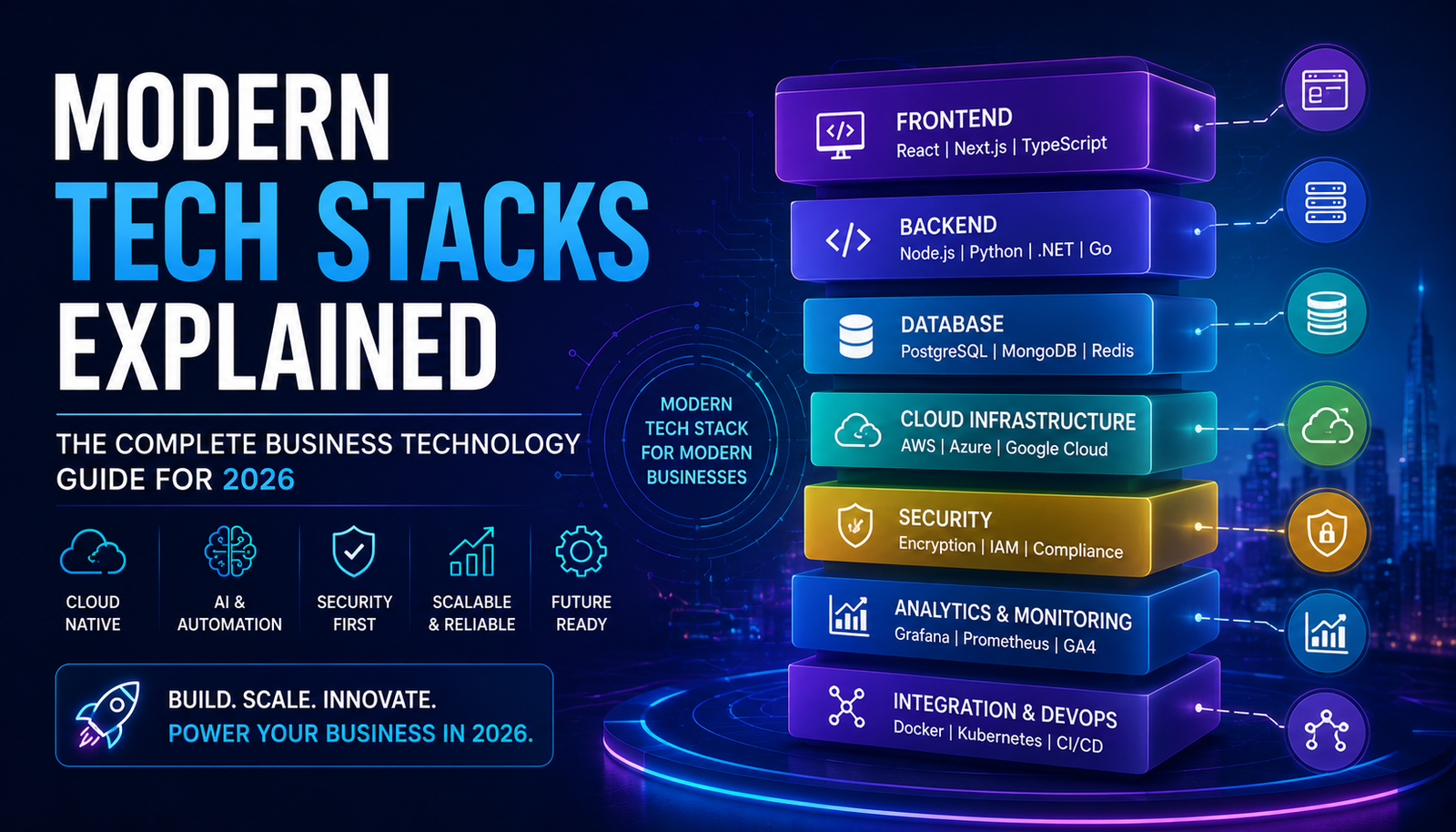
The baseline for digital infrastructure has undergone a fundamental shift. Today, a tech stacks is no longer just an administrative arrangement of operating systems, databases, and web servers. In 2026, the global web development market has reached approximately $88 billion, growing at a compound annual rate of nearly 9% [1]. This growth is accompanied by a massive architectural shift: over 84% of developers now integrate AI-powered tools directly into their development and deployment pipelines.
Selecting and managing the right business technology stack has evolved from an isolated IT decision into a core driver of business performance, directly influencing customer experience, system security, and operational overhead. Choosing an incompatible or outdated architecture can quickly lead to high maintenance costs, developer burnout, and slow release cycles. Conversely, a highly optimized, modern architecture enables organizations to scale services quickly, leverage real-time data, and seamlessly deploy intelligent capabilities.
This guide provides an exhaustive, practical breakdown of modern tech stacks in 2026. Whether you are building a lightweight startup product or modernizing a complex enterprise system, this analysis covers the architectural patterns, components, real-world examples, and step-by-step decision frameworks required to build a highly competitive digital foundation.
Table of Contents
Anatomy of a Modern Tech Stack
A modern software architecture consists of multiple specialized layers. Unlike the rigid, vertical setups of the past, today’s applications rely on modular components that communicate through highly structured APIs.
┌─────────────────────────────────────────────────────────┐
│                    Frontend Layer                       │
│     (Next.js 15, Svelte 5, React Native, Tailwind)      │
└────────────────────────────┬────────────────────────────┘
                             │ (HTTPS / WSS / gRPC)
┌────────────────────────────▼────────────────────────────┐
│                      API Gateway                        │
│            (GraphQL, Envoy, Kong, REST)                 │
└────────────────────────────┬────────────────────────────┘
                             │
┌────────────────────────────▼────────────────────────────┐
│                    Backend Services                     │
│         (Node.js/TypeScript, Go, Rust, Python)          │
└────────────┬───────────────┬───────────────┬────────────┘
             │               │               │
┌────────────▼────┐  ┌───────▼──────┐  ┌─────▼────────────┐
│ Relational DB   │  │ NoSQL / Cache│  │ Vector DB (RAG)  │
│ (PostgreSQL)    │  │ (Redis/Valkey)│  │ (Qdrant, Milvus) │
└─────────────────┘  └──────────────┘  └──────────────────┘
Below is a detailed analysis of the core layers that make up a contemporary software platform.
The Client-Side (Frontend Layer)
The frontend layer is responsible for rendering user interfaces, managing client-side state, and ensuring smooth user interactions. In 2026, frontend technologies prioritize fast rendering and reducing client-side execution overhead through strategies like hybrid rendering and partial hydration.
React 19 & Next.js 15+: React continues to be a widely adopted frontend ecosystem. With the widespread adoption of the React Compiler, manual memoization (such as useMemo and useCallback) is largely automated. Next.js remains a leading meta-framework, utilizing Server Components and Server Actions to bridge frontend interfaces and database queries while keeping the client bundle small.
Vue 3 & Nuxt: Nuxt provides a highly productive developer experience with automated routing, state management, and excellent support for static site generation (SSG) and server-side rendering (SSR).
Svelte 5: Utilizing “Runes” for fine-grained reactivity, Svelte 5 avoids the virtual DOM entirely, compiling code into highly efficient, direct DOM updates. This makes it an excellent choice for performance-sensitive and interactive dashboard applications.
Tailwind CSS & Utility-First Styling: Tailwind CSS remains a dominant styling solution. It is often paired with modern build engines like Vite and Rolldown to optimize CSS delivery and eliminate unused styles during compile time [2].
Frontend Rendering Strategies
Choosing the right rendering model directly affects Core Web Vitals, initial load speeds, and search engine optimization (SEO).
| Rendering Strategy | Mechanism | Best Use Cases | Pros | Cons |
| Server-Side Rendering (SSR) | Pages are generated dynamically on the server for each request. | Dynamic e-commerce sites, user dashboards. | Up-to-date data, fast First Contentful Paint (FCP). | Higher server load, potential latency under high traffic. |
| Static Site Generation (SSG) | Pages are compiled into static HTML files at build time. | Documentation portals, public blogs, marketing landing pages. | Extremely fast load times, low hosting costs, secure. | Build times grow with site size; not suitable for real-time data. |
| Incremental Static Regeneration (ISR) | Static pages are regenerated in the background on a schedule or via webhooks. | Large catalog sites, news publications. | Combines the speed of SSG with the dynamic updates of SSR. | Complex caching invalidation workflows. |
| Resumability (e.g., Qwik) | Eliminates hydration by serializing the application state into HTML and loading JavaScript execution on demand. | High-traffic mobile-first web applications. | Instant time-to-interactive (TTI) regardless of page complexity. | Smaller ecosystem, requires learning new architectural paradigms. |
The Server-Side (Backend Layer)
The backend handles core business logic, user authentication, data processing, and integration with databases and third-party APIs.
Node.js & TypeScript: JavaScript and TypeScript remain foundational for web services, representing a significant portion of developer activity [2]. Frameworks like NestJS provide highly structured, enterprise-grade architectures, while minimalist setups like Fastify offer high-throughput routing.
Go (Golang): Prized for its extreme efficiency, low memory footprint, and native concurrency primitives (goroutines). Go is widely used to build microservices, high-traffic API gateways, and distributed cloud-native utilities.
Rust: Increasingly chosen for core infrastructure, high-performance data processing, and system tools due to its memory safety without a garbage collector. Companies use Rust to optimize critical paths where latency must be kept to a minimum.
Python: Driven by the massive growth in AI and machine learning engineering, Python remains highly relevant. Modern frameworks like FastAPI leverage Python’s type hints to generate clean, highly performant asynchronous APIs that connect easily to vector databases and machine learning runtimes.
The Data & Storage Layer
Choosing a data layer is no longer a choice between just SQL and NoSQL. Today’s applications use polyglot persistence—matching specific data types to the database engine optimized for that structure.
┌─────────────────────────────────────────────────────────┐
│                      Data Ingestion                     │
└────────────────────────────┬────────────────────────────┘
                             │
            ┌────────────────┴────────────────┐
            ▼                                 ▼
┌────────────────────────┐        ┌───────────────────────┐
│   Relational Store     │        │ Vector & NoSQL Store  │
│  (PostgreSQL / NewSQL)  │        │ (Pinecone / MongoDB)  │
│   • Transactional Data │        │  • Semantic Search    │
│   • User Profiles      │        │  • Unstructured Docs  │
└────────────────────────┘        └───────────────────────┘
Relational Databases (SQL)
PostgreSQL: The standard for transactional databases. With extensions like pgvector, PostgreSQL easily handles relational data, JSON payloads, and high-dimensional vector embeddings within a single database instance.
NewSQL / Distributed SQL (CockroachDB, YugabyteDB): These databases combine the ACID compliance and relational structure of traditional databases with the horizontal scalability of NoSQL engines. They are ideal for global SaaS applications requiring consistent, multi-region database operations.
Non-Relational Databases (NoSQL)
MongoDB & Document Databases: Ideal for storing unstructured or semi-structured JSON records, rapidly changing schemas, and document catalogs.
Redis & Valkey: Highly performant in-memory key-value stores used for session caching, pub/sub queues, and real-time database acceleration.
Vector Databases (AI and Search)
Qdrant, Pinecone, and Milvus: Specialized database systems engineered specifically to store, index, and query high-dimensional vector embeddings. These databases are a crucial part of Retrieval-Augmented Generation (RAG) pipelines and semantic search features, allowing systems to locate contextually relevant information in fractions of a millisecond.
The API & Integration Layer
Modern APIs must support a variety of communication protocols to balance speed, payload size, and real-time synchronization.
REST (Representational State Transfer): The standard pattern for external integrations, public-facing developer APIs, and simple CRUD applications due to its universal compatibility.
GraphQL: Highly useful for complex data structures and client-side applications where over-fetching data is a concern. Instead of hitting multiple REST endpoints, a single GraphQL query fetches exactly the data required by the interface.
gRPC (Google Remote Procedure Call): Built on top of HTTP/2 and utilizing Protocol Buffers, gRPC is designed for fast, low-latency communication between internal microservices.
WebSockets & SSE (Server-Sent Events): Essential for applications that require continuous, low-latency, bidirectional data updates, such as collaborative document editors, live financial dashboards, and real-time chat systems.
Cloud Infrastructure & DevOps Layer
The cloud technology stack dictates how an application is deployed, managed, and scaled under varying traffic loads.
Hyperscale Cloud Providers: Amazon Web Services (AWS), Google Cloud Platform (GCP), and Microsoft Azure remain the foundation of enterprise deployments.
Specialized Platforms-as-a-Service (PaaS): Platforms like Vercel, Supabase, Railway, and Render abstract away infrastructure complexity, allowing small teams to deploy web applications and databases with minimal DevOps overhead.
Infrastructure as Code (IaC): Tools like Terraform and Pulumi allow teams to define, version, and deploy cloud infrastructure using declarative configuration files or standard programming languages, ensuring environments remain consistent and easily reproducible.
Containerization & Orchestration: Docker is the standard for packaging applications with all their dependencies. For large systems, Kubernetes provides the orchestration required to manage container lifecycle, networking, and scaling.
Cognitive & AI Integration Layer
In 2026, AI integrations are no longer external add-ons; they are integrated directly into the core application layer [2].
LLM Orchestration: Toolkits like LangChain and LlamaIndex manage the complex workflows required to clean, format, feed, and retrieve data from Large Language Models.
Agentic API Gateways: Gateway architectures now manage AI agent interactions, handling semantic caching (to avoid expensive duplicate LLM API calls), rate-limiting for automated accounts, and prompt security checks.
Architectural Patterns: Monoliths, Microservices, and Edge
Selecting a modern software architecture involves evaluating trade-offs between system complexity, operational overhead, and scalability.
┌─────────────────────────────────────────────────────────────────┐
│                      Architectural Taxonomy                     │
├─────────────────┬─────────────────┬──────────────┬──────────────┤
│    Monolithic   │  Microservices  │  Serverless  │     Edge     │
│   "All-in-One"  │  "Distributed"  │ "On-Demand"  │ "Localized"  │
└─────────────────┴─────────────────┴──────────────┴──────────────┘
Monolithic Architecture
A monolithic architecture packages the user interface, business logic, and database interactions into a single, cohesive codebase.
When to Use: Early-stage startups, Proofs of Concept (POCs), and small business internal tools where development speed and simple deployment are the priority.
Pitfall: Over time, codebases can become tightly coupled, making it difficult to update individual features without deploying the entire system.
Microservices Architecture
This approach splits the application into small, independent services organized around specific business capabilities. Each service runs in its own process and communicates using lightweight protocols like HTTP/REST or gRPC.
When to Use: Enterprise platforms, multi-tenant SaaS networks, and complex systems managed by separate development teams.
Pitfall: Significantly increases the complexity of local testing, data consistency, and distributed logging.
Serverless Architecture
Serverless computing abstracts server management entirely. Code is executed inside lightweight ephemeral containers that spin up in response to events and scale down to zero when idle.
When to Use: Event-driven processing pipelines, background jobs, dynamic file conversion, and fluctuating API traffic.
Pitfall: Cold starts can introduce latency spikes, and vendor lock-in with cloud-specific services can be difficult to reverse.
Edge Computing
Edge architectures deploy lightweight server-side code to distributed CDN points of presence located as close to the user as possible.
When to Use: Global personalization, geographical redirect routing, real-time image transformation, and low-latency API proxying.
Pitfall: Limited memory and computing capacity prevent running heavy database operations directly at the edge.
Architectural Pattern Comparison Matrix
| Architectural Dimension | Monolithic Architecture | Microservices Architecture | Serverless Architecture | Edge Architecture |
| Initial Velocity | Exceptionally High | Low to Medium | High | Medium |
| Deployment Complexity | Low (Single Artifact) | High (Multiple pipelines) | Low (Managed by cloud) | Medium |
| Operational Overhead | Low to Medium | High (Requires Kubernetes/Service Mesh) | Minimal | Low to Medium |
| Horizontal Scalability | Vertical mostly; complex to scale horizontally | High (Scale individual services) | Infinitely Auto-scalable | Highly scalable, local execution |
| Cold-Start Penalties | None | None | 50ms – 500ms (Language dependent) | Near zero (<10ms) |
| Global Latency | High (Tethered to single region) | Variable (Region dependent) | Variable (Region dependent) | Ultra-Low (<30ms global average) |
Real-World Tech Stack Examples
The following design patterns illustrate how different components are combined to build high-performance production systems across various industries.
The B2B SaaS Startup (Optimized for Speed & Efficiency)
For a startup, the primary goals are minimizing operational overhead, accelerating feature delivery, and ensuring clear scalability as user adoption grows.
┌─────────────────────────────────────────────────────────┐
│                    Next.js Frontend                     │
│                  (Vercel Hosting)                       │
└────────────────────────────┬────────────────────────────┘
                             │ (TypeScript APIs)
┌────────────────────────────▼────────────────────────────┐
│                    Fastify Server                       │
│                  (Render Hosting)                       │
└────────────────────────────┬────────────────────────────┘
                             │
            ┌────────────────┴────────────────┐
            ▼                                 ▼
┌────────────────────────┐        ┌───────────────────────┐
│     PostgreSQL         │        │    Redis (Valkey)     │
│   (Neon Serverless)    │        │  (Upstash Cache)      │
└────────────────────────┘        └───────────────────────┘
Frontend Framework: Next.js (TypeScript) hosted on Vercel.
Backend Server: Fastify running on Node.js.
Database: PostgreSQL hosted via Neon Serverless.
Caching & Queue: Redis managed by Upstash.
Authentication & Security: Clerk or Kinde for rapid identity integration.
Production Configuration Example
A clean, production-ready backend dockerization file ensures that application environments are identical across local developer laptops and cloud deployment services.
# ==============================================================================
# B2B SaaS Backend Service Dockerfile
# Optimized for Node.js / TypeScript / Fastify in Production
# ==============================================================================

# Phase 1: Build & Compiling
FROM node:22-alpine AS builder

WORKDIR /usr/src/app

COPY package*.json tsconfig.json ./
RUN npm ci

COPY src/ ./src
RUN npm run build && npm prune --production

# Phase 2: Lightweight Production Execution Run-Time
FROM node:22-alpine AS runner

ENV NODE_ENV=production
ENV PORT=8080

WORKDIR /usr/app

COPY --from=builder /usr/src/app/package*.json ./
COPY --from=builder /usr/src/app/node_modules ./node_modules
COPY --from=builder /usr/src/app/dist ./dist

# Run as non-privileged system user for container security
USER node

EXPOSE 8080

CMD ["node", "dist/server.js"]
Basic Infrastructure as Code (IaC) with Terraform
Defining the infrastructure explicitly allows developers to build reproducible cloud resources for local test verification and clean, matching production setups.
# ==============================================================================
# Terraform configuration file for B2B SaaS Startup Infrastructure
# Creates a managed PostgreSQL database and Redis Cache instance
# ==============================================================================

terraform {
  required_version = ">= 1.5.0"
  required_providers {
    aws = {
      source  = "hashicorp/aws"
      version = "~> 5.0"
    }
  }
}

provider "aws" {
  region = var.aws_region
}

variable "aws_region" {
  type    = string
  default = "us-east-1"
}

variable "environment" {
  type    = string
  default = "production"
}

# ------------------------------------------------------------------------------
# Managed Database Layer (PostgreSQL)
# ------------------------------------------------------------------------------
resource "aws_db_instance" "postgres" {
  identifier             = "saas-db-${var.environment}"
  allocated_storage      = 20
  max_allocated_storage  = 100
  engine                 = "postgres"
  engine_version         = "16.1"
  instance_class         = "db.t4g.micro"
  db_name                = "saas_app_db"
  username               = "db_admin_user"
  password               = "SecureRandomPassword123!" # In real setups, use AWS Secrets Manager
  parameter_group_name   = "default.postgres16"
  skip_final_snapshot    = true
  publicly_accessible    = false

  tags = {
    Environment = var.environment
    Service     = "database"
  }
}

# ------------------------------------------------------------------------------
# In-Memory Cache Layer (Redis / Valkey Compatibility)
# ------------------------------------------------------------------------------
resource "aws_elasticache_cluster" "redis" {
  cluster_id           = "saas-cache-${var.environment}"
  engine               = "redis"
  node_type            = "cache.t4g.micro"
  num_cache_nodes      = 1
  parameter_group_name = "default.redis7"
  port                 = 6379

  tags = {
    Environment = var.environment
    Service     = "cache"
  }
}

output "database_endpoint" {
  value       = aws_db_instance.postgres.endpoint
  description = "The database connection endpoint."
}

output "cache_endpoint" {
  value       = aws_elasticache_cluster.redis.cache_nodes[0].address
  description = "The primary cache node address."
}
High-Growth Fintech App (Optimized for Security & Compliance)
Fintech architectures prioritize strict data privacy (GDPR, PCI-DSS compliance), deterministic calculations, and detailed, real-time transaction tracking.
┌─────────────────────────────────────────────────────────┐
│                 Swift / Kotlin Native Mobile            │
└────────────────────────────┬────────────────────────────┘
                             │ (Mutual TLS)
┌────────────────────────────▼────────────────────────────┐
│                  Envoy API Gateway                      │
└────────────────────────────┬────────────────────────────┘
                             │
            ┌────────────────┴────────────────┐
            ▼                                 ▼
┌────────────────────────┐        ┌───────────────────────┐
│      Go Services       │        │     Rust Ledger       │
│  (Payment Processing)  │        │   (Double-Entry)      │
└───────────┬────────────┘        └───────────┬───────────┘
            │                                 │
┌───────────▼────────────┐        ┌───────────▼───────────┐
│      CockroachDB       │        │     Apache Kafka      │
│  (Distributed SQL)     │        │  (Audit Log Stream)   │
└────────────────────────┘        └───────────────────────┘
Mobile Clients: Native iOS (Swift) and Native Android (Kotlin) to ensure maximum hardware-level security, secure storage integration, and snappy user interfaces.
API Gateway: Envoy Proxy utilizing mutual TLS (mTLS) decryption for secure backend service communication.
Backend Engines: Go for high-throughput payment routing; Rust for processing the double-entry accounting ledger to ensure low-latency, thread-safe calculations.
Database: CockroachDB (Distributed SQL) to prevent data inconsistencies and guarantee immediate data synchronization across multiple geographic locations.
Event Pipeline: Apache Kafka to maintain a reliable, immutable real-time audit trail of all transactions.
The Enterprise E-Commerce Engine (Optimized for Scalability)
This architecture uses a headless setup designed to handle sudden traffic spikes (such as holiday sales) while delivering personalized buyer interfaces globally.
Frontend Layer: Next.js running on Vercel. This setup relies on dynamic routing and Edge Middleware to run regional personalization rules without adding server latency.
Core Microservices: Go-based services containerized inside Kubernetes (AWS EKS), separating checkout, user profiles, product catalogs, and review engines.
Primary Database: PostgreSQL (using Amazon Aurora Serverless) to manage user accounts, cart configurations, and checkout details securely.
In-Memory Store: Valkey clusters to manage product catalog caching and high-speed session tracking.
Search Engine: Elasticsearch or Meilisearch to power rapid, typo-tolerant search and filtered product navigation.
The AI-First SaaS Stack (Optimized for LLM Workflows)
Designed for modern generative AI applications, this stack efficiently handles unstructured document uploads, text extraction, semantic search, and context-aware LLM processing.
┌─────────────────────────────────────────────────────────┐
│                  Next.js App Interface                  │
└────────────────────────────┬────────────────────────────┘
                             │
┌────────────────────────────▼────────────────────────────┐
│                 Python FastAPI Backend                  │
└────────────┬───────────────┬───────────────┬────────────┘
             │               │               │
┌────────────▼────┐  ┌───────▼──────┐  ┌─────▼────────────┐
│   PostgreSQL    │  │   LlamaIndex │  │    Qdrant DB     │
│ (Transactional) │  │(Orchestration)│  │ (Vector Store)   │
└─────────────────┘  └───────┬──────┘  └──────────────────┘
                             │
                     ┌───────▼──────┐
                     │ OpenAI / Claude│
                     │  (LLM Engine)│
                     └──────────────┘
Application Interface: Next.js (TypeScript) to manage application dashboards, document upload pipelines, and responsive real-time chat screens.
Backend API Service: Python FastAPI. Python is the standard language for AI development due to its rich ecosystem of data manipulation libraries.
Orchestration Engine: LlamaIndex to manage document parsing pipelines, clean raw text inputs, and coordinate prompt generation.
Vector Database: Qdrant or Pinecone, used to index and run vector similarity searches on uploaded files.
Primary Database: PostgreSQL to store core transactional records like billing details, user profile data, and conversation history logs.
AI Engine: Claude 3.5 Sonnet or OpenAI GPT-4o accessed via API, combined with open-source models like Llama 3 running on dedicated inference instances.
Python AI Orchestration Example
Below is a complete FastAPI backend router showing how to handle unstructured PDF file parsing, create vector embeddings, and store them securely in a vector database instance using Python.
"""
==============================================================================
AI-First SaaS Router Example (FastAPI + Qdrant + OpenAI Embeddings)
==============================================================================
"""

from fastapi import APIRouter, UploadFile, File, HTTPException, status
from pydantic import BaseModel
import openai
from qdrant_client import QdrantClient
from qdrant_client.http.models import Distance, VectorParams, PointStruct
import uuid
import os

router = APIRouter(prefix="/api/v1/ingest", tags=["AI Ingestion"])

# Safe initialization of vector client and AI model components
QDRANT_HOST = os.getenv("QDRANT_HOST", "localhost")
QDRANT_PORT = int(os.getenv("QDRANT_PORT", 6333))

qdrant_client = QdrantClient(host=QDRANT_HOST, port=QDRANT_PORT)
collection_name = "kb_user_documents"

# Ensure target Vector Collection exists upon system startup
try:
    qdrant_client.create_collection(
        collection_name=collection_name,
        vectors_config=VectorParams(size=1536, distance=Distance.COSINE),
    )
except Exception:
    # Collection exists or connection fallback logic runs
    pass


class IngestResponse(BaseModel):
    document_id: str
    vector_status: str
    chunk_count: int


@router.post("/document", response_model=IngestResponse, status_code=status.HTTP_201_CREATED)
async def ingest_document(file: UploadFile = File(...)):
    """
    Parses incoming client documents, generates text chunk embeddings,
    and inserts the data into Qdrant for semantic search queries.
    """
    # Simple validation on file extension
    if not file.filename.endswith(".txt"):
        raise HTTPException(
            status_code=400,
            detail="Invalid file format. Only standard plain-text .txt files are supported."
        )

    try:
        # Read the file content safely
        raw_content = await file.read()
        text_content = raw_content.decode("utf-8")

        # Split text into simple 500-character chunks
        chunks = [text_content[i:i+500] for i in range(0, len(text_content), 400)]

        point_structures = []
        document_uuid = str(uuid.uuid4())

        for index, chunk in enumerate(chunks):
            # Generate OpenAI embeddings for the current text chunk
            embedding_response = openai.embeddings.create(
                model="text-embedding-3-small",
                input=[chunk]
            )
            vector = embedding_response.data[0].embedding

            # Formulate the payload structure
            point_structures.append(
                PointStruct(
                    id=str(uuid.uuid4()),
                    vector=vector,
                    payload={
                        "document_id": document_uuid,
                        "chunk_index": index,
                        "text_content": chunk,
                    }
                )
            )

        # Bulk upsert the embedded vectors into Qdrant database
        qdrant_client.upsert(
            collection_name=collection_name,
            points=point_structures
        )

        return IngestResponse(
            document_id=document_uuid,
            vector_status="Success",
            chunk_count=len(chunks)
        )

    except Exception as error:
        raise HTTPException(
            status_code=500,
            detail=f"Failed to complete document ingestion pipeline. Error: {str(error)}"
        )
Step-by-Step Workflow: Choosing & Evaluating Your Tech Stack
Selecting a business technology stack is a significant capital decision. This structured five-phase framework helps teams align engineering choices with core business objectives.
┌──────────────────────────────────────────────┐
│ Phase 1: Requirements Discovery              │
│  • Define scaling targets, latency limits    │
└──────────────────────┬───────────────────────┘
                       │
┌──────────────────────▼───────────────────────┐
│ Phase 2: Create Architectural Decision Records│
│  • Record technical patterns, evaluate tech   │
└──────────────────────┬───────────────────────┘
                       │
┌──────────────────────▼───────────────────────┐
│ Phase 3: Map Security & Regulatory Rules     │
│  • Plan compliance constraints (GDPR/HIPAA)  │
└──────────────────────┬───────────────────────┘
                       │
┌──────────────────────▼───────────────────────┐
│ Phase 4: Assess Developer Talent Pool        │
│  • Evaluate language popularity, hiring costs│
└──────────────────────┬───────────────────────┘
                       │
┌──────────────────────▼───────────────────────┐
│ Phase 5: Calculate Total Cost of Ownership   │
│  • Projection of ongoing infrastructure costs │
└──────────────────────────────────────────────┘
Requirements Discovery & Technical Trade-offs
Avoid choosing tools based on hype or trend checklists. Start by defining the core operational limits and requirements of the system:
Peak Traffic Scaling: How many concurrent users or requests per second must the system support from day one?
Database Access Patterns: Is the application read-heavy (e.g., content portals), write-heavy (e.g., IoT data ingestion), or transaction-heavy (e.g., order processing)?
Acceptable Latency Budget: What are the target latency limits for critical user API endpoints?
Offline Support Needs: Does the application need client-side data synchronization to remain functional offline (such as field service software)?
Creating Architectural Decision Records (ADRs)
An Architectural Decision Record (ADR) is a simple document that captures a critical design choice, the context around it, and the long-term trade-offs of the decision. Writing ADRs helps keep teams aligned and prevents recurring arguments about why specific systems or frameworks were chosen.
# ADR 04: Use PostgreSQL as the Primary Relational Database

## Status
Accepted

## Context
Our core application requires ACID-compliant transactions for payment processing and structured user accounts. We also need to support semi-structured metadata for client custom fields, and planned feature roadmaps call for basic semantic search capabilities down the line.

## Decision
We will use PostgreSQL as our primary database engine, hosted via a managed cloud database service. We will use the native jsonb columns for semi-structured metadata and the pgvector extension for high-dimensional semantic search.

## Consequences
- **Pros**: Reduces operational overhead by eliminating the need to run and manage separate document and vector databases early on.
- **Cons**: Scalability relies on vertical database upgrades; we will eventually need to implement read replicas as traffic scales.
Security, Regulatory, and Compliance Mapping
Regulatory compliance is a core structural constraint that must be addressed at the beginning of the design phase, not as a quick fix before launch.
GDPR/CCPA Compliance: Implement architectures that support the “Right to be Forgotten” (erasing customer data across primary databases and backup systems) and allow user data to be exported easily.
HIPAA/HITECH Compliance (Healthcare): Ensure all data is encrypted both in transit and at rest, configure detailed access logging, and choose cloud vendors that will sign a Business Associate Agreement (BAA).
PCI-DSS (Payment Processing): Minimize security liability by routing payment inputs through secure payment gateways (like Stripe or Adyen) to keep credit card numbers out of your internal databases.
Talent Pool Viability & Ecosystem Support
Your engineers must build, maintain, and secure the systems you choose. Before committing to a niche programming language or a highly complex framework, evaluate:
Talent Availability: How easy is it to hire experienced engineers for this language in your area or remote hiring markets?
Community Lifespan: Does the framework have active development, regular security patches, and a large ecosystem of libraries and extensions?
Onboarding Velocity: How long does it take for a new engineer to clone the code repository, set up their local development environment, and ship their first change?
Calculating Total Cost of Ownership (TCO)
The cost of a technology stack goes far beyond your monthly cloud platform bill. A realistic TCO projection includes:
Direct Cloud Cost: Compute resources, database instances, network egress fees, and storage buckets.
SaaS Licensing Fees: Managed authentication engines (e.g., Auth0), communication APIs (e.g., Twilio), and payment processing fees.
Maintenance Labor: The engineering time required to run database migrations, patch operating systems, and upgrade dependencies.
Opportunity Cost of Complexity: The impact of developer time spent managing complex infrastructure instead of building core business features.
To illustrate, consider the financial difference between hosting a custom containerized system versus using a managed platform-as-a-service (PaaS).
TCOPaaS=Cloud Costs+SaaS Fees+(Fewer Engineering Hours×Hourly Rate)TCOPaaS=Cloud Costs+SaaS Fees+(Fewer Engineering Hours×Hourly Rate)TCOCustom=Lower Cloud Costs+SaaS Fees+(More DevOps Engineering Hours×Hourly Rate)TCOCustom=Lower Cloud Costs+SaaS Fees+(More DevOps Engineering Hours×Hourly Rate)While direct resource costs are typically lower when using raw infrastructure, the additional engineering hours required for maintenance can make managed platforms a highly cost-effective choice for smaller teams.
Technology Decision Matrix
This matrix provides a structured starting point for choosing primary architectural tools based on your specific team size, product stage, and scale requirements.
| Business Profile | Ideal Strategy | Key Advantages | Suggested Frontend | Suggested Backend | Suggested Database |
| Early-stage Startup / POC | High-productivity monolith or managed serverless setup. | Maximizes feature speed, reduces cloud bills, and minimizes DevOps work. | Next.js or Nuxt | Node.js (TypeScript) | Managed PostgreSQL (Supabase) |
| High-Traffic Consumer App | Hybrid rendering paired with edge computing. | Delivers fast page loads globally and scales automatically during traffic spikes. | Next.js (SSR/Edge rendering) | Go or Rust microservices | Distributed SQL / Redis Cache |
| Fintech / Financial Service | Strict microservices with transactional databases. | Guarantees data consistency, provides detailed audit trails, and isolates critical services. | Native iOS (Swift) & Android (Kotlin) | Go / Rust | CockroachDB / Apache Kafka |
| Enterprise / Multi-tenant SaaS | Cloud-native microservices running on Kubernetes. | Allows engineering teams to work independently and scales services on demand. | React or Vue | Go or NestJS | Multi-region PostgreSQL / Valkey |
| Generative AI / RAG Platform | Python backend paired with dedicated vector search databases. | Simplifies document parsing and delivers fast semantic search queries. | Next.js | Python (FastAPI) | PostgreSQL + Qdrant / Pinecone |
Business Benefits of Stack Modernization
Upgrading legacy platforms to a modernized business technology stack yields significant, measurable improvements in engineering efficiency and operational costs.
┌─────────────────────────────────────────────────────────┐
│             Key Business Benefits of Modernization      │
├─────────────────────────┬───────────────────────────────┤
│  Cost Optimization      │  Developer Velocity           │
│  • Scale compute down   │  • Fast deployments, modern   │
│  • Eliminate idle costs │    tooling improves retention │
├─────────────────────────┼───────────────────────────────┤
│  Operational Resiliency │  Intelligent Integrations     │
│  • Auto-scaling, self-  │  • Fast vector search, direct │
│  • healing architectures│    cognitive tool support     │
└─────────────────────────┴───────────────────────────────┘
Significant Infrastructure Cost Savings
Older server systems require keeping virtual machines running constantly to handle traffic spikes, which leads to high idle hosting costs. Modern serverless containers and auto-scaling setups spin down resources when traffic is low, ensuring you only pay for the compute resources you actually use.
Shorter Time-to-Market for New Features
Modern development tooling—such as fast local runtimes (Vite), continuous deployment pipelines (GitHub Actions), and clear modular APIs—greatly reduces development cycle times. Teams can write, test, and deploy feature updates in hours instead of waiting weeks for a manual, monolithic release process.
Improved Engineering Team Retention
Developer experience directly affects developer retention. Forcing development teams to work with slow, outdated build pipelines, unstable test environments, and manual server configurations often leads to frustration and high turnover. Providing modern, reliable frameworks and automated deployment setups improves morale and allows engineers to focus on building features rather than managing infrastructure.
Better System Reliability and Uptime
By shifting core services to cloud-native platforms, systems gain access to self-healing tools, multi-region database failovers, and automatic traffic routing. If a server container crashes, the container manager automatically destroys and replaces it in seconds, minimizing the risk of user-facing downtime.
Challenges & Pitfalls: Navigating Legacy Debt
System modernization is a complex process with several common pitfalls. Avoiding these traps is critical for a smooth architectural transition.
The Trap of Over-Engineering (Resume-Driven Development)
Engineers can sometimes recommend complex, hype-driven tools—such as building a multi-region Kubernetes cluster when a simple, well-structured monolith or PaaS setup would easily handle the traffic. This over-engineering introduces unnecessary complexity, making the system harder to maintain and slowing down the product roadmap. Keep your architecture as simple as possible until scaling demands require more complex solutions.
Managed Services vs. Vendor Lock-In
Using cloud-specific features (like AWS DynamoDB or GCP Firestore) allows teams to build products quickly but binds the application to that specific cloud provider. If hosting costs rise or you need to shift to a different platform, rewriting database structures and integration code can be incredibly expensive.
Mitigation: Use containerized platforms (Docker) and open-source standards (like PostgreSQL or Valkey) so you can easily shift workloads between different cloud providers if needed.
Managing Data Migration from Legacy Systems
Moving legacy systems (such as migrating database records from old COBOL setups or legacy PHP relational schemas) presents real risk.
Mitigation: Avoid high-risk, “big bang” deployments where you switch off the old system overnight. Instead, use the Strangler Fig Pattern: gradually replace parts of the legacy system with modern services until the old application is completely phased out.
Step 1 (Legacy App):
┌────────────────────────┐
│  [Legacy Application]  │──────► Users
└────────────────────────┘

Step 2 (Coexistence):
                           ┌────────────────────────┐
                     ┌────►│  [Modern Backend App]  │
┌─────────────────┐  │     └────────────────────────┘
│   API Gateway   │──┤
└─────────────────┘  │     ┌────────────────────────┐
                     └────►│  [Legacy Application]  │
                           └────────────────────────┘

Step 3 (Target State Completed):
┌────────────────────────┐
│  [Modern Backend App]  │──────► Users
└────────────────────────┘
Future Trends Beyond 2026
As you plan your infrastructure, keep an eye on several key trends shaping modern software systems.
┌─────────────────────────────────────────────────────────┐
│               Emerging Technical Frontiers              │
├─────────────────────────────────────────────────────────┤
│  WebAssembly (Wasm) on the Edge                         │
│  • Instant startups, sandboxed near-native speeds      │
├─────────────────────────────────────────────────────────┤
│  AI-Guided System Optimization                          │
│  • Automated database indexing, adaptive resource scales │
├─────────────────────────────────────────────────────────┤
│  Green Computing Metrics in DevOps                      │
│  • Carbon-efficient cloud zones, low-watt algorithms   │
└─────────────────────────────────────────────────────────┘
WebAssembly (Wasm) Server-Side Deployments
WebAssembly is moving beyond the browser to become a major technology for edge compute runtimes. Wasm modules run sandboxed, start up in milliseconds, and consume far fewer server resources than standard Docker containers. This enables organizations to run high-performance services directly on edge CDNs.
AI-Assisted System Optimization
Cloud infrastructure setups are shifting from manual configuration to self-optimizing setups guided by machine learning. Automated AI agents analyze production traffic patterns in real-time, dynamically adjusting server scale, modifying database indexes, and tuning API gateway caching rules to keep hosting costs as low as possible while maintaining target performance levels.
Green Computing and Carbon-Aware Infrastructure
As computational power demands rise—particularly from high-performance AI workloads—businesses face pressure to monitor and reduce the carbon footprint of their digital infrastructure. Modern CI/CD platforms and cloud orchestration tools are beginning to include energy consumption metrics. These features allow systems to run heavy, non-time-sensitive data analysis tasks in geographic regions and at times of day when renewable energy is most available on the local power grid.
Comprehensive Glossary of Modern Tech Terms
API Gateway: A reverse proxy that acts as a single entry point for all clients, routing incoming requests, handling authentication, and consolidating response payloads from multiple internal services.
ACID Compliance: A set of database properties (Atomicity, Consistency, Isolation, Durability) that guarantee database transactions are processed reliably, avoiding data corruption.
Edge Computing: A distributed computing model that executes code on servers positioned geographically closer to the end user (often on CDN edge nodes) to reduce latency.
Hydration: The client-side process where framework libraries load state and attach event listeners to static HTML sent by the server, making the page interactive.
Infrastructure as Code (IaC): The practice of managing and provisioning cloud resources (such as virtual servers, networks, and databases) through machine-readable configuration files rather than manual dashboard configuration.
Microservices: An architectural style where a large application is built as a suite of small, modular services that run independently and communicate via structured protocols like REST or gRPC.
Monolithic Architecture: A traditional software design pattern where all application components—user interface, business logic, and database access—are compiled and deployed as a single unit.
Protocol Buffers: An open-source, binary serialization protocol developed by Google that is used by gRPC to exchange structured payloads faster and with less overhead than text-based JSON.
Retrieval-Augmented Generation (RAG): An architectural pattern that extends the capabilities of Large Language Models (LLMs) by retrieving contextually relevant information from an external vector database before sending a prompt to the model.
Serverless Computing: A cloud execution model where cloud providers dynamically manage the allocation and scaling of server resources, billing clients only for the exact computing time used during execution.
Vector Embedding: A high-dimensional numerical representation of unstructured data (such as text, images, or audio) that captures the semantic meaning of the source material.
Frequently Asked Questions (FAQs)
How do you choose between building a monolith and building microservices in 2026?
Start with a well-structured monolithic architecture unless you have clear, compelling reasons to do otherwise. If you have a small engineering team and are still finding product-market fit, a monolith will let you ship features quickly and keep deployment pipelines simple. Move to microservices when your scaling requirements or team growth demand it. For example, if you have separate product teams that need to deploy updates independently without blocking each other, or if certain features have highly specific scaling needs (like high-throughput processing tasks that would overwhelm the main web server), microservices are the appropriate choice.
Why is PostgreSQL so widely recommended over NoSQL databases?
PostgreSQL has evolved to support a wide range of modern data needs. Beyond its robust relational transactional features, it handles semi-structured data through JSONB columns, geospatial coordinates with PostGIS, and vector embeddings using pgvector. This flexibility allows businesses to manage relational tables, document stores, and vector search in a single database. This eliminates the operational overhead of running and paying for separate document or vector databases early on.
What are the key elements of an AI-ready tech stack?
An AI-ready stack requires:
A clean document ingestion pipeline (often built with Python FastAPI and libraries like LlamaIndex or LangChain).
A vector store (like Qdrant, Pinecone, or pgvector) to index high-dimensional text embeddings.
A secure API integration layer to connect with LLM providers (like Anthropic or OpenAI) or local open-source models.
A caching layer (like Valkey or Redis) to save semantic queries and prevent expensive, redundant LLM API calls.
What is the impact of edge computing on SEO and core web vitals?
Edge computing improves SEO and Core Web Vitals by moving server-side logic closer to the user. Running features like geographic routing, custom redirects, dynamic image transformation, and personalization rules at edge nodes means the initial server response times are kept extremely low (often under 30 milliseconds). This dramatically improves Largest Contentful Paint (LCP) and reduces Cumulative Layout Shift (CLS), which directly helps search engine rankings.
Why has Rust become so popular in modern backend tooling?
Rust provides high-performance execution on par with C and C++, but features built-in compiler-enforced memory safety. This prevents common security vulnerabilities like buffer overflows and memory leaks without requiring a garbage collector. As a result, companies use Rust to build high-performance developer tools (like build engines and linters), web servers with low, predictable latency, and high-throughput data processing systems that run efficiently with minimal server costs.
What is the difference between gRPC and REST APIs, and when should I use each?
REST APIs are built on HTTP and exchange human-readable text payloads (usually JSON). This simplicity makes REST the standard choice for public APIs and integration with external platforms.
In contrast, gRPC runs on HTTP/2 and uses Protocol Buffers to serialize data into highly compressed binary payloads. It supports fast, bidirectional streaming communication, making it ideal for internal microservices where reducing server-to-server communication latency is the primary goal.
How does using Infrastructure as Code (IaC) save money for a business?
Infrastructure as Code (IaC) saves money by preventing human configuration errors and automating how cloud environments are managed. Instead of manually creating servers, firewalls, and storage databases through a web console, teams define infrastructure in version-controlled files. This prevents “configuration drift” between staging and production and makes it easy to spin up clean development environments on demand. Teams can also write scripts to automatically shut down development environments overnight and on weekends, eliminating waste.
What are “cold starts” in serverless environments, and how do you prevent them?
A cold start happens when a serverless function is called after being idle. The cloud platform has to spin up a new container instance and load your application code before running the function, which can add several hundred milliseconds of latency.
To minimize cold starts:
Keep runtime bundles small by using lightweight, fast-compiling languages (like Go or Node.js) instead of heavier frameworks.
Configure “provisioned concurrency,” which pays to keep a baseline number of container instances warm and active.
Use edge computing networks (like Cloudflare Workers), which rely on isolated V8 execution spaces to run code with near-zero startup delay.
What is a “Cognitive Operating System,” and how does it relate to tech stacks?
A Cognitive Operating System is an emerging architectural layer where AI agents coordinate and execute workflows across multiple business platforms. Instead of relying on manual point-to-point API integrations, a cognitive layer uses a central model with access to your systems (like CRMs, support ticket systems, and databases) to analyze complex data across platforms, automate tasks, and make real-time decisions.
How do you handle legacy databases when modernizing an application?
Avoid trying to replace or rewrite a legacy database overnight. Use the Strangler Fig Pattern: build an API gateway layer in front of your legacy systems, and write adapter services to translate communication between the old database and new applications. Gradually route write and read actions to a new, modern database instance for individual services, keeping data synchronized in the background. Once all features and services are migrated, you can safely retire the legacy database.
Conclusion
Building a successful digital platform relies on keeping your architecture as simple as possible while planning for future growth. By selecting modular components, documenting technical decisions clearly with Architectural Decision Records, and using modern cloud-native standards, your team will spend less time managing complex infrastructure and more time building features that deliver real business value.
References
[1] https://www.webandcrafts.com/blog/modern-tech-stack-trends
[2] https://survey.stackoverflow.co/2025/