
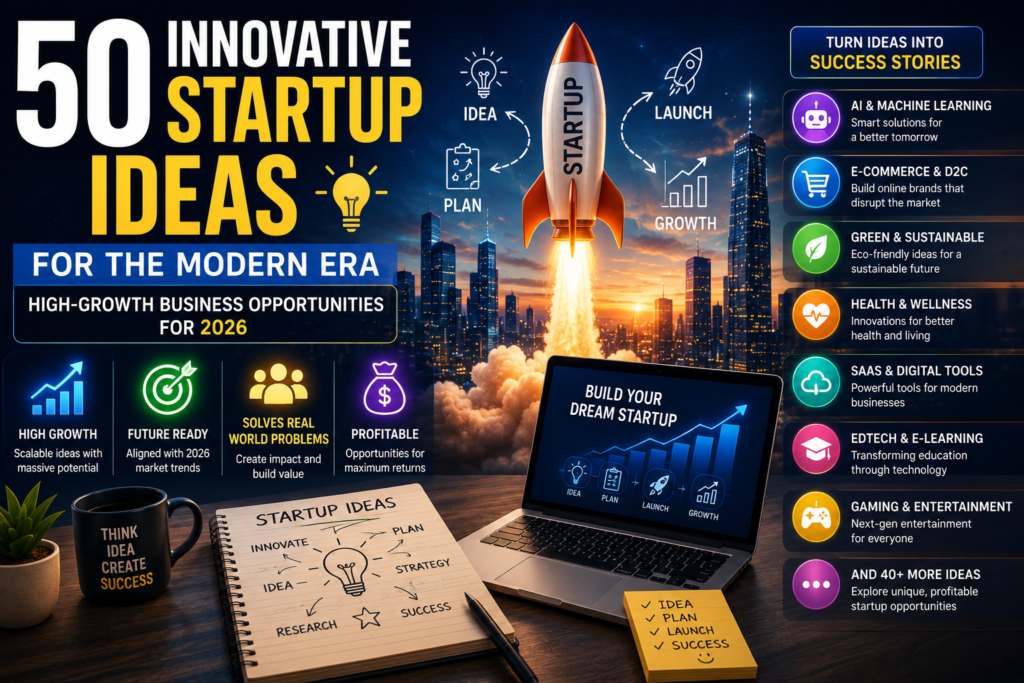
The entrepreneurial landscape is undergoing one of the most profound transitions in recent economic history. The initial wave of general-purpose artificial intelligence has matured[1], giving way to a pragmatic era defined by vertical integration, autonomous agent networks[2][3], physical AI[1][4], and a strict regulatory focus on sustainability and digital sovereignty[2]. Founders looking for high-growth startup ideas 2026 must move past superficial software layers. High-interest rates and disciplined capital markets mean that venture capitalists and bootstrappers alike are demanding clear paths to profitability, demonstrable unit economics, and defensible IP[5][6].
Whether you are an aspiring builder, an experienced operator, or an investor seeking the next wave of profitable business ideas, this comprehensive guide details 50 innovative business ideas across five high-growth sectors, accompanied by practical validation frameworks, funding strategies, and financial projections.
Market Trends Shaping 2026 and Beyond
To build a resilient enterprise, founders must align their startup opportunities with macro-technological and structural shifts. Key factors defining the market include:
1. The Rise of Agentic and Physical AI
The era of simple prompt-and-response AI is behind us. Businesses are prioritizing agentic workflows—systems where multi-agent networks operate autonomously, make decisions, execute multi-step APIs, and self-correct[2][3][7]. Simultaneously, AI is moving into the physical realm[1][4]. The convergence of advanced computer vision, sensor technology, and low-cost robotics has made localized physical automation highly accessible to mid-market enterprises[1][4].
2. Verticalization and the Disruption of Legacy SaaS
Horizontal SaaS platforms that offer generic tools (such as general-purpose CRM or project management tools) are facing intense downward pricing pressure. High-growth future business ideas are centered on Vertical SaaS—deeply specialized software tailored to specific, highly regulated industries like maritime logistics, clinical trials, regional banking, and agricultural compliance.
3. Digital Sovereignty, Privacy, and Trust
With the rise of sophisticated synthetic media, deepfakes, and stringent regional data laws, there is a massive market demand for trust infrastructure[2][3][8]. Technologies focused on digital provenance, confidential computing, and localized, sovereign data centers are transitioning from niche compliance needs to core enterprise requirements[2][3][8].
4. Carbon Transparency and Circular Supply Chains
Global environmental regulations now demand that corporations account not just for their direct emissions, but also for their Scope 3 emissions (indirect emissions from their upstream and downstream supply chains). This regulatory shift has transformed sustainability from a public relations asset into a hard compliance requirement, opening up vast B2B markets.
Category 1: Artificial Intelligence & DeepTech Startups
The market for specialized artificial intelligence has transitioned from foundation model development to the execution layer[1]. The following ten innovative startup ideas focus on high-impact, practical deployments of DeepTech.
1. Multi-Agent Coordination Platforms for Enterprise Workflows
Concept: A platform that enables enterprise IT departments to orchestrate, monitor, and audit networks of autonomous AI agents working collaboratively to resolve multi-step business workflows[2][3].
Target Market: Operations and IT leaders in financial services, insurance, and supply chain logistics.
Monetization Model: B2B SaaS model based on active agents, computational steps, or seat licenses.
How to Get Started: Utilize open-source multi-agent frameworks (such as CrewAI or LangGraph) to construct a localized pilot for a specific back-office workflow, proving cost reduction to secure your initial enterprise client.
2. AI-Powered Scope 3 Carbon Accounting Software
Concept: An automated data ingestion and analysis platform that plugs into enterprise ERPs and supply chain management systems to track and audit Scope 3 carbon emissions.
Target Market: Multinational enterprises subject to global ESG reporting mandates.
Monetization Model: Tiered annual enterprise software subscription.
How to Get Started: Target mid-market manufacturing firms that need to supply emissions data to larger enterprise buyers. Build API integrations into common inventory databases to automate the estimation processes.
3. Physical AI Systems for Small-Scale Warehousing Robotics
Concept: Softwares-as-a-Service that provides advanced computer vision and spatial mapping models to enable low-cost, off-the-shelf robotic arms to handle unstructured inventory[1][4].
Target Market: Boutique e-commerce fulfillment centers and regional distributors.
Monetization Model: Hardware-enabled SaaS (Robotics-as-a-Service) with a monthly software licensing fee per active robot.
How to Get Started: Partner with a local warehouse, purchase a standard robotic arm, and deploy custom computer vision models trained specifically on irregular retail packaging.
4. Domain-Specific Large Language Models for Regulatory Compliance
Concept: Locally hostable, highly secure language models trained exclusively on specific legal and regulatory compliance databases (e.g., aviation safety, medical device approvals, maritime law)[3].
Target Market: Compliance officers, corporate legal counsels, and regulatory affairs specialists.
Monetization Model: High-ACV (Annual Contract Value) enterprise software licenses with dedicated maintenance support.
How to Get Started: Focus on a single highly complex regulation. Secure a partnerships with industry consultants to curate high-quality, verified training datasets for fine-tuning.
5. AI-Driven Personalized Medicine Formulation Systems
Concept: A software suite that analyzes patient genomic, microbiome, and biometric data to generate personalized compound pharmaceutical recipes and supplement formulas.
Target Market: Compounding pharmacies, longevity clinics, and private healthcare institutions.
Monetization Model: Pay-per-formulation API model or monthly clinic licensing fees.
How to Get Started: Develop a secure, HIPAA-compliant pipeline that aggregates peer-reviewed medical journals and genetic markers, starting with non-regulated longevity supplements to establish proof of concept.
6. Privacy-Preserving Synthetic Data Generators for FinTech
Concept: An enterprise tool that ingests sensitive financial transaction histories and generates high-fidelity, completely anonymous synthetic datasets for machine learning model training.
Target Market: Risk, fraud, and data science teams within retail banks and payment processors.
Monetization Model: Enterprise software license based on the volume of data processed.
How to Get Started: Build a prototype using Generative Adversarial Networks (GANs) on open financial datasets[9], demonstrating that models trained on your synthetic data perform comparably to those trained on real data.
7. Digital Provenance & Anti-Deepfake Verification APIs
Concept: An API-first security platform that uses cryptographic watermarking and decentralized digital ledgers to verify the authenticity and source of video and audio media[3][8].
Target Market: Digital publishers, news organizations, political campaigns, and insurance claims processors.
Monetization Model: Tiered API usage subscription based on the volume of media files verified.
How to Get Started: Build a browser extension and developer SDK that checks files against established standards, focusing on verifying corporate executive video announcements.
8. Automated DevSecOps Vulnerability Patches via LLMs
Concept: A continuous integration/continuous deployment (CI/CD) tool that not only scans codebases for security vulnerabilities but automatically generates and tests code patches before human review.
Target Market: Software engineering teams and enterprise security departments.
Monetization Model: Seat-based SaaS pricing integrated directly into GitHub/GitLab enterprise environments.
How to Get Started: Build an integration that focuses on a single category of vulnerabilities (such as SQL injections or dependency risks) and validate its accuracy on open-source code repositories.
9. AI Logistics Optimization for Last-Mile Green Vehicles
Concept: A dynamic route-planning engine optimized specifically for mixed fleets of cargo bikes, electric vans, and autonomous delivery pods, taking into account vehicle battery range, terrain, and city infrastructure.
Target Market: Urban delivery services, postal agencies, and quick-commerce companies.
Monetization Model: Pay-per-route API call or monthly fleet management software subscription.
How to Get Started: Map a highly congested urban area and demonstrate to a local delivery business how optimizing routes for electric cargo bikes can reduce delivery times and carbon footprints.
10. Multi-Modal Localization and Dubbing Engines for Global Creators
Concept: An AI platform that translates video content into dozens of languages, matching the speaker’s original voice tone, inflection, and lip movements.
Target Market: Mid-to-tier-one digital content creators, corporate training departments, and educational platforms.
Monetization Model: Monthly subscription based on video minutes processed.
How to Get Started: Create a web interface utilizing state-of-the-art lip-syncing and voice-cloning APIs, targeting corporate HR departments that need to translate training videos for global offices.
Category 2: Software as a Service (SaaS) & B2B Solutions
Enterprise SaaS is evolving away from generic collaboration tools toward hyper-specialized, system-of-record applications. Here are ten high-growth B2B SaaS ideas.
+-------------------------------------------------------------------+
|                        THE NEW B2B SAAS stack                     |
+-------------------------------------------------------------------+
|  [User Interface / Workflow Automation Layer]                      |
|  - Custom-fit UX for industry-specific roles (Vertical SaaS)       |
+-------------------------------------------------------------------+
|  [Agentic Orchestration & AI Middleware Layer]                     |
|  - Multi-agent coordination, API healing, data parsing             |
+-------------------------------------------------------------------+
|  [Secure Data & Infrastructure Layer]                             |
|  - Zero-Trust, Confidential Computing, Sovereign Cloud storage      |
+-------------------------------------------------------------------+
11. Decoupled Headless CMS for Spatial Computing
Concept: A content management system designed specifically to deliver 3D assets, interactive text, and spatial layouts to augmented, virtual, and mixed-reality applications.
Target Market: Enterprises building educational, retail, or industrial training experiences for spatial headsets.
Monetization Model: Tiered developer subscription based on api calls and data egress limits.
How to Get Started: Build a developer-friendly API that makes it easy for developers to update 3D interactive elements inside Unity or Unreal Engine without redeploying the app.
12. Automated Tax and Financial Close SaaS for Fractional CFOs
Concept: A collaborative platform designed specifically for fractional CFOs and outsourced accounting firms to automate the complex monthly close processes, accruals, and tax preparations across multiple client accounts[5].
Target Market: Regional accounting firms and freelance fractional CFOs[5].
Monetization Model: Seat-based licensing for advisors with client collaboration portals.
How to Get Started: Target a niche accounting pain point—such as cross-border remote employee tax compliance—and automate the data aggregation from payroll tools.
13. Collaborative Real-Time Sourcing Platforms for Circular Materials
Concept: A B2B procurement network that connects industrial manufacturers with verified suppliers of recycled plastics, organic textiles, and circular construction materials.
Target Market: Procurement managers, circular product designers, and corporate sustainability heads.
Monetization Model: Transaction fees (percentage of transaction value) or premium sourcing subscriptions.
How to Get Started: Launch a regional marketplace directory focusing on one industrial material (such as recycled PET plastic) to build liquid supply and demand.
14. Dynamic Employee Upskilling SaaS Tailored for Gen-AI Adoption
Concept: An enterprise learning platform that monitors employee software usage patterns and dynamically serves highly localized micro-lessons to help workers adopt AI tools in their daily tasks.
Target Market: Mid-market service firms, customer support centers, and creative agencies.
Monetization Model: Enterprise annual licensing fee per employee.
How to Get Started: Develop a lightweight desktop or browser assistant that detects when an employee is struggling with complex Excel formulas or email drafting, and displays context-aware AI shortcuts.
15. Cross-Border Regulatory Compliance Trackers for Global Commerce
Concept: A software engine that monitors real-time changes in international trade regulations, customs duties, and compliance mandates, alert-fitting e-commerce brands when their product categories face regulatory shifts.
Target Market: High-growth D2C and cross-border e-commerce brands.
Monetization Model: Tiered SaaS subscription mapped to the number of target countries tracked.
How to Get Started: Aggregate tax and custom database APIs of five major trade corridors (e.g., US, UK, EU, CA, AU) and present a clean compliance dashboard to online sellers.
16. Zero-Trust Remote Access Security for Industrial IoT (IIoT)
Concept: A cybersecurity software platform that establishes secure, cryptographically verified remote sessions for technicians who need to update and maintain heavy industrial equipment in the field.
Target Market: Water treatment facilities, smart power grids, and manufacturing plants.
Monetization Model: Per-node monthly security subscription.
How to Get Started: Design a lightweight, containerized software agent that runs on industrial hardware and requires multi-factor cryptographic keys before permitting local SSH access.
17. Autonomous Meeting-to-Action Item Automation Engines
Concept: A highly secure meeting intelligence tool that doesn’t just transcribe audio but parses complex stakeholder arguments, updates Jira/Trello boards, and drafts email follow-ups for specific owners.
Target Market: Engineering teams and management consultancies.
Monetization Model: User seat model with premium integrations.
How to Get Started: Build a highly focused integrations for a single project management environment (like linear.app) to automate issue creation directly from Google Meet calls.
18. Collaborative Real Estate Development Planning & Feasibility SaaS
Concept: A spatial analysis software that runs hundreds of zoning, environmental, financial, and construction cost simulations to determine the feasibility of building developments on specific land parcels.
Target Market: Real estate developers, urban planners, and municipal architecture firms.
Monetization Model: Tiered pricing per report generated or annual developer licenses.
How to Get Started: Build a tool for a single major city by digitizing local zoning codes, property taxes, and construction cost indexes, allowing users to run instant feasibility simulations.
19. Privacy-Preserving HR Analytics Platforms for Hybrid Teams
Concept: An employee sentiment analysis tool that aggregates communication signals from Slack and email, analyzing burnout risks and team alignment without ever exposing individual conversations to management.
Target Market: People Operations leaders in fully remote and hybrid corporations.
Monetization Model: Subscription priced per active employee per month.
How to Get Started: Use localized zero-knowledge cryptography protocols to run sentiment analytics locally, exporting only aggregated high-level trends to corporate dashboards.
20. AI-Native API Monitoring and Self-Healing Maintenance Software
Concept: A developer-focused operations platform that monitors integration endpoints and automatically updates downstream ingestion code whenever external third-party APIs change their schemas or payloads.
Target Market: Tech startups and enterprise IT teams maintaining dozens of SaaS API integrations.
Monetization Model: Tiered B2B SaaS pricing model based on API calls and healed endpoints.
How to Get Started: Create a middleware library that catches API parsing errors, sends the failing response payloads to an LLM engine to map it to the updated structure, and generates a pull request with code fixes automatically.
Category 3: E-Commerce, D2C, and Next-Gen Retail
Direct-to-consumer models are moving away from cheap arbitrage toward unique product formulations, circular business processes, and tech-enabled shopping experiences.
21. Hyper-Personalized Direct-to-Consumer Nutritional Supplements
Concept: A brand delivering custom-compounded liquid or powder daily nutrient packs based on real-time biometric and lifestyle data inputs from consumer wearable devices.
Target Market: Health-conscious professionals and fitness enthusiasts.
Monetization Model: Recurring monthly subscription for personalized vitamin packages.
How to Get Started: Partner with a licensed contract food manufacturer, build an API pipeline to pull biometric data from Apple Health or Oura, and offer personalized formulation boxes.
22. Augmented Reality (AR) Try-On Infrastructure for Small Shopify Brands
Concept: A low-code Shopify app that allows independent jewelry, eyewear, and apparel brands to easily generate realistic 3D try-on experiences from simple 2D product photos.
Target Market: Small-to-medium direct-to-consumer brands looking to reduce return rates.
Monetization Model: Flat monthly platform subscription plus a small transaction fee per successful AR interaction.
How to Get Started: Develop a web-based spatial engine that translates standard product images into dynamic 3D assets, package it as a Shopify App Store plugin, and run localized marketing campaigns.
23. On-Demand 3D-Printed Circular Apparel Brands
Concept: A direct-to-consumer apparel brand using completely circular, biodegradable thermoplastic filaments to 3D-print made-to-order footwear or athletic wear, encouraging customers to mail back old items to be melted down and re-printed.
Target Market: Eco-conscious consumers and style innovators.
Monetization Model: Retail unit sales coupled with trade-in discounts for returned materials.
How to Get Started: Secure a high-resolution commercial 3D printer, formulate a recyclable thermoplastic elastomer, and design a single model of comfortable, fully recyclable slippers.
24. Decentralized B2B Marketplace for Surplus Retail Inventory
Concept: An online trading platform that connects independent local retail shops looking to liquidate surplus stock with regional discount buyers, cutting out national liquidators.
Target Market: Independent physical boutique owners and local discounters.
Monetization Model: Transaction fee (10-15%) on all completed inventory sales.
How to Get Started: Launch a localized, invitation-only web platform for apparel and homeware retailers within a single metropolitan area to test liquid trade mechanics.
25. AI-Driven Dynamic Pricing and Markdown Software for Boutique Grocers
Concept: An inventory integration app that connects to point-of-sale systems and digital price tags, automatically discounting fresh, perishable products as they approach their expiration dates.
Target Market: Independent organic food markets, local bakeries, and regional grocery chains.
Monetization Model: Software-as-a-Service subscription scaled to store locations, or percentage of waste-cost savings.
How to Get Started: Build a simple prototype that links digital shelf tags to a store inventory system, running a pilot with a local independent bakery to showcase waste reduction.
26. Eco-Friendly Refillable Home & Personal Care Subscription Services
Concept: A direct-to-consumer lifestyle brand providing high-quality personal care products (soaps, shampoos, detergents) in durable, aluminum or glass containers, utilizing an elegant subscription model for concentrated refill packs sent in compostable envelopes.
Target Market: Urban, environmentally conscious families and young professionals.
Monetization Model: Recurring subscription model for concentrated refill deliveries.
How to Get Started: Formulate high-quality concentrated personal care soaps, design premium durable bottles, and establish a simple monthly refill delivery model.
27. Gamified Live-Stream Social Shopping Networks
Concept: A highly interactive mobile marketplace platform focused on real-time video auctions, gamified limited drops, and live creator interactions for specialized collector markets (such as rare books, vintage luxury watches, or card games).
Target Market: Collectors, Gen Z, and millennial hobbyist buyers.
Monetization Model: Transaction fees on checkout sales, coupled with premium streaming features for verified sellers.
How to Get Started: Build a mobile web experience focusing on a single high-passion niche (e.g., retro video games) and recruit trusted local collector communities to run weekly live sales events.
28. Zero-Waste Packaging Logistics as a Service (PLaaS)
Concept: A regional B2B logistics service that manages, cleans, and restocks durable, reusable silicone and plastic packaging boxes for local e-commerce brands, completely replacing single-use cardboard boxes.
Target Market: Local sustainable consumer brands and premium direct-to-consumer retailers.
Monetization Model: Pay-per-shipment model where brands lease, ship, and return standard reusable shipping packages.
How to Get Started: Design a durable, flat-folding shipping mailer with a pre-printed returns label, lease a small warehouse space for cleaning and inspection, and partner with a local eco-friendly cosmetic brand.
29. Local Hyper-Delivery Networks Powered by Shared Light Electric Vehicles
Concept: A software-enabled delivery network that aggregates local merchant deliveries and coordinates dispatch networks of shared cargo e-bikes and small electric vehicles.
Target Market: Local brick-and-mortar retailers, pharmacies, and specialty food stores.
Monetization Model: Delivery service fees based on drop-offs, backed by commercial subscription accounts for high-volume retailers.
How to Get Started: Partner with a handful of independent local retailers in a single high-density neighborhood, rent several cargo electric bikes, and run a manually managed dispatch group to prove cost savings.
30. Smart D2C Home Integration Devices for Aging-in-Place Seniors
Concept: A collection of beautifully designed, non-invasive smart home hardware products (such as discrete ambient activity sensors, medication reminders, and smart safety mats) aimed at helping independent seniors live safely without invasive cameras.
Target Market: Adult children looking to support their aging parents.
Monetization Model: Hardware purchase bundle paired with a recurring monthly monitoring and emergency contact subscription.
How to Get Started: Source off-the-shelf low-energy smart sensors, design a simple companion app that monitors daily patterns (e.g., refrigerator openings, bathroom visits), and market to local senior care associations.
Category 4: Creator Economy & Digital Media Businesses
The creator economy has matured into a multi-billion dollar enterprise industry[10]. Creator-focused businesses are transitioning from basic monetization platforms toward sustainable intellectual property ecosystems and highly secure media workflows.
31. Micro-SaaS for Niche Newsletter Management and Content Slicing
Concept: A simple publishing tool that automatically slices long-form written or audio newsletter content into optimized, platform-specific social media posts, micro-videos, and platform threads, scheduling them seamlessly.
Target Market: Independent newsletter publishers, podcasters, and brand marketing executives.
Monetization Model: Tiered monthly subscription based on social channels connected and volume of media sliced.
How to Get Started: Build a web app that parses Markdown text or MP3 audio transcripts, uses LLMs to extract interesting quotes and summaries, and publishes directly to social platform APIs.
32. Decentralized Licensing Networks for Creator-Owned IP
Concept: A registry platform enabling creators to easily register, sell, or lease usage rights of their digital assets, characters, catchphrases, and designs to game developers and independent merchandise brands.
Target Market: Independent digital artists, VTubers, animators, and niche content creators.
Monetization Model: Licensing brokerage commission (5-10%) on active licensing agreements.
How to Get Started: Build a simple licensing marketplace focused on digital stickers, custom character designs, or independent fonts, ensuring easy contract generation.
33. Custom AI Voice Cloning & Rights Management Platforms
Concept: A secure audio management platform that allows high-profile voice talent and digital creators to clone their voices safely, offering secure licensing pathways to developers while preventing unauthorized deepfakes[3][8].
Target Market: Professional voice-over artists, audio publishers, and actors.
Monetization Model: Platform usage subscription paired with licensing royalty splits.
How to Get Started: Formulate a voice-cloning engine with cryptographic identity verification, proving that only authorized users can access the generated voices.
34. Interactive Virtual Event Software with Embedded Asset Ownership
Concept: A virtual event platform that provides interactive webinars and digital conferences, enabling attendees to purchase and exchange exclusive brand assets, materials, and certificates in real-time.
Target Market: Corporate conference organizers, independent creators, and educational publishers.
Monetization Model: Software platform usage fees paired with ticketing transaction commissions.
How to Get Started: Build a web-based, interactive streaming room that allows hosts to push real-time digital download bundles, premium workbook access, and tradeable event cards to active listeners.
35. AI-Assisted Video-to-Interactive Course Conversions
Concept: A SaaS platform that ingests raw video channels, podcasts, or webinar archives, and automatically generates organized, multi-chapter online educational courses containing quizzes, study guides, and discussion prompts.
Target Market: Professional creators, digital educators, and corporate training divisions.
Monetization Model: Tiered pricing mapped to hours of video processed and enrolled students.
How to Get Started: Develop a processing script that uses LLMs to split videos into conceptual chapters, extract key takeaways, generate matching multiple-choice questions, and output structured course templates.
36. Niche Community-Led Professional Networking Ecosystems
Concept: Paid, highly curated professional networks built around very specific modern job functions (e.g., Generative AI Prompt Engineers[10][11], Sustainability Auditors, Fractional CFOs[5], or Spatial UX Designers).
Target Market: High-earning professional specialists seeking peer mentorship and job opportunities.
Monetization Model: Annual membership subscriptions paired with premium recruiter access fees.
How to Get Started: Launch a highly-moderated private community on Discord, Slack, or Circle, personally recruiting 50 leading figures in a modern tech sector before implementing paid tiers.
37. Dynamic Ad-Insertion Engines for Independent Audio Content Networks
Concept: An audio platform that dynamically inserts highly relevant, localized, and context-aware advertisement spots into independent podcasts and audio networks in real-time, removing static sponsorships.
Target Market: Mid-tier independent podcasters and local business advertisers.
Monetization Model: CPM-based ad-revenue split (percentage of ad budget managed).
How to Get Started: Build a dynamic RSS feed audio-routing server that replaces marked audio segments with highly targeted localized digital audio ads at the moment of download.
38. Creator Brand Incubation and Manufacturing Infrastructure
Concept: A supply chain management platform that coordinates, designs, and manufactures bespoke physical product lines (such as beauty lines, energy drinks, or unique board games) specifically for content creator brands.
Target Market: Influencers and content creators looking to transition from ad-revenue to brand ownership.
Monetization Model: Shared brand equity, manufacturing project fees, and supply chain logistics margins.
How to Get Started: Partner with local contract manufacturers of high-margin personal care products or custom card games, then approach a mid-tier creator with an established community to launch a pilot brand.
39. Personalized Virtual Mentor Chatbots Trained on Expert Creator Content
Concept: An interface that allows experts, authors, and industry mentors to safely train customized personal mentor chatbots on their specific books, courses, and podcast library, providing accessible coaching to their audience.
Target Market: High-profile coaches, business consultants, and authors.
Monetization Model: Monthly subscription fees split between the platform and the creator.
How to Get Started: Create a secure RAG (Retrieval-Augmented Generation) infrastructure that ingests an author’s verified texts, ensuring no public data leaks, and build a highly customized, elegant chat interface.
40. Multi-Channel Brand Preservation and Cyber-Security Services for Influencers
Concept: A digital protection suite providing real-time scanning for account impersonation, automated digital DMCA takedown requests, and advanced multi-channel account recovery support.
Target Market: High-profile digital creators, gaming streamers, and digital brands.
Monetization Model: Monthly cyber-security monitoring subscription.
How to Get Started: Set up continuous digital monitors for brand keywords across popular social and web registration platforms, alerting creators when fraudulent copycat accounts are detected, and automate the legal reporting processes.
Category 5: Sustainability, GreenTech & Circular Economy
As environmental regulations tighten and consumer pressure increases, businesses require practical, scalable green technologies that offer clear financial returns alongside positive climate impact[8].
+-------------------------------------------------------------------+
|                     THE GREEN TECH FLYWHEEL                       |
+-------------------------------------------------------------------+
|  [Compliance & Regulatory Pressures]                              |
|  - Scope 3 Auditing mandates drive corporate demand               |
+-------------------------------------------------------------------+
|  [Operational Cost Savings]                                       |
|  - HVAC AI optimization, circular supply routes reduce waste     |
+-------------------------------------------------------------------+
|  [Direct Economic Benefits]                                       |
|  - Resale margins, energy trading, lower raw material costs       |
+-------------------------------------------------------------------+
41. Battery Second-Life Diagnostics and Repurposing Software for Grid Storage
Concept: A hardware-software testing suite that analyzes retired electric vehicle (EV) batteries, certifies their remaining capacity, and optimizes their assembly into stationary utility-scale grid storage arrays.
Target Market: Renewable energy grid developers, EV battery recycling centers, and power companies.
Monetization Model: Software diagnostics licensing and hardware-enabled certification fees.
How to Get Started: Develop a proprietary diagnostic algorithm that quickly reads health parameters from common EV battery management systems, partnering with local auto wreckers to source scrap EV packs.
42. Smart Food Waste Upcycling Marketplaces for Institutional Kitchens
Concept: A B2B trading platform that coordinates and redirects surplus, unserved ingredients from institutional kitchens (such as hospitals, university dining halls, and large corporate campuses) to local animal feed producers, bio-gas plants, or composting businesses.
Target Market: Large food service management corporations and industrial agricultural processing facilities.
Monetization Model: Listing transaction fees and coordinated cargo shipping logistics margins.
How to Get Started: Focus on a single metropolitan corridor, signing up local commercial kitchens and bio-gas facilities to trade bulk organic waste products.
43. Localized Urban Micro-Farming Kits and Monitoring SaaS
Concept: Automated, indoor vertical farming hardware units coupled with cloud monitoring software, allowing local restaurants and regional grocers to grow high-value organic microgreens and rare herbs directly on-site.
Target Market: Premium high-volume restaurants, boutique grocers, and urban farming operations.
Monetization Model: Initial hardware and physical setup sale, followed by monthly subscription fees for seed pods, growth media, and automated nutrient-monitoring software.
How to Get Started: Build a highly-efficient, automated vertical rack system using off-the-shelf LED lights, digital pumps, and simple IoT sensors, validating the system with a local high-end restaurant.
44. AI-Optimized HVAC Diagnostics and Management Platforms for Commercial Buildings
Concept: A smart building sensor system and control software that connects with existing building management setups, optimizing real-time heating, ventilation, and air conditioning operations based on real-time room occupancy and changing external weather forecasts.
Target Market: Commercial property managers, multi-tenant corporate offices, and warehouse complexes.
Monetization Model: Shared energy savings contracts (shared percentage of proven utility bill reductions) or recurring software licensing.
How to Get Started: Install high-accuracy commercial sensors in a single mid-sized corporate office and run optimization pilots to prove measurable electricity reduction.
45. Decentralized Peer-to-Peer Renewable Energy Trading Platforms
Concept: A platform that enables localized buildings and private homes with solar generation setups to sell their excess electricity directly to nearby energy consumers, bypassing traditional utility middle-layers.
Target Market: Private residential solar owners, commercial microgrids, and local communities.
Monetization Model: Transaction fees per kilowatt-hour of peer-to-peer energy traded.
How to Get Started: Partner with a local neighborhood microgrid developer to build a secure energy tracking system, managing energy transaction settlements.
46. Recycled Plastic Filament Production for Large-Scale Industrial 3D Printing
Concept: An industrial processing operation that collects local commercial plastic waste (such as manufacturing cut-offs or durable clean bins) and processes it into high-strength, consistent filament optimized for large-scale construction and industrial 3D printing.
Target Market: Architecture companies, manufacturing R&D departments, and industrial designers.
Monetization Model: Physical direct sales of filament reels, complemented by custom processing services for corporate plastic scrap.
How to Get Started: Set up a small extrusion workshop using clean post-industrial waste streams, verifying physical material strength and print consistency.
47. Water Footprint Optimization Software for Agricultural Enterprises
Concept: A spatial software platform that processes real-time satellite imagery, localized ground sensors, and weather modeling to help agricultural growers minimize water waste and optimize irrigation timing.
Target Market: Large-scale agricultural enterprises, premium vineyards, and commercial orchards.
Monetization Model: Software subscription billed per acre analyzed per season.
How to Get Started: Focus on premium crops (like wine grapes) in drought-prone regions, demonstrating to a local vineyard how soil moisture sensors paired with spatial imagery can lower water use while protecting crop quality.
48. Reverse Logistics Software for Circular Furniture Brands
Concept: A specialized shipping, refurbishing, and tracking platform designed for furniture brands that want to offer lifetime product buy-back programs, managing the collection, cleaning, and resale of used furniture.
Target Market: Modern direct-to-consumer and corporate furniture companies.
Monetization Model: Subscription fees for inventory tracking software paired with a percentage of refurbished resale revenues.
How to Get Started: Design a logistics workflow with a local moving company, offering a buy-back pilot program for a boutique furniture brand to show them how to recapture high resell margins.
49. Biodegradable and Marine-Safe Alternative Packaging Materials Distribution
Concept: A wholesale distribution business offering robust, cost-effective packaging materials derived from seaweed, mushroom mycelium, and agricultural byproduct fibers, directly replacing plastic bubbles and foam inserts.
Target Market: High-volume e-commerce shipping departments and manufacturing packaging lines.
Monetization Model: Bulk business-to-business material product sales.
How to Get Started: Partner with pioneering biotech materials developers to serve as their regional distributor, securing small, fast-shipping pilot clients.
50. AI-Assisted Forest Fire Early Detection and Wildlife Tracking Sensor Networks
Concept: Low-power, solar-powered mesh sensor networks designed for deployment in remote forests, using onboard micro-AI sound analysis to identify fires or illegal logging activity and send real-time warnings.
Target Market: Forestry agencies, environmental conservation organizations, and rural insurance companies.
Monetization Model: Direct hardware mesh network installation combined with ongoing monitoring software licensing.
How to Get Started: Build a highly efficient, rugged micro-sensor that detects fire signatures (such as specific gas combinations or acoustic signatures), running a field pilot with a private forest owner or regional park system.
Startup Validation Framework: Turning Ideas into Viable Businesses
The primary cause of startup failure is building something that customers do not actually want[12]. To make sure your selected startup idea has true potential, follow this disciplined validation framework before spending significant time and capital.
+-----------------------+
       |   Hypothesis Design   |
       |  Define problem, target |
       |  audience & core value |
       +-----------+-----------+
                   |
                   v
       +-----------------------+
       |  Customer Interviews  |
       | Talk to 20-30 prospects|
       |  without selling      |
       +-----------+-----------+
                   |
                   v
       +-----------------------+
       |   Smoke Landing Page  |
       |  Build simple landing |
       |  page with pricing CTAs|
       +-----------+-----------+
                   |
                   v
       +-----------------------+
       |   Pre-Sales / Letters |
       | Get real credit cards |
       |  or signed LOIs       |
       +-----------+-----------+
                   |
                   v
       +-----------------------+
       |  Minimum Viable Product|
       | Build bare-bones MVP  |
       |  to deliver core value|
       +-----------------------+
Phase 1: Hypothesis Formulation
Do not start by building software or manufacturing products. Clearly write out your core business assumptions using this structure:
“I believe [Target Customer Segment] experiences the problem of [Specific Pain Point], and is willing to pay [Pricing Hypothesis] to solve it using [Your Core Value Proposition].”
Phase 2: Qualitative Customer Interviews
Identify and speak with 20 to 30 prospective buyers matching your target profile.
Do not pitch your solution.
Instead, ask open-ended questions about how they currently manage the problem.
Ask questions like: “How do you currently handle X?”, “What is the most frustrating part of that process?”, and “When was the last time you spent money trying to fix this?”
If they cannot point to active, painful workarounds or budget spent trying to solve the problem, the market pain may not be strong enough.
Phase 3: The Smoke-Test Landing Page
Build a clear, professional landing page using modern no-code builders (such as Webflow, Framer, or Carrd).
Write a compelling headline explaining your unique value proposition.
Include detailed screenshots, interactive wireframes, or explainer diagrams showing how the system works.
Place a clear call-to-action button (e.g., “Request Early Enterprise Access” or “Subscribe to Starter Plan”).
Require users to input their email and answer three qualification questions (e.g., company size, role, current tools).
Drive targeted traffic to the page using highly specific search or social platform ad campaigns (budgeting
100–100–200). Aim for an email sign-up conversion rate of over 10%.
Phase 4: Pre-Sales and Letters of Intent (LOI)
The ultimate validation is monetary commitment.
For B2C/D2C: Offer a discounted pre-order option. If users are willing to input their credit card information for a future product delivery, you have strong validation.
For B2B/SaaS: Ask qualified prospects to sign a non-binding Letter of Intent (LOI). This document states that if your product launches within a specified period (e.g., 90 days) and meets defined criteria, their organization intends to purchase a trial subscription[12]. Securing 3 to 5 signed LOIs is a strong signal of demand before building your MVP.
Funding Strategies for Modern Startups in 2026
The venture capital and fundraising environment of 2026 demands that founders demonstrate clear unit economics, low burn rates, and capital efficiency[5][6]. When planning your funding strategy, choose the pathway that best matches your target industry and scale goals.
+------------------+------------------+-------------------+--------------------+
|  Funding Option  | Best Suited For  | Typical Funding   | Key Pros & Cons    |
|                  |                  | Range             |                    |
+------------------+------------------+-------------------+--------------------+
| Bootstrapping /  | Niche SaaS,      | $1,000 - $50,000  | Pros: Total control|
| Customer-Funded  | Creator Economy, | (Self-funded /    | Cons: Slower,      |
|                  | Consulting-first | early sales)      | limited initial scale|
+------------------+------------------+-------------------+--------------------+
| Revenue-Based    | Established SaaS,| $50,000 -         | Pros: No equity loss|
| Financing        | High-margin D2C  | $1,000,000        | Cons: Requires real|
|                  |                  |                   | monthly revenues   |
+------------------+------------------+-------------------+--------------------+
| Equity           | Community brands,| $50,000 -         | Pros: Brand loyalists|
| Crowdfunding     | Physical consumer| $500,000          | Cons: High prep cost|
|                  | hardware         |                   | public admin work  |
+------------------+------------------+-------------------+--------------------+
| Institutional    | DeepTech, AI     | $500,000 -        | Pros: Massive scale|
| Venture Capital  | Infrastructure,  | $5,000,000+       | Cons: Extreme growth|
| (Pre-Seed/Seed)  | HardTech         | (Seed stages)     | pressure, dilution |
+------------------+------------------+-------------------+--------------------+
1. Bootstrapping and Customer-Funded Development
Bootstrapping is highly viable for niche vertical SaaS and digital media startups[5]. By launching a consulting or service arm first, you can get paid by clients to solve their problems manually. This services-first approach generates immediate cash flow, helps you understand the operational workflows, and funds the step-by-step automation of the process into a scalable software tool.
2. Revenue-Based Financing (RBF)
Once your business has predictable, recurring monthly revenues, Revenue-Based Financing offers an alternative to equity dilution. RBF providers lend growth capital in exchange for a small percentage of ongoing monthly revenues until the principal plus a fixed fee is paid back. This approach is highly effective for scaling marketing efforts, expanding sales teams, and purchasing inventory for high-margin e-commerce brands.
3. Equity Crowdfunding
Modern equity crowdfunding platforms allow founders to raise capital directly from their users, customers, and community supporters. This approach is highly effective for consumer brands, creator economy projects, and hardware products with highly engaged followings. It turns customers into active equity holders, creating a powerful community of brand advocates.
4. Institutional Venture Capital
If you are building deep technologies that require high initial research and development costs (such as physical robotics software[1][4], custom compound pharmaceuticals, or decentralized micro-grids), venture capital remains the primary pathway. When pitching to modern venture capital firms, focus on defensible technology assets, secure intellectual property, and a realistic path to positive unit economics within 12 to 18 months of funding.
Comprehensive Profitability Analysis & Sector Benchmarks
The financial profiles of startups vary significantly across different industries. The following benchmark table provides realistic, conservative projections for capital requirements, operating margins, and typical timelines to achieve profitability across the major sectors discussed.
| Industry Sector | Average Initial Startup Cost | Average Gross Margin | Average Net Margin | Typical Time to Profitability | Primary Cost Drivers |
| B2B Vertical SaaS | Low ($5,000 – $25,000) | 80% – 90% | 20% – 35% | 9 – 15 Months | Software development, Cloud server costs, B2B customer acquisition (CAC). |
| AI & DeepTech Infrastructure[4] | Medium-High ($50,000 – $250,000+) | 65% – 75% | 15% – 25% | 18 – 24 Months | Specialized developer salaries, LLM training costs, secure cloud host infrastructure. |
| Next-Gen E-Commerce & Retail | Medium ($15,000 – $75,000) | 50% – 70% | 10% – 18% | 12 – 18 Months | Custom formulation, Sustainable packaging materials, Logistics shipping. |
| Creator Economy & Digital Media | Low ($2,000 – $15,000) | 70% – 85% | 25% – 40% | 6 – 12 Months | Content production equipment, Community platform operations, Creative talent. |
| Sustainability & GreenTech[8] | High ($75,000 – $300,000+) | 45% – 60% | 12% – 20% | 24 – 36 Months | Custom hardware prototypes, Diagnostic lab testing, Regulatory compliance certification. |
Frequently Asked Questions (FAQs)
What are the most profitable business ideas for 2026?
The most profitable business ideas are those that offer a clear, immediate reduction in customer operating costs. High-performance B2B SaaS platforms[5], automated logistics software, and vertical AI agents that replace manual, repetitive workflows are highly profitable[2][5]. These business-to-business models command high gross margins (typically 80%+) and have low ongoing physical inventory requirements.
How can I find unique innovative startup ideas with low competition?
To identify high-potential innovative startup ideas before they become mainstream:
Look for boring, highly regulated industries that still rely on manual processes, outdated spreadsheets, or legacy on-premise software.
Speak with operations professionals, compliance officers, and trade workers to learn about their daily administrative frustrations.
Pay attention to recent regulatory updates (such as new carbon tracking mandates or updated data protection laws), which often create immediate, underserved compliance software markets.
Is SaaS still a viable future business idea in the age of AI?
Yes, but the traditional generic SaaS model has evolved. The most successful future business ideas are built around Vertical SaaS and Agentic SaaS[1][2][3]. Generic tools are being replaced by highly customized, deeply integrated applications designed for specific industries. Rather than simply organizing data in dashboards, modern software must run autonomous, self-healing workflows that directly resolve business tasks[2][5][6].
What are the main startup opportunities in the green economy?
Current startup opportunities in the green economy are heavily focused on transparency and practical circularity. Key markets include Scope 3 carbon auditing software, regional B2B logistics systems for reusable packaging[8], and diagnostics and management software for recycling industrial batteries or organic kitchen waste. Modern climate startups succeed by aligning positive environmental impact with clear financial and regulatory benefits.
How do I choose between bootstrapping and raising venture capital?
Your funding choice depends on your startup’s development costs and target growth speed:
Bootstrap: Choose this route if you are building high-margin software, niche community platforms, or consulting businesses[5]. Bootstrapping allows you to maintain full ownership, build a sustainable business at your own pace, and focus on immediate profitability.
Venture Capital: Choose this route if you are developing deep technologies with high initial research costs, complex hardware requirements, or large infrastructure needs[4]. Venture capital is ideal when you need to scale rapidly to capture a fast-moving, highly competitive market.
Conclusion
The year 2026 is a rewarding time to build a business for founders who focus on capital efficiency, clear unit economics, and solving real-world customer pain points[5][6]. Successful startup ideas 2026 will move beyond basic software tools, focusing instead on deep vertical integrations[1], autonomous workflows[2], physical automation[1][4], and practical sustainability[8].
By selecting a high-impact market segment, systematically validating your business assumptions, and aligning your funding strategy with your goals, you can build a resilient, profitable, and high-growth enterprise in the modern era. Use these insights as your blueprint, start with a highly focused niche, and build an exceptional solution step by step.
Sourceshelp
